IDNO
DG.145056.SHP
Description
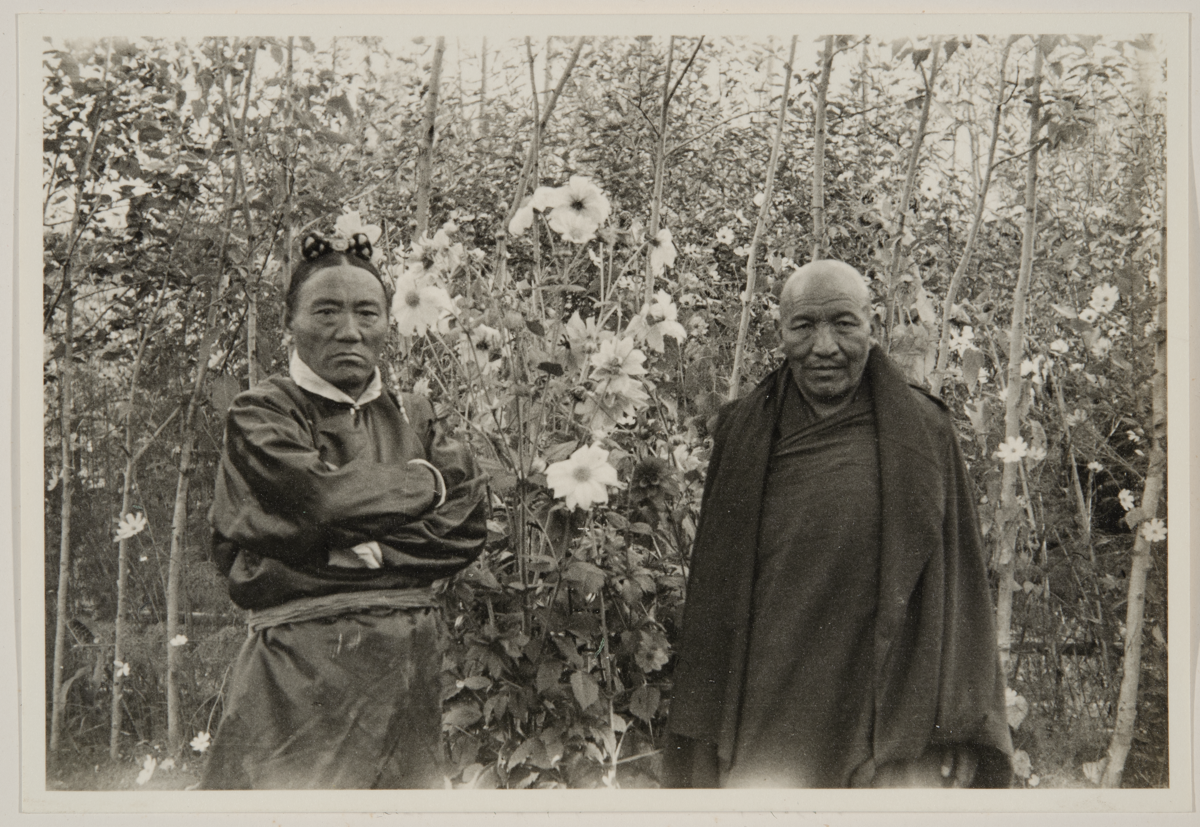
Portrait of Tsarong, the Commander in Chief, and a monk engineer. Tsarong is wearing a chuba (gown) made from silk brocade with Chinese-style dragon motifs. His gold, turquoise and coral sog byil (ear-ring) indicates that Tsarong was a high-ranking layman of the Tibetan government. The two men are standing in a garden, probably at Tsarong's house. [JD 29/06/2020]
Place
S Asia; Tibet; Lhasa
Cultural Affliation
Named Person
Tsarong Dzasa (Namgang Dazang Damdu)
Photographer
Jack, Archibald (Archie) Frederick Maclean (Leuit., R.E.)
Collector / Expedition
Date
11 - 15 September 1938
Collection Name
Shepheard Collection
Source
Shepheard Rogers, Patricia
Format
Album Print Black & White
Primary Documentation
Other Information
Related Archive: Noted in Shepheard's diary 'Some Notes of Ken Shepheard on his expedition to Lhasa, Tibet, in September - October 1938' p.43,
"15 September 1938
Our second day of calling started with the P.M., Lönchan.
He lives next door to Tsarong on the eastern edge of the town and we again rode across the fields.
He was polite and rather cold and stand-offish but allowed me to take his photograph -- probably blurred as there was no suitable stand available.
We tried to explain the intricacies of stops etc on the camera we gave him.
We went on to Ringang, another Rugby boy, 4th rank official and Municipal Officer of Lhasa.
He was delightful and having spent about 13 years in England at school and at an engineering college in London and getting practical experience in various works including the G.E.C. spoke perfect English
He too spoke affectionately of and enquired after Mr. Odgers.
Below his house is an electric sub-station with emergency oil engines and a large battery room -- probably the only one in the world with carved and painted beams and pillars!
The power comes from water driven turbines further up the valley and at present lights about 400 lamps and drives the Mint machinery. He wants to extend it but it means building head works etc.
It is amazing how all his and the Mint’s machinery could have been carried up from India.
In the winter the water freezes and charging is limited to 8 hrs a day; hence the large battery room.
Ringang was all but English and very interesting and intelligent.
Our next call was on Möndong, a monk and the last of the Rugby boys. The fourth (Gongkar soldier) died. He is Shö magistrate and has two lay colleagues. Shö is the collection of houses lying right under the East face of the Potala and is separate and distinct from Lhasa proper.
Mondong is a splendid fellow, tall and well built and with a great sense of humour and an infectious guffawing laugh.
He received us in his new large house in which the decorations were not yet finished and he is much teased as to the reason for it and asked when he is forsaking his lama’s robes and taking a wife to provide the necessary family to fill it.
Back to lunch and then at 4 p.m. to call on Tsarong -- the strong man of Lhasa.
He was a favourite of 13th D.L. over 30 years ago and accompanied him when he fled across country to Pekin on the arrival of the Younghusband expedition.
Again in 1912 when the Chinese attempted to seize the D.L. he fled with him to British India fighting a very gallant rearguard action and causing many Chinese casualties at the Chaksam Ferry.
From 1921 - 1924 he was C-in-C (Magtsi) and a Shapé. Now although only a Dzara he is known to everyone as Tsarong Shapé.
Although a favourite he was deposed by the D.L. to his present rank it is said because he was too pro-British. Since then he has been in charge of the Arsenal and is now in charge of the Mint.
He has two wives and two young daughters, Kate and Betty, by the present favourite.
We returned to Dekyi Lingha past the P.M.’s house and the old Chinese barracks -- now occupied by Tibetan troops -- and across the fields.
Tsarong is very George Robey-ish in appearance and mind!" [JD 31/01/2020]
Named Person: "Tsarong Dzasa, born 1886 died 1959
Personal name Namgang Dazang Damdu. Born about 1885. Of humble origin, he at first occupied a menial position in the household of the late Dalai Lama. Was one of the devoted few, who accompanied the Dalai Lama in his flight to Mongolia in 1903 and rapidly became the Dalai Lama's most trusted servant. He signed the Trade Regulations in Calcutta in April, 1908, on behalf of the Tibetan Government. At the Chaksam Ferry in March, 1910, he went with a party of Tibetan soldiers, kept back a force of Chinese troops who were attempting to prevent the flight of the Dalai Lama to India. Afterwards he followed the Dalai Lama to India and resided with him in Darjeeling. In the autumn of 1911 he was sent by the Dalai Lama to Shigatse and it was largely owing to him that the Chinese Garrison they were compelled to surrender their arms and ammunition. Was appointed Commander-in-Chief early in 1912 and given the title of Dzasa in April of the same year. In July, 1913, he married first: the eldest daughter of the late Tsarong Shap-pe and second: the widow of the Tsarong Shap-pe's son, who had been put to death in 1912 for being pro-Chinese. With the permission of the Dalai Lama the widow of Tsarong Shap-pe caused him to be recognised as heir of Tsarong and he is now [1915] known as Tsarong Shap-pe's. Appointed Shap-pe in 1914 in place of the late Sechung Shap-pe. Visited Gyantse in September, 1915, and met the Poiltical Officer in Sikkim. Visited India on pilgrimage in 1924. Was deprived of the post of Commander-in-Chief in 1925 on his return from India, and in 1929 he was degraded from Shap-pe to the rank of Dzasa. Was again offered the post of Shap-pe but refused to accept it. In July, 1934, prevailed upon as one of the Manager of the Trapchi Factory. Is still very influential and has the support of Drepung Monastery. Speaks a little Russian, Mongolian and Hindustani. He completed the construction of a steel bridge over the Tolung Chu at Trisum, eight miles from Lhasa, in 1937. Clever, wealthy, mechanically and progressively minded but fearful, nowadays, of expressing publicly his considered opinions. He is acquainted with Russian military drill and speaks a little Russian, Mongolian and Hindustani. A man of great energy and sound sense. He has a large following among the lay officials, but on the whole he is not popular with the monks, who regard his advanced views as a danger to their influence. He has an estate near Shigatse and Mr. Williamson describes him as "the most powerful friend of His Majesty's Government in Tibet". He is very friendly to British officials.
Page references from Who's Who in Tibet
1920 (page 11) 1933 (page 24) 1938 (page 73-74) 1942 (page 37) 1945 (page 45-46) 1949 (page 136-137)
This entry is from "Who Was Who in Tibet?" Copyright Frank Drauschke, Facts & Files, Berlin." [Source: https://tibet.prm.ox.ac.uk/biography_265.html, JD 29/06/2020]
Related Image: A similar portrait of Tsarong wearing the same dress is at the Pitt Rivers Museum, reference 2001.35.336.1, where his dress is described as of "a high official at the New Year ceremony in 1936. The chuba (gown) is made from silk brocade with Chinese-style dragon motifs. His gold, turquoise and coral ‘sog byil’ (ear-ring) indicates that Tsarong was a high-ranking layman of the Tibetan government. A strict dress code applied at ceremonial occasions such as this and Tibetans were told what to wear depending on their status. Born into a peasant family, Nangang, took the name Dasang Damdul Tsarong when he married into an aristocratic family. He was a favourite of the 13th Dalai Lama and served both as a military leader and a member of the Tibetan government. [CH 2003]" [Source: https://tibet.prm.ox.ac.uk/photo_2001.35.336.1.html, JD 29/06/2020]
FM:282960
Images (Click to view full size):