IDNO
N.132242.MST
Description
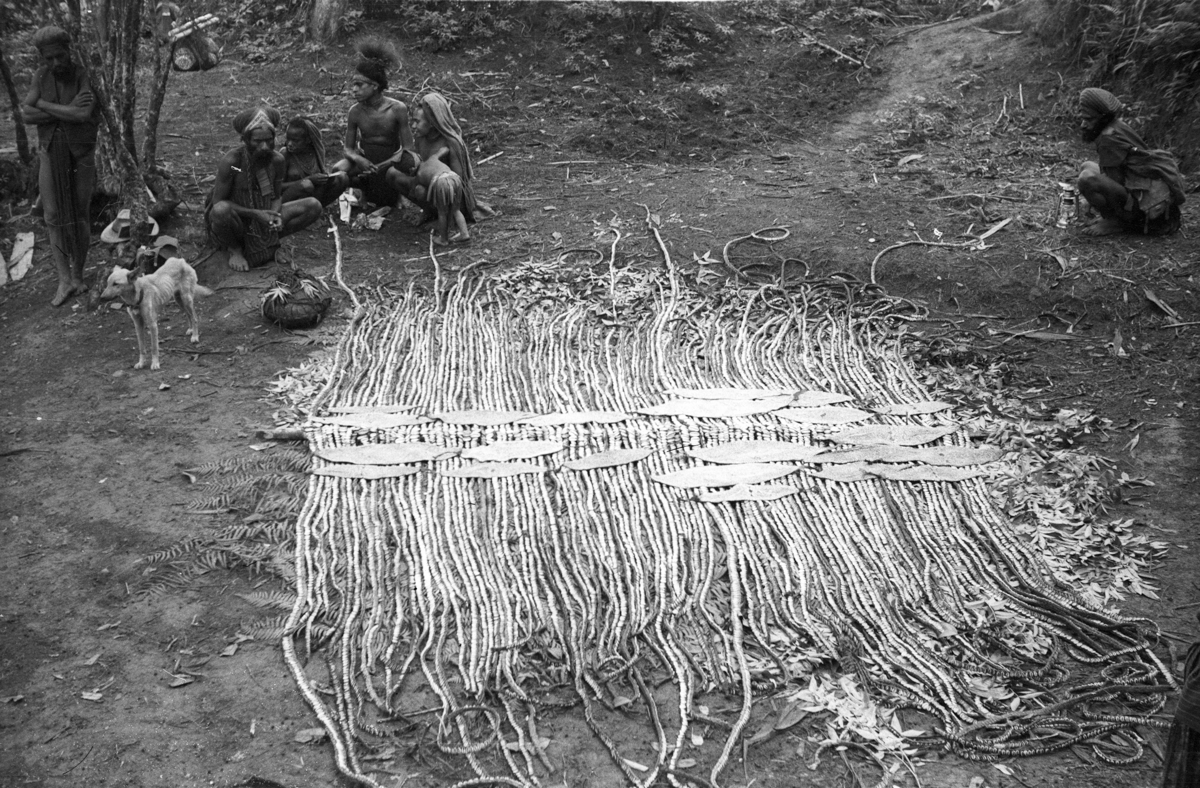
On Strathern's listing: Pela øi laid out.
See generally Andrew Strathern, The rope of moka (CUP 1971), and on the value of these kinds of shells pp. 107-09.
Place
Oceania Melanesia; Papua New Guinea; Western Highlands Province; Mbukl
Cultural Affliation
Named Person
Photographer
Strathern, Marilyn (later Prof., Dame)
Collector / Expedition
Date
September 1964
Collection Name
Strathern Collection
Source
Strathern, Marilyn (Prof., Dame)
Format
Film Negative Black & White
Primary Documentation
Other Information
N.132225.MST - N.132246.MST were identified by Marilyn Strathern as Set 16.
Context: moka = 1. General term for ceremonial exchange between partners coordinated in a single set of events, involving gifts of pigs and / or shells according to certain formulae, and in several stages, with the sequences eventually reversing so donors become recipients.
2. Term for the occasion of a ‘final’ gift in such a sequence, at which people – especially and often only the donors -- dance and decorate. The rationale for the gift payments may be in terms of warfare exchange, e.g. for enemy-compensation and ally-reparation payments (in 1970s, esp. N Melpa) or as ‘pure moka’, which includes pig-moka and shell-moka (pp3,48; MS word document “Order B (3) 1967”, p1) where payments to kin or allies may be made under all kinds pretext (1970s, esp. C Melpa). The size and significance of the moka will determine whether or not a festive occasion is made of the final gift. (Melpa). [Strathern's Glossary word document, JD 4/24/2017]
Context: pela øi = shell ‘mat’ made of nassa shells, sometimes worn as forehead ornament (see description of objects MAA 1967.60 and 1967.61). [Strathern's Glossary word document, JD 4/27/2017]
Related Object: MAA 1967.60 "Nassa-shell headband. A small headband, 4" wide and 18" long, used as a forehead ornament only. The shells are sewn on to a bark backing, which has a strip of European cloth incorporated into it. A central panel is left bare and covered in red ochre. cf. 1967.59 eg. Vicedom I:105." From Buk, Mount Hagen Area. Donated by A.M. and A.J. Strathern, 1967. [JD 4/25/2017]
Related Object: MAA 1967.61 "Four large nassa-shell mats. These were used as valuables in bridewealth, moka and compensation payments in the Buk area till c.1960 although their popularity had begun to wane by the mid 1950s, and earlier in the Kelua area near Mount Hagen township. Europeans paid for vegetables with handfuls of these shells, and men say what hard work it was to accumulate enough shells for a mat. Mat B (c. 8 1/2" x 24") has about 2200 shells in it; the other mats are; A: 9 3/4" x 21"; C: 8" x 22"; D: 10 1/2" x 24". They are all made with bark backing, A having some European brown paper incorporated, while C has some native silk (cf.1967.5). A and C show how the bark has been beaten from a single piece, as the ends are left un-beaten. In some dances women used to wear pela oi tied to their aprons so that these flapped as they moved and bent their knees in the dance. Like the cowrie ropes (1967.63) the 'mats' may be ficticiously divided in the centre, hence the special patterning of the shells." From Buk, Mount Hagen Area. Donated by A.M. and A.J. Strathern, 1967. [JD 4/25/2017]
Bibliographical Reference: See generally Andrew Strathern, The Rope of Moka (CUP 1971), and on the value of these kinds of shells pp.107-09. [Strathern's word document, JD 4/24/2017]
A grant from the Wenner-Gren Foundation Historical Archives Program supported the documentation and preservation of the Strathern photographic collection. [JD 6/11/2017]
FM:267400
Images (Click to view full size):