IDNO
N.132183.MST
Description
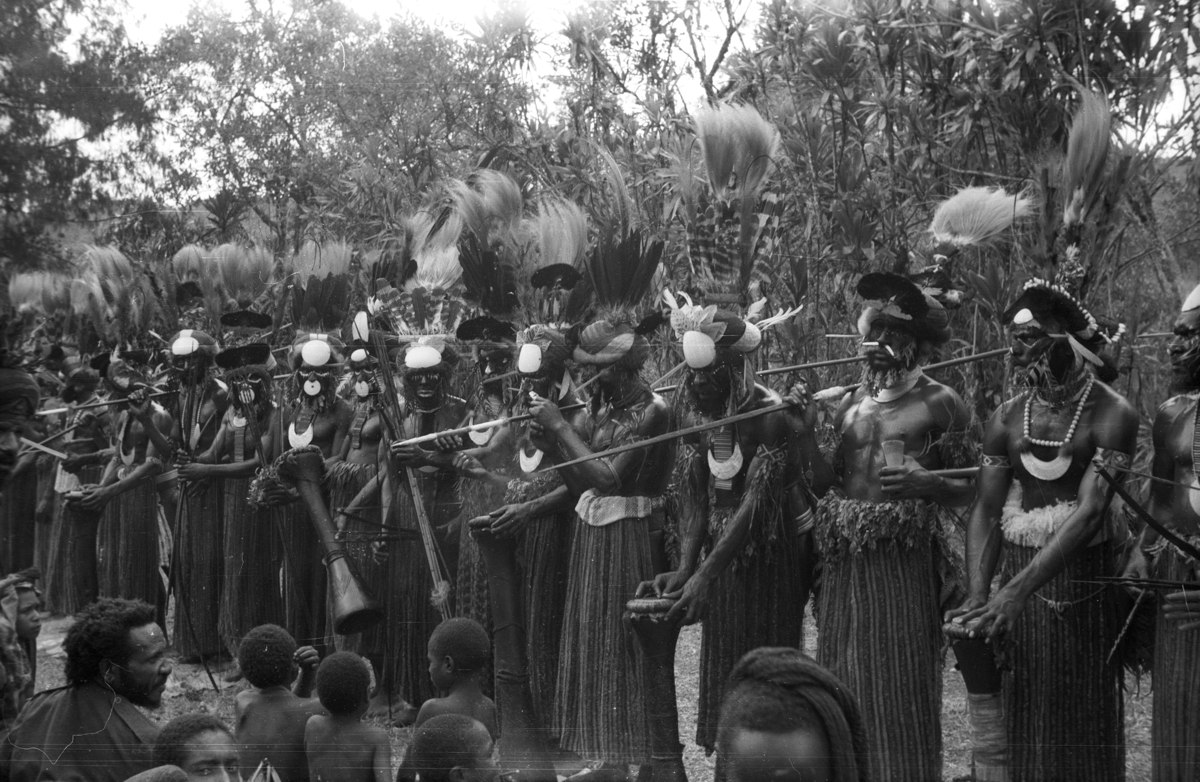
On Strathern's listing: “Tipuka-Kawelka wua peng [death compensation payment]. Specifically the clans (Kawelka) Mandembo (= Ngglammbo & Kurupmbo) and Membo giving to (Tipuka) Kitepi and Oklembo. Kawelka practising.”
Mbukl moka pena (ceremonial ground).
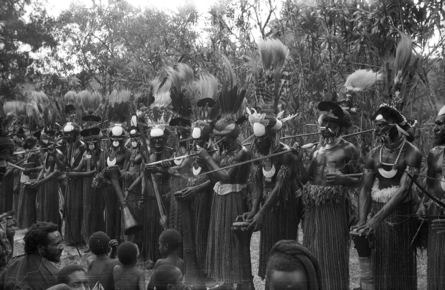
Line of dancers resting for a moment. 47 in all.
Place
Oceania Melanesia; Papua New Guinea; Western Highlands Province; Mbukl moka pena
Cultural Affliation
Named Person
Photographer
Strathern, Marilyn (later Prof., Dame)
Collector / Expedition
Date
5 August 1964
Collection Name
Strathern Collection
Source
Strathern, Marilyn (Prof., Dame)
Format
Film Negative Black & White
Primary Documentation
Other Information
N.132170.MST - N.132205.MST were identified by Marilyn Strathern as Set 14.
Related Archive: Related Archive: Marilyn Strathern lists for this series “Tipuka-Kawelka wua peng [death compensation payment]. Specifically the clans (Kawelka) Mandembo [= Ngglammbo & Kurupmbo] and Membo giving to (Tipuka) Kitepi and Oklembo. Kawelka practising.”
Context: moka pena = ceremonial ground. [Strathern's Glossary word document, JD 4/24/2017]
Context: peng = head (p86) (Melpa). [Strathern's Glossary word document, JD 4/27/2017]
Context: wua peng = ‘men’s head’ payment = war death compensation (MS word document “Order B (3) 1967”, p.1). [Strathern's Glossary word document, JD 4/26/2017]
Publication: Similar image [N.132182.MST] published in 'Self-Decoration in Mount Hagen', 1971, p.74 and captioned: “Plate 48 Kawelka dance mør in eagle, kumin and Red bird feathers”. [KH 23/11/2016]
Related Archive: Draft caption for similar image [N.132182.MST] in blue folder of book draft with the following text: “The same dancers as in photograph 49 [photograph 49 not yet identified]. Here the details of their feather arrangements can be seen. They all have Red bird of paradise plumes, and except in the case of one man these form a spray above a setting of eagle (striped) or kumin (dark) feathers. These are attached to a short length of soft wood that is stuck directly into the wig. The wigs themselves are bound with mara leaves, and the dancer second from the left has trimmed his with the yellow crest feathers of the sulphur-crested cockatoo. All of them wear cut bailer shells on their foreheads, and have leaves or feathers trailing by their cheeks that 'darken' the face. With one exception, the men have painted their faces black, superimposing designs in white and some colours; the exception (fourth from the left) has smeared charcoal over parts of his face, leaving the rest bare. This was highly idiosyncratic, a device we never saw repeated on such an occasion. The individual concerned is one of the most important men of his clan; but his colleague on his right is a man of almost equal pre-eminence, and he is much more conventionally adorned. As this is only a practice, the dancers are not wearing the King of Saxony plumes that they brought out for the final day.” [Paper Archives will be deposited at Girton College, Cambridge, date to be confirmed. KH 23/11/2016]
Bibliographic Reference: See generally Andrew Strathern, The rope of moka (CUP 1971), and specifically for this prestation pp123-29. [Strathern's word document file]
A grant from the Wenner-Gren Foundation Historical Archives Program supported the documentation and preservation of the Strathern photographic collection. [JD 6/11/2017]
FM:267341
Images (Click to view full size):