IDNO
N.131191.HNL
Description
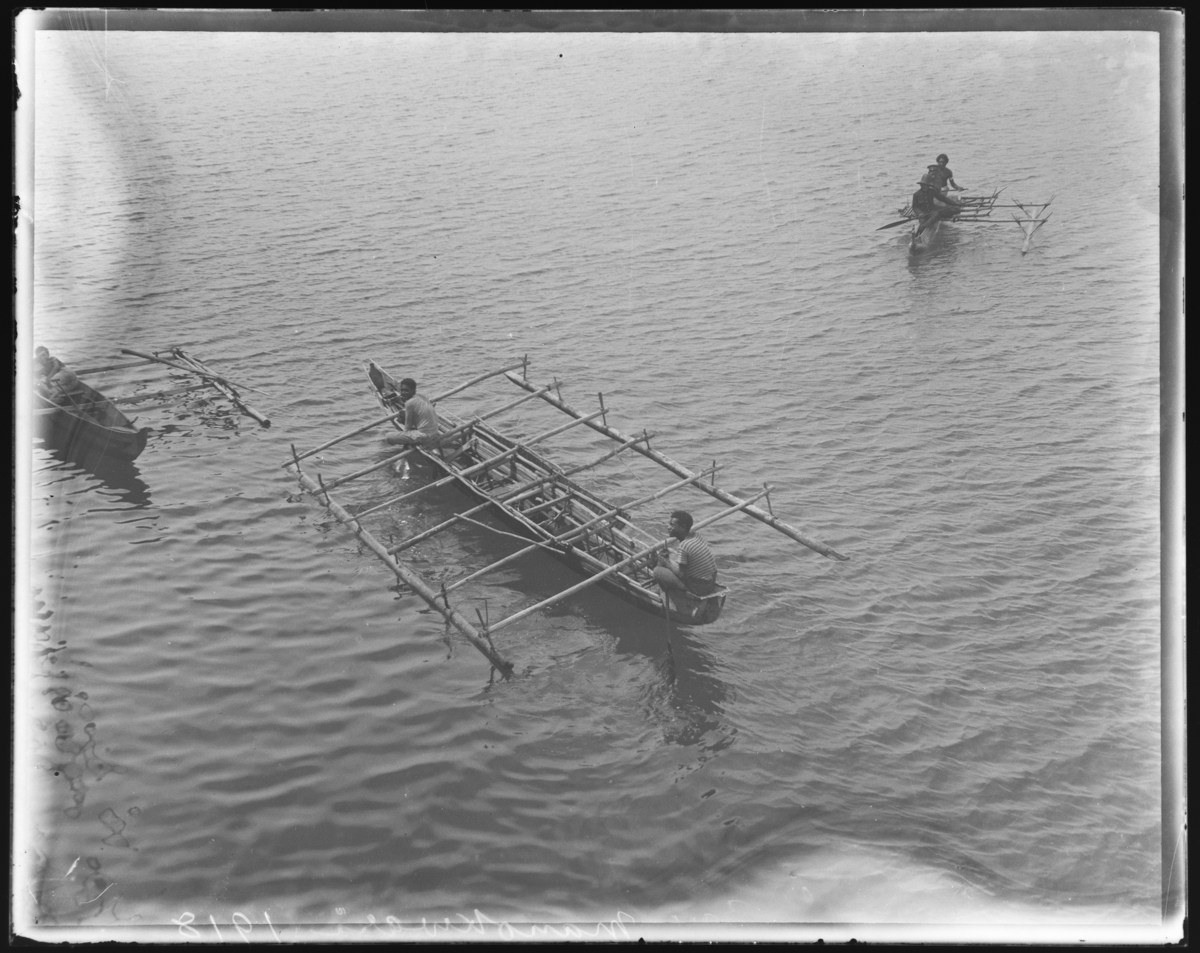
"Humboldt Bay, Manokwari 1918." [Hornell's caption]
Elevated view from a ship of two men paddling a "small-sized double outrigger fishing canoe of the Geelvink Bay type; seen at Humboldt's Bay." A second canoe is the background, and a third canoe cropped by the left frame. [JD 12/01/2017]
Place
Oceania Melanesia; SE Asia; New Guinea; Indonesia; Papua Province; West Papua; Cenderawasih Bay; Manokwari [Dutch New Guinea; North Netherlands New Guinea; Irian Jaya; Humboldt Bay]
Cultural Affliation
Named Person
Photographer
Hornell, James
Collector / Expedition
Hornell, James
Date
1918
Collection Name
Hornell Collection
Source
Hornell, Charlotte (Mrs)
Format
Glass Negative
Primary Documentation
Other Information
P.131173.HNL - N.131198.HNL were found unaccessioned in Drawer C.45.23 of the Photo Store, in a cardboard box, now numbered C744/.
Publication: Image published in 'The Outrigger Canoes of Indonesia' by James Hornell. Madras Fisheries Department, Bulletin No. 12. Administration Report, 1918-19. A Statistical Analysis at Madras, 1919, Pl.III, and captioned: "Fig. V. A small Double Outrigger Canoe, Geelvink Bay Type."
In 'Explanation of Plates' p.112, "Figure V. A small-sized double outrigger fishing canoe of the Geelvink Bay type; seen at Humbolt's Bay." [JD 12/01/2017]
Bibliographical Reference: Haddon, A.C. and Hornell, J. 1937. Canoes of Oceania: Volume II: The Canoes of Melanesia, Queensland, and New Guinea. (Bernice P. Bishop Museum: Honolulu, Hawaii), with relevant text on pp.324; 326-7, 328 noting:
"When there is a double outrigger, as there is in all large canoes and in most of the small ones of Manokwari (H, 1920, p/ 44) the booms stretch right across the hull... There are usually four to ten booms, but Hornell (1920, p. 44) saw an exceptionally large canoe at Serui with 11 booms and Friederici saw one with 12 and Wooi Bay. Hornell says the booms at Manokwari are squared poles of light wood.
The float is of an especially soft wood and is generally nearly as long as the hull, or at all events as long as its water line. The fore end is pointed, slightly turned up, and may be carved a little (H, 1920, fig. 5) ; the aft end is blunt. ... Hornell says that in the larger canoes at Manokwari two floats are employed on each side of the canoe ; one boat of this kind with seven booms was 28 feet long, 25 inches beam, and 26 inches deep (fig. 187, a, b).
The attachment for each boom, whether with a single or double float, consists of a single vertical nail-like wooden spike or connective which passes from above through the end of the boom and is driven vertically into the float; sometimes it is lashed to the side of the boom (Hornell MS). A piece of a bough is usually selected that has a natural thin branch projecting from it more or less at right angles ; this branch is laid over the boom and lashed firmly to it (F, pp/ 249, 253-254). Connectives either with or without the branch appear to be used indiscriminately and separately (figs. 181, 184. 187, b, c). ...
At Manokwari a stringer (aisuye, asuye) may be lashed over the booms close to the attachment spikes and upon their branches ; it is connected with the float by rattan or liana loops between the connectives. ...
"Hornell (1920. pp. 51-53) states that in all the sailing canoes in this district which adhere to the original style of rig, a tripod mast and oblong sail are carried. This mast is more or less prevalent throughout the eastern section of Indonesia, particularly in the Moluccas and Celebs, [quotation:] "... is here [at Manokwari] composed of three bamboos, connected at the apex by rattan or rope lashing. The smaller New Guinea canoes have usually a Y-shaped crutch peg fitting into the top end of one of the paired legs ; upon this is itched a loop attached to the yard of the sail at a point a little way forward of the centre. In larger canoes where the increased size of the sail renders it impossible for the crew to lift it high enough to hitch the loop over the mast-head peg, a whole is cut in the projecting end of one of the paired mast legs which is cut longer than the other ; through this hole a rope is rove and by this means the sail is hoisted. The sail is oblong with a bamboo yard along the upper edge, and a similar pole (the boom) along the lower... The sail is hoisted when rolled up and as soon as the yard is supported on the mast it is unrolled from above ; Friederici says this maneuver is done very simply and quickly." ... At Manokwari Friederici (1912, p. 254) saw the mast tied inboard to the front of the second boom from the front... At Manokwari (fig. 189, b) a string loop passes through a perforation in the lower end of each leg which is passed over a spike, which presumably is fastened to a thwart."
"Friederici gives the following canoe terms:
Outrigger canoe: wa (wai)
Very large canoe: tababeri
Large canoe: wai beba
Small canoe: wai kapirare
Boom: yas, yaas
Float: adi
Connective: fadok
End-piece: sara
Breakwater: (not given)
Tripod mast: padaren
Mat sail: saruer, saurer
Paddle: bores
Bailer: coconut: obek." [JD 9/3/2016]
FM:265915
Images (Click to view full size):