IDNO
N.131185.HNL
Description
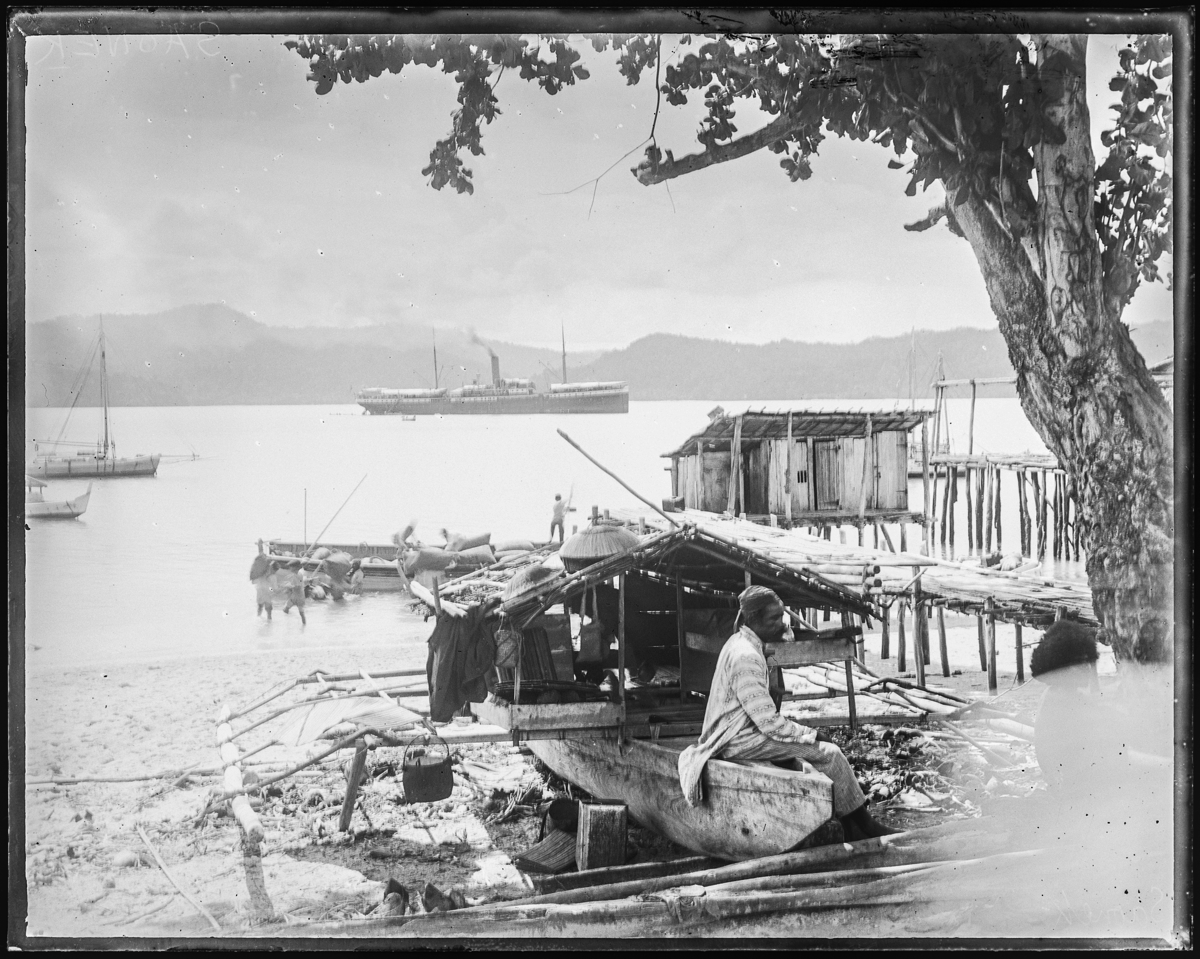
Waigou type of outrigger on beach, Saonek, Waigou Island - off N.W. of New Guinea. 1918. [Hornell's annotation from P.131173.HNL]
A South Asian? man wearing white tunic and trousers sitting on a prow of a Waigou-type of outrigger canoe beached on the shoreline of Saonek. The canoe has a double outrigger and a small cabin; a cooking pot hangs from one boom.
In the background are a jetty and second boat, a pole-building, and further in the distance, a yacht and a large liner ship in the sea bay. [JD 12/01/2017]
Place
SE Asia; Oceania Melanesia; Indonesia; Papua Province; Waigou Island; Saonek [Dutch New Guinea]
Cultural Affliation
Named Person
Photographer
Hornell, James
Collector / Expedition
Hornell, James
Date
1918
Collection Name
Hornell Collection
Source
Hornell, Charlotte (Mrs)
Format
Glass Negative
Primary Documentation
Other Information
P.131173.HNL - N.131198.HNL were found unaccessioned in Drawer C.45.23 of the Photo Store, in a cardboard box, now numbered C744/.
Bibliographical Reference: 'The Outrigger Canoes of Indonesia' by James Hornell, f.l.s., f.r.a.i. Madras Fisheries Department, Bulletin No. 12. Administration Report, 1918-19. A Statistical Analysis at Madras, 1919. pp.54-55
"WAIGOU AND THE N.-W. POINT OF NEW GUINEA.
At Saonek, the chief port in the island of Waigou, and at Sorong
at the extreme north-west point of New Guinea, intercourse with the Moluccas is of extremely long standing. ...
The Waigou type, as we may term these outriggers, are well built
and much more carefully put together than the majority of the
Geelvink Bay canoes (PI. IV, fig. VI). The hull is built up
upon a dugout with flared sides, deep wash-strakes being added
to the requisite height. Four or five booms cross the canoe ; each is extremities of the booms (Fig. 14). The upper end owing to
the elbow or angle present there, can be secured to the boom very
strongly by two lashings, and further stiffness is obtained by the
insertion of a longitudinal bracing pole between the angle of the
elbow and the boom (Fig. 15). The long limb is straight or only
slightly curved ; its distal end is lashed upon the upper surface of
the boom. In some examples the short limb has disappeared and
the joint reduced to a single nearly straight rod (Fig. 16). In the larger canoes a fairly roomy cabin is provided ; this is of
great use to the crew both when engaged in fishing or when away
on prolonged trading trips. The double outrigger frame permits of
a fairly large structure as the booms enable it to be built outboard
on each side to a distance of a couple of feet. Part of the outboard
cabin space is utilized for a sand-box fireplace, so the crew and
their passengers enjoy a fair amount of comfort. Water is carried
in long bamboo joints set upright in the cabin.
The outrigger design is particularly useful when cabin
accommodation is necessary to fishermen who cannot afford large
plank-built boats, for the employment of this device permits the
owner to use a comparatively small and inexpensive hull to what
would otherwise be necessary. This is the real raison d'etre of the
continuance of the double outrigger design in waters where the
superior handiness of the boat type must be well known.
[Source: https://archive.org/stream/madrasfisheriesb12madr/madrasfisheriesb12madr_djvu.txt, JD 12/01/2017]
FM:265909
Images (Click to view full size):