IDNO
N.130206.WIL
Description
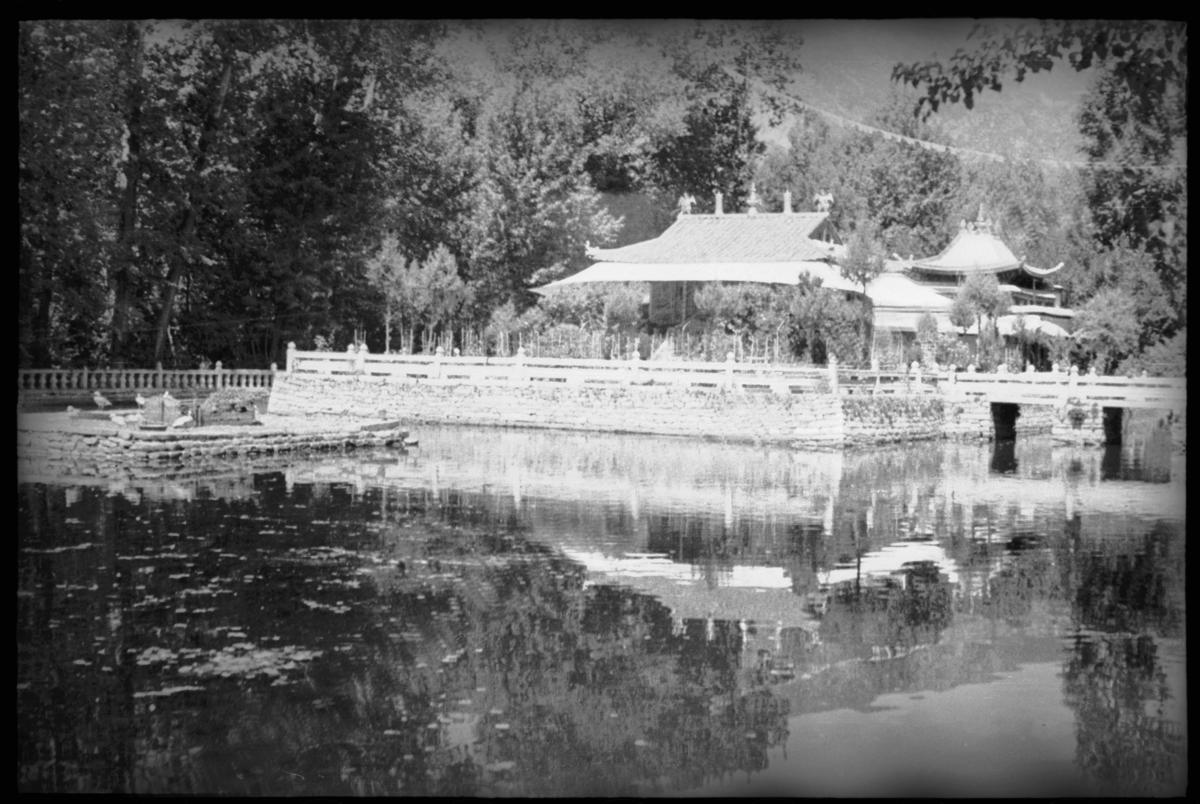
View of the Snake Temple beside the lake that surrounds the Dalai Lama’s Summer Palace. The temple is of the Han architectural style with a surrounding textile awning attached to the roof, and situated amongst planting with a path leading up to it on the left. [JD 21/09/2021]
Place
S Asia; Tibet; Lhasa; Norbu Lingka; Snake Temple
Cultural Affliation
Named Person
Photographer
Williamson, Margaret
Collector / Expedition
Date
?1933
Collection Name
Williamson Collection
Source
Williamson, Margaret
Format
Film Negative Black & White
Primary Documentation
Other Information
N.130190.WIL - N.130224.WIL were found on Margaret Williamson's film, ref MW.32, in a Spencer & Co. box now numbered C902/7.
Bibliographical Reference: The Williamson’s visit to Norbulingka is mentioned in Williamson, Margaret, 1987. Memoirs of a Political Officer’s Wife (Wisdom Publication, London) pp.99-102, and pp.122-123, which has the following test:
“Another visit I remeber well was one we made to the grounds of the Norbhu [sic] Lingka. We were escorted round teh beautifully kept gardens by the Kunphel-la dn Ringang. We followed flagged paths that wove through them and admired the profusion of blooms on every side. ...
In a small rest-house the Dalai Lama kept his collection of exquisite jade carvings and cloisonne brought back with him from his exile in China. There was also a lake in which a delightful little temple had been built. This was surrounded by stone balustrades and pots of flowers, and on the outside walls were painted panels. Here a scribe was seated cross-legged, so deeply engrossed in his work that his nose nearly touched the paper.” [JD 16/5/2008]
Place: “Norbulingka is “the summer palace of the Dalai Lamas situated about 4 km to the west of Lhasa and situated in a large open area. Most of the main buildings were constructed during the 18th century by the 13th and 14th Dalai Lamas.” [Source: Cech’s list, JD 15/5/2008]
Place: “Norbulingka [is] The Summer Palace of the Dalai Lama and the Tibetan government was selected by the seventh Dalai Lama in the 18th century on account of its medicinal spring. The palace complex was notable for its ornate assembly halls and shrine rooms as well as for its extensive gardens.” [Source: The Tibet Album, http://tibet.prm.ox.ac.uk/glossary.php#Shol, JD 16/5/2008]
Place: “Norbulingka, meaning "Treasure Park", was first built in the 1740s. As a result of continuous expansion by the Dalai Lamas, it covers an area of 40 hectares. The Qing magistrate dispatched to Tibet built the original palace for His Holiness, the Seventh Dalai Lama who often visited the area. In 1751, the Seventh Dalai Lama began construction on the Kelsang Potrang as his palace where he ruled and received officials and high lamas. The Fourteenth Dalai Lama lived in the Kelsang Potrang during the construction of his new palace. Construction seldom stopped under the reigns of different Dalai Lamas. In 1956 the Fourteenth Dalai Lama finished his own palace - Takten Migyur Potrang, usually called the New Summer Palace. In the past, each spring a grand procession of lamas would follow the Dalai Lama to move into the park. Before 1959, common people had no access to the palace.” [Source: Tibet Travel, www.tibettravel.org, JD 16/5/2008]
FM:264856
Images (Click to view full size):