IDNO
N.129638.HNL
Description
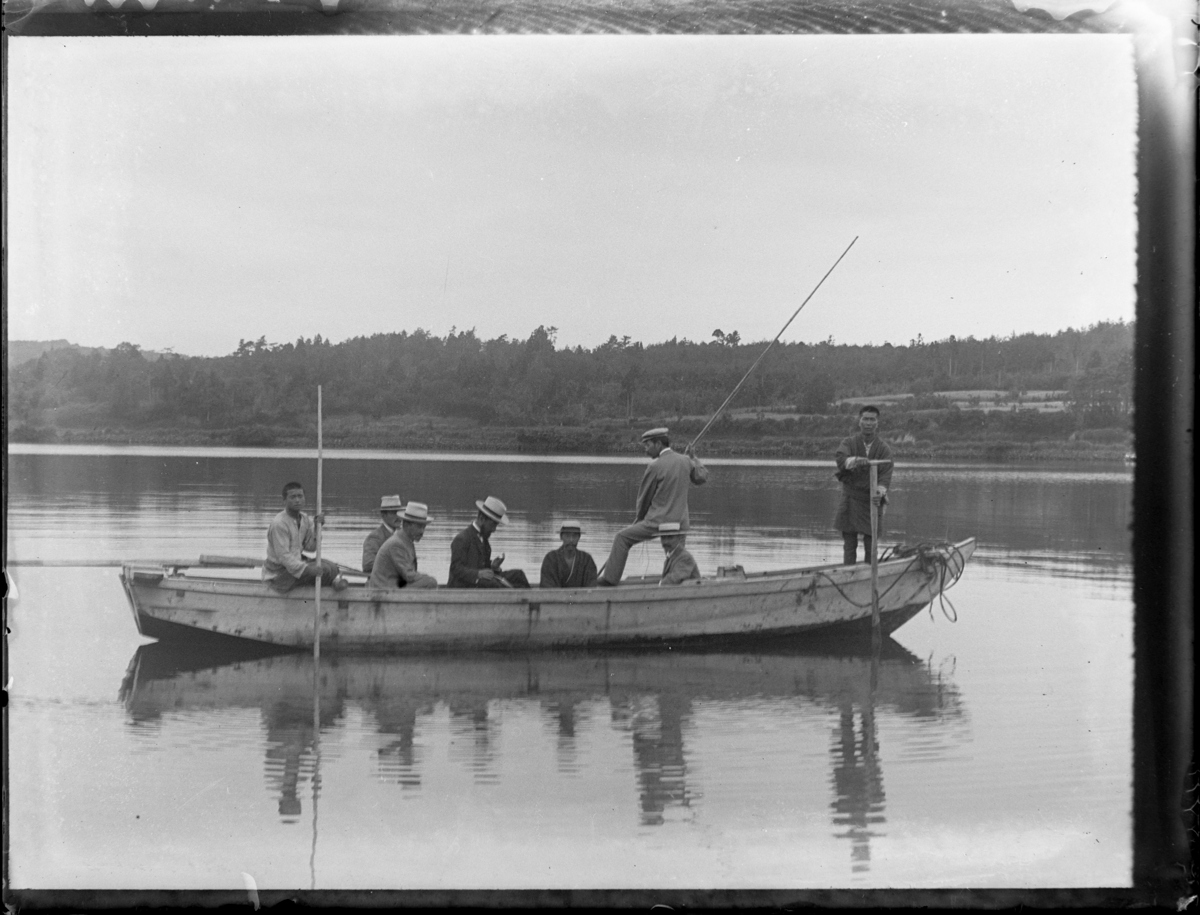
Dr. Kishinoue Kamakichi, and five men sit on a boat observing pearl oysters at a research station for cultured pearls around Ao island in Nanao Bay. All are dressed in youfu (Western style) clothing with the exception of one man who wears a boater hat and kimono and has been identified as the owner of the villa on Ao island, Miyamori Otojiro. The group are accompanied by two boatmen dressed in sagyougi (workmen's clothing), one who steers the boat from the rear with a paddle, and another who sits at the front of the boat holding a long pole. [HE 1/9/2014, record updated by Hannah Eastham after fieldwork in Ishikawa prefecture 31/08/2017; updated HE 04/08/2022]
Place
E Asia; Japan; Noto Peninsula; Ishikawa prefecture; Nanao Bay; Anamizu; Aoshima [Ao Island]
Cultural Affliation
Named Person
Kishinoue Kamakichi; Kishinouye Kamakichi; Takamuku E.; Kadowaki S; Saito S.; Fukui K.; Miyamori Otojiro
Photographer
Hornell, James
Collector / Expedition
Hornell, James [visit to Japan via Saigon, Hong Kong & Shanghai [May 15th-August 12th 1907]
Date
26 June 1907
Collection Name
Hornell Collection
Source
Hornell, Charlotte (Mrs)
Format
Glass Negative Quarterplate
Primary Documentation
Other Information
N.129634.HNL - N.129647.HNL were found unaccessioned in Drawer C.45.19 of the Photo Store, in a cardboard box, now numbered C740/.
Bibliographic reference: Hornell refers to the trip to Ao island to visit an experimental pearl cultivation station in Hornell, J., 1950. Fishing in Many Waters (Cambridge University Press), p. 197 "We circled the island to see what progress the experiments had made. The water being shallow and pellucid, everything on the bottom showed up clearly when viewed through a water glass...pearl oysters were abundant and healthy." [HE 1/9/2014]
Related Archive: A newspaper article found during fieldwork for the Crowther-Beynon 2014/15 project, "The Pearl King and James Hornell in Japan" at the Mikimoto Pearl Island Museum archives confirms Hornell’s visit to Japan with Dr. Kishinoue in 1907. [HE 23/9/2015]
Named Person: Dr. Kishinoue Kamakichi was a Japanese marine scientist from Tokyo Imperial University (University of Tokyo). Hornell describes meeting Dr. Kishinoue in Hornell, J., 1950, Fishing in Many Waters, Cambridge University Press, p. 190, “I had the pleasure of meeting a very courteous gentleman, the late Dr. K. Kishinouye, the head of the Bureau of Fisheries and scientist of world-wide reputation. In many ways, he was unlike the ordinary Japanese type: although distinctly Mongoloid in features, he had a beard of sufficient strength to suggest a touch of another race; probably some blood of the old Ainus, earliest inhabitants of Japan, flowed in his veins. In disposition he was frank and free, with an appreciation of humour that made him a genial companion; apart from a quite reasonable indisposition to divulge trade secrets, he gave freely of his knowledge.” Note that Hornell probably used the term "Mongoloid" in the context of nineteenth and early twentieth century perceived notions of physical anthropology rather than as an intentionally derogatory term. [HE 25/9/2015; updated HE 04/08/2022]
Named people: The identity of five men who joined Hornell on his investigation at Aoshima is described in Hornell's Japan diary stored in Cambridge University Library Haddon papers, 10.065, "E. Takamuku, S. Kadowaki (Fishery Expert to the Prefecture of Ishikawa), S. Saito, K. Fuku, M. Yoneda and Otojiro Miyamori who was the owner of the villa on Aoshima, who can be seen sitting in the middle of the image wearing a kimono and boater hat. [HE 20/9/2015, record updated by Hannah Eastham after fieldwork in Ishikawa prefecture 31/08/2017]
Biographical Information: Dr. Kishinoue Kamakichi was a specialist in fish species, he is also mentioned in research related to pearl culturing. Director of the Mikimoto Research Laboratory, Nagai Kiyohito in Nagai, K. 2013. A History of the Cultured Pearl Industry, Zoological Science, 30(10), (Zoological Society of Japan), p.789 mentions that Dr. Kishinoue appears in a 1926 report by the Imperial Association for the Encouragement of Inventions noted for his work with Professors Chujiro Sasaki and Seitaro Goto on microscopic instruments for pearl culturing. Although highly regarded amongst the academic community in his time, his career is not so widely known in Japan today. He died unexpectedly on 22nd November 1929 from an alimentary disorder at Chengdu in Sichuan China during a collecting expedition to the Yangtze (see Science, Feb. 14th 1930, Kamakichi Kishinouye Obituary, p. 179). [HE 23/9/2015]
Place: Aoshima (Ao island) is a small inlet in the northern section of Nanao Bay. The closest large town is Anamizu. Hornell describes Aoshima in his 1907 Japan diary in the University of Cambridge Library Haddon papers 10065, p. 90, "On the island is a small villa occupied by the official in charge of the station, which is at present run by the local authorities though a private syndicate now will take it over. Work has been going on for some 5 years in protecting and restocking some selected spots around and near the island with P.Os. and last November a beginning was made in experimenting win the production of 'culture-pearls' after the plan pursued by Mikimoto in Shima." A business card pasted into the diary of Hornell identifies the proprietor of the villa on Aoshima as "Mr. Otojiro Miyamori of Anamizu, Noto." (UL 1907 Japan Diary p96). [HE 30/9/2014; updated HE 10/08/2022]
Context: Today, the most famous centres for cultured pearls in Japan are Mie and Ehime prefectures, and warmer regions, such as the South island of Kyushu and Okinawan Islands. The area around the Noto peninsula is not well recognised in Japan for its connection to pearl culturing; edible oyster culture is an important industry there today. During fieldwork for the project in 2017 a reference to pearl culturing at Ao Island in Nanao Bay was found in the Anamizu Historical Museum’s library in a social studies textbook for elementary and junior high school students. This textbook by Hase Susume’s ‘A History of Anamizu’ refers to an experimental test station for pearl culturing that was set up by Iwata Fisheries in 1904 but was stopped in 1935 on account of a red tide (toxic algae bloom) that destroyed the oyster stocks. It is unclear if the experimental station Hornell visited was connected to this fishery. [HE 23/9/2015; updated HE 02/08/2022]
FM:264288
Images (Click to view full size):