IDNO
N.129636.HNL
Description
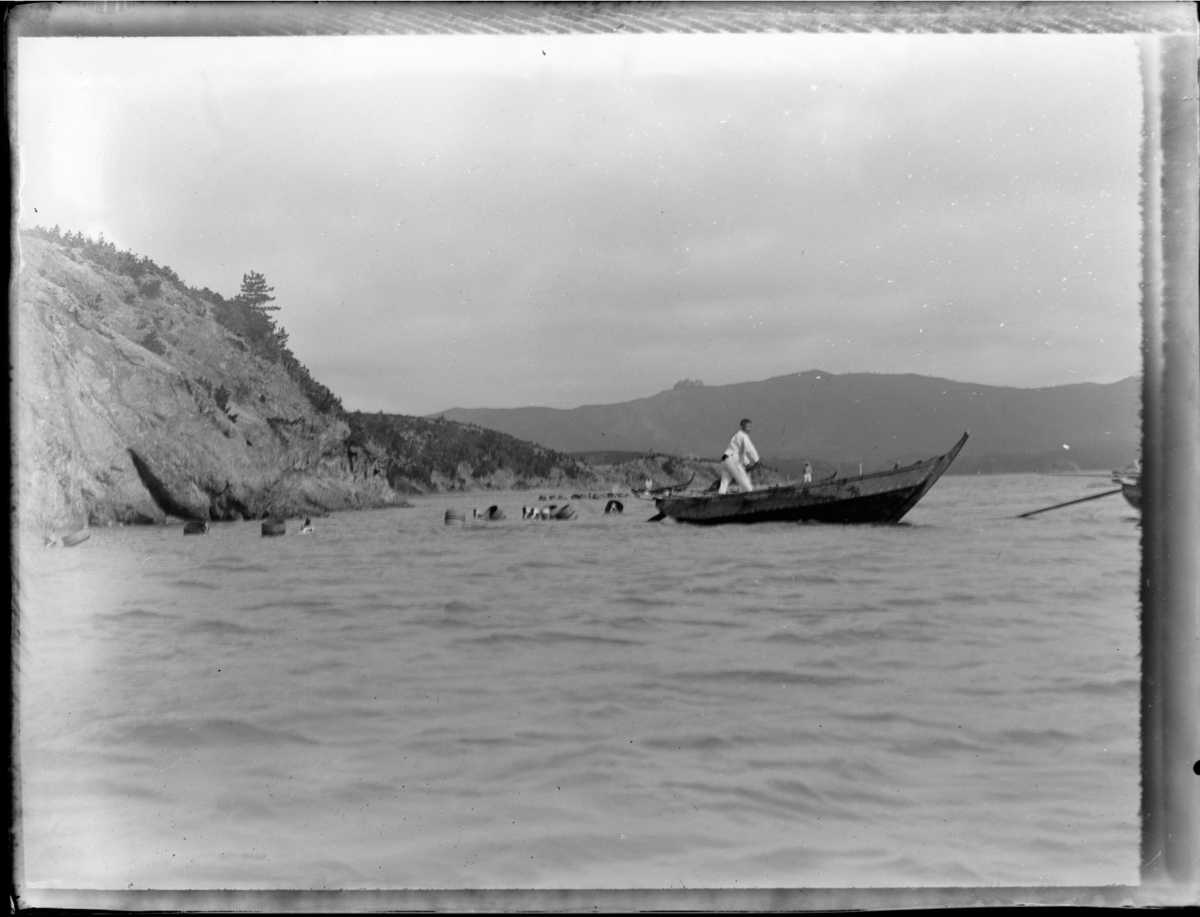
A scene of women ama (breath-hold divers) accompanied by a sendou (boatman) in white clothing who steers an ama bune (diving boat). Although ama divers customarily dive for molluscs, particularly awabi (abalone), the group in this scene were employed by Mikimoto Kokichi to collect Akoya oysters for the cultured pearl industry. [HE 18/9/2015, record updated by Hannah Eastham after fieldwork in Mie prefecture 31/08/2017; updated HE 02/08/2022]
Place
E Asia; Japan; Kansai; Mie prefecture; Shima peninsula; Ago Bay [Bay of Agu]
Cultural Affliation
Named Person
Mikimoto Kokichi
Photographer
Hornell, James
Collector / Expedition
Hornell, James [visit to Japan via Saigon, Hong Kong & Shanghai [May 15th-August 12th 1907]
Date
17 July 1907
Collection Name
James Hornell Collection
Source
Hornell, Charlotte (Mrs)
Format
Glass Negative Quarterplate
Primary Documentation
Other Information
N.129634.HNL - N.129647.HNL were found unaccessioned in Drawer C.45.19 of the Photo Store, in a cardboard box, now numbered C740/.
Related Archive: Hornell describes his journey through Japan in his 1907 Japan Diary stored in the Cambridge University Library Haddon papers, 10.065. Departing from Colombo on May 15th, he arrived in Kobe late in the evening of June 3rd 1907, moving on to Yokohama port on June 5th, and eventually arriving in Tokyo on June 7th 1907. He talks about his visit to the Mikimoto pearl farm in July on p 197 where he describes, "1907. 17th July. At 8:30am I was taken by boat to see the women divers at work in the channel West of Tadoka Island. Four boats put off with a complement of 8 women divers + the 4th with 12. Arrived at the spot where 3 to 4 fathoms of water was the depth they shipped overboard each with a wooden tub in which to place the catch on missing from the bottom. A line from the divers' waist connected with the tub, 3 to 5 pearl oysters seemed the average catch - various ages. No special means to carry the divers to the bottom. They swim down in small depths. In deeper water, I am told they assist their progress by getting their feet against the side or bottom of the boat when making their dive + so get an impetus that helps materially in reaching the bottom." [HE 1/9/2015; record updated by Hannah Eastham after fieldwork in Mie prefecture 31/08/2017; updated HE 02/08/2022]
Place: Hornell describes the location of the Mikimoto pearl farm in Hornell, J., 1950. Fishing in Many Waters (Cambridge University Press) p. 194, "The Bay of Agu, where this establishment is located, is a rock-bound inlet of considerable area, land-locked and abounding in side-branches sheltered so effectually that work can be carried on the whole year round. The bottom is rocky and stony, ideal ground for pearl-oyster cultivation..." [HE 1/9/2015]
Context: Ama (breath-hold divers) customarily used their skills to dive for a variety of sea products, such as awabi (abalone) molluscs. However, Mikimoto Kokichi, who is popularly considered the founder of the modern day cultured pearl industry in Japan, was employing ama at this time to collect pearl oysters. These oysters were being cultured in the waters around Tatoku Island in Ago Bay. Ama diving practices in Japan differ according to region, but the methods are separated into two main types: kachido and funado divers. As described in Martinez, D.P, 2004, Identity and Ritual in Japanese Diving Village: The Making and Becoming of Person and Place (University of Hawaii Press) p. 106, "Funado divers are more experienced and typically travel further out to sea by boat; they are able to dive to depths of 10-15m, holding their breath for an average of one minute." The other style of diving is called kachido. Kachido ama usually wade out from the shore and "descend and ascend by their own power", see Ishihara, Y. & Maeda, K. 2013, Witness with your own eyes: Ama of Toba-Shima (Toba Seafolk Museum). p22. It is interesting to observe that the photographs in the Hornell collection reflect different clothing styles, customs, and generations of ama diving. The images P.43578.HNL; P.43113.HNL; P.66514.HNL; N.121260.HNL- P.121269.HNL; and N.121295.HNL are of funado ama divers employed by Mikimoto, who wear isogi (a white cloth diving suit). Meanwhile, images P.121280.HNL; P.121270.HNL; N.121279.HNL; P.121281.HNL; P.121294.HNL; N.121282.HNL from Toba Bay on Sugashima Island are a series of images of funado ama, wearing loincloths who were probably diving in a family group. The souvenir print P.43578.HNL that Hornell received as a gift from the Mikimoto company depicts kachido style ama diving. The collection thus reveals an important period of transition for ama diving at a time when many of Japan's fishing industries were moving from family/community based methods, to larger industrial scale models of work. [HE 18/9/2015, record updated by Hannah Eastham after fieldwork in Mie prefecture 31/08/2017; updated by HE 02/08/2022]
Context: Ama clothing is described in Ishihara, Y. & Maeda, K. 2013, Witness with your own eyes: Ama of Toba-Shima (Toba Seafolk Museum) p.24. The authors explain that from the Edo period of Japan through to Meiji 16 (1883) ama appear in woodblock prints of the Mie Prefecture Fishery Illustrations in loincloths. It seems shortly after the middle of the Meiji period (c. 1900) that ama began wearing isogi (white cloth diving suits) and by the Taisho period (1911-1926), "ama clothing was established to accord with public standards." (p24). This quote is reflective of the fact that public attitudes in Japan to clothing, particularly for women, were in a period of transition. From around the end of the Meiji period (1911 onwards) up until 1960 before the widespread use of rubber (neoprene) wet suits, many ama routinely wore some variation of the isogi diving outfit. This often consisted of an isoshatsu (diving shirt) and an isonakane (lower body wrap). A good description of ama clothing can be found in Ishihara, Y. & Maeda, K. 2013, Witness with your own eyes: Ama of Toba-Shima (Toba Seafolk Museum) p. 25. [HE 18/9/2015; updated HE 02/08/2022]
FM:264286
Images (Click to view full size):