IDNO
LS.116704.TC1
Description
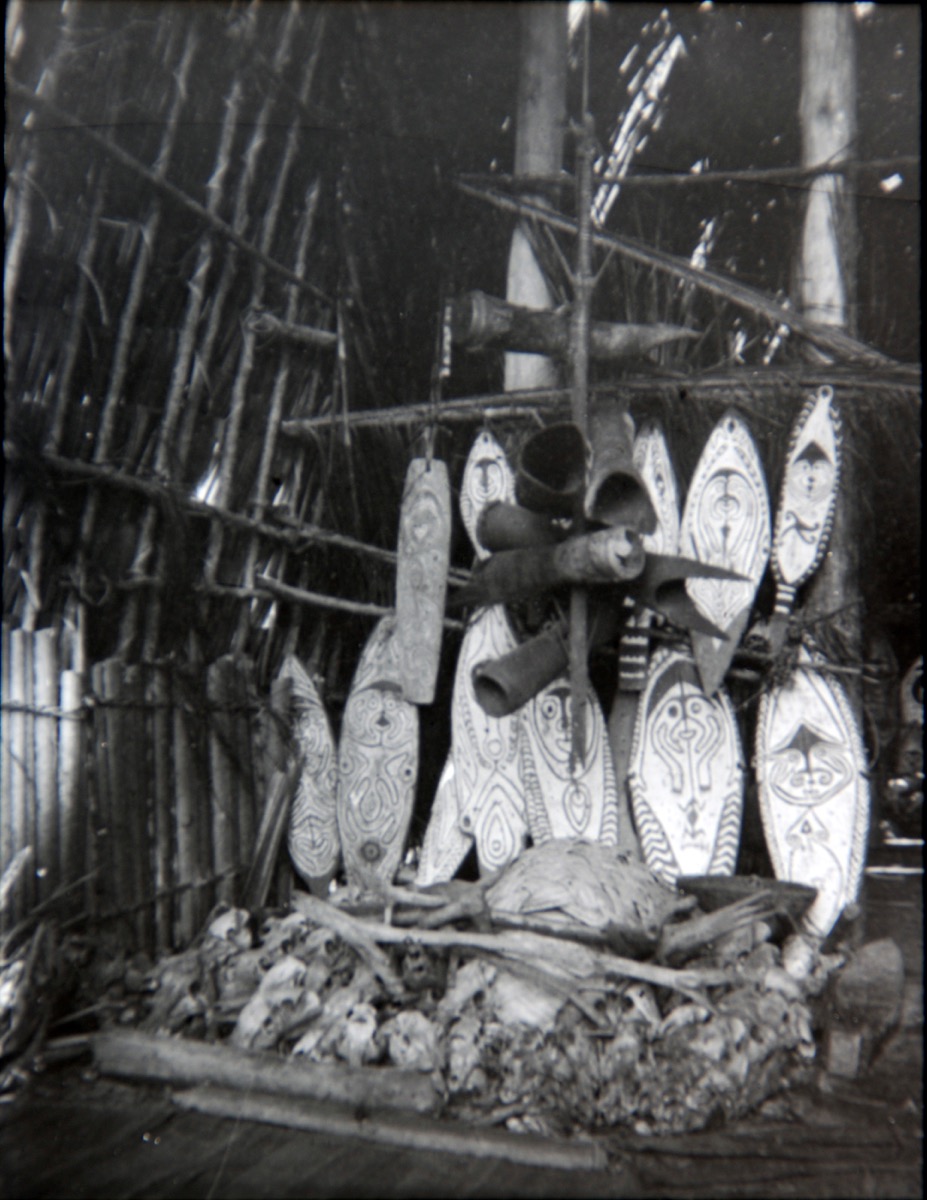
On Catalogue Card: "B.N.G. Delta Division.
Kairu.
Interior of a ravi showing a shrine with ceremonial
tablets, pigs’ skulls & drums." [manuscript in ink]
On Catalogue Card for duplicate print P.1599.ACH1: "Interior of eravi, Maipua." [Typed text]
An alcove (larava) inside a men’s longhouse (ravi). The alcove contains eleven oblong painted carvings (koi), each of which possess a stylised anthropomorphic face, and a series of patterns below and around it. The carvings are attached by cane (kaia ini) to a wooden scaffold that is attached to the two posts (aipua) of the longhouse, which form the alcove’s back. Hanging from the longhouse’s roof before the carvings is a wooden hook upon which are attached six hand drums. Before the carvings are a pile of pigs and crocodile skulls, upon which rest several pieces of wood and a nipa leaf basket (kepai). Along the wall of the longhouse and next to the alcove is a row of cut sago leaf stems (vae’e) tied together by cane (kaia ini). Behind this alcove another alcove is visible. [JB 6/1/2004]
Place
Oceania Melanesia; Papua New Guinea; Delta Division; Papuan Gulf; Purari Delta; Kairu [British New Guinea]
Cultural Affliation
Named Person
Photographer
Haddon, Kathleen (later Rishbeth)
Collector / Expedition
Haddon, Alfred Cort and Haddon, Kathleen (later Rishbeth) [Expedition to New Guinea, 16 September - 20 November 1914]
Date
19 October 1914
Collection Name
Teaching Slide CollectionKathleen Haddon Collection
Source
Format
Lantern Slide Black & White
Primary Documentation
Other Information
Publication: This image appears as figure 2 in Haddon, A.C. (1919) "The Kopiravi Cult of Namau, Papua." Man 19: 177-179. In the article it has the following caption: "Ceremonial drums suspended in front of a skull shrine in a ‘ravi’ at Kairu, a Koriki village, Namau." [JB 6/1/2004]
Place: There is some confusion over the village attribution of this photograph. P.1599.ACH1 is identified as being taken in Maipua, while both duplicate images are listed as taken in Kairu. This image is one of a series of an interior of one men’s longhouse (ravi). The alcove depicted in this photograph is opposite from the alcove shown in P.1600.ACH1. Both are visible in P.1607.ACH1. P.1609.ACH1 is taken closer to the longhouse’s entrance and shows alcove depicted in P.1599.ACH1. P.1609.ACH1 is visible in the background of P.1645.ACH1. In the alcove shown in P.1609.ACH1 is a ‘shield’ that Haddon collected and which is currently in the Cambridge Museum of Archaeology & Anthropology’s collection. The shield and the photograph are attributed to a longhouse in Kairu. The designation of this image (P.1599.ACH1) is based on the accumulative evidence provided by this series that it and the other images in the
series were taken in a Kairu longhouse. [JB 6/1/2004]
Related Object: The upper right carving with the star pattern was collected and is now in the collection as object: FILL IN NUMBER. [JB 6/1/2004]
Expedition: A.C. Haddon and his daughter, Kathleen Rishbeth arrived in the Papuan Gulf on October 7th, 1914. They spent two weeks in the Delta Division, the administrative division that covered the western side of the Papuan Gulf before leaving the region for Port Moresby. Kairu was an off-shoot village of the main Koriki village of Ukiaravi. [JB 6/1/2004]
FM:251354
Images (Click to view full size):