IDNO
DG.102053.PAO
Description
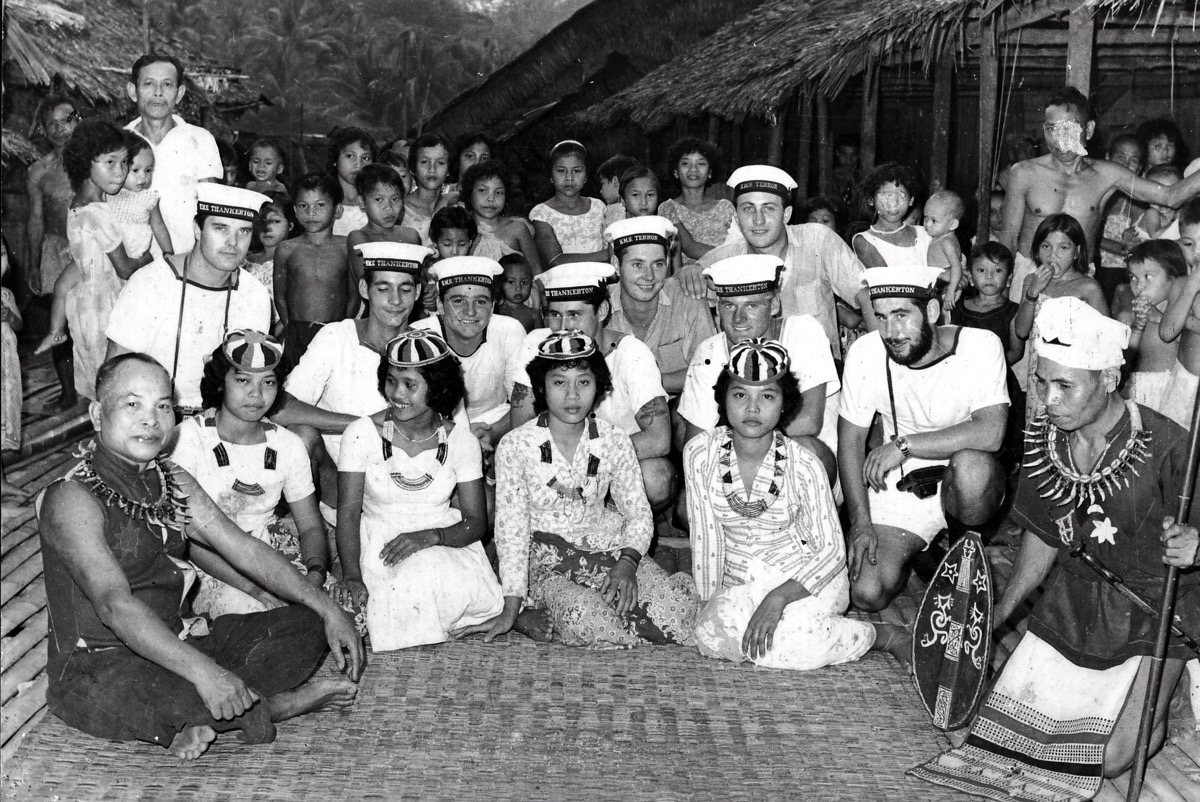
Eight uniformed male visitors from the British Navy pose on the bamboo slat tanju of the longhouse at Kampung Benuk, together with a large crowd of villagers.
The visitors wear naval uniform and caps with “H.M.S. THANKERTON” and “H.M.S. TERROR” on their tallies. Seated on a kasah (rattan and bark mat) in front of them are Otor anak Sunjam (far right) and Babai Punjo (far left), both dressed in tua gawai (ritual chief) outfits and four young women (from left to right), Suku, Moye, Mijo and Bukak wearing sepiya (round cloth caps with red, black and white stripes and back flaps), stagi (elliptical bead necklaces), and patterned blouses and sarongs.
Behind them is a large crowd of villagers, mostly women and children. On the left can be seen the thatched attap roofs of working sheds, and on the right, the sloping thatched attap roof of the longhouse.
In the background is jungle foliage.
Place
SE Asia Borneo; Malaysia; Sarawak; Penrissen; Kampung Benuk [Kampung Segu Bunuk]
Cultural Affliation
Bidayuh [historically Land Dayak]
Named Person
Otor anak Sunjam; Suku; Moye; Mijo; Bukak; Babai Punjo
Photographer
None
Collector / Expedition
Paka anak Otor
Date
circa 1966
Collection Name
Paka anak Otor Collection
Source
Paka anak OtorChua, Liana
Format
Print Black & White
Primary Documentation
Other Information
Source: A selection of 185 prints from Paka anak Otor’s larger collection of approximately 500 prints was made by Liana Chua during fieldwork in Kampung Benuk, Sarawak, Malaysia, in 2005. The purchase of non-exclusive reproduction rights [RM 1845, £250] by the Museum to the family of Paka anak Otor [82 Kampung Benuk, Jalan Puncak Borneo, Kuching 93250, Sarawak, Malaysia], and digital copy photographs of the collection [RM 869, £125] were paid for by the Museum Acquisition Fund [£250] and part of a Crowther-Beynon grant [£125] for the collecting of Sarawak objects. The digital scans were made by Fung Huang Colour Photo Centre [153 Padungan Road, Kuching, Sarawak] in 2005. [Liana Chua 2/8/2007]
Context: Kampung Benuk has been a small-scale tourist attraction since the 1960s, being particularly famous for its longhouse. Its first visitors were often members of the British, Australian and American armed forces stationed nearby during the Confrontation years between Indonesia and Malaysia (1963-1966); later visitors included civilian tourists, foreign dignitaries, UNESCO representatives, film crews, and government officials. Otor’s family often played host to the villagers, entertaining them with dances, and inviting them to their home for meals.
Benuk’s visitor numbers appear to have peaked around the 1970s and 1980s, especially with increasing domestic and Asian tourism and the state government’s tourist promotion efforts. Today it remains a fairly popular attraction despite its much diminished longhouse. [Liana Chua 10/9/2007]
This catalogue record has been updated with the support of the Getty Grant Program Two. [Liana Chua 10/9/2007]
FM:236703
Images (Click to view full size):