IDNO
DG.102034.PAO
Description
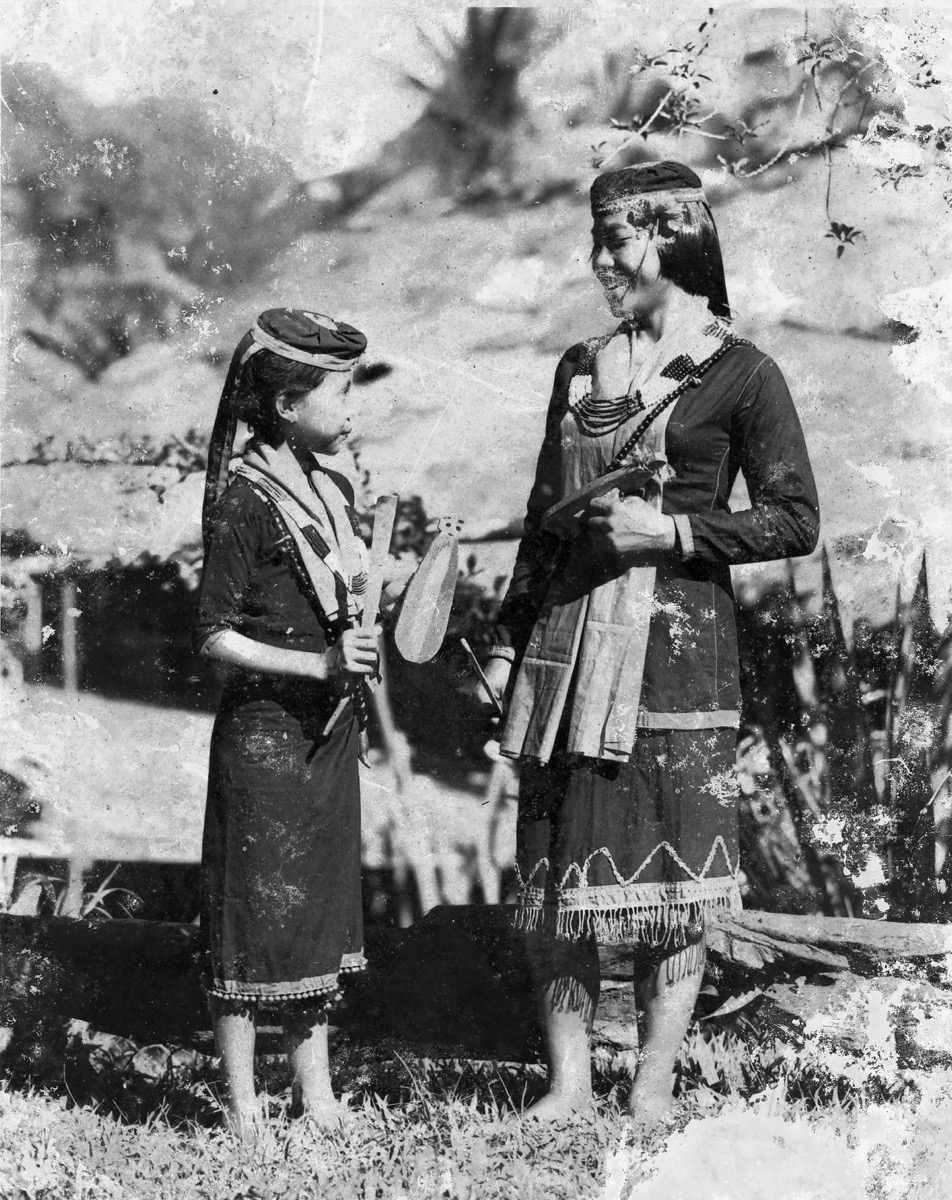
Portrait of a young girl, probably Kena anak Paka, and a slightly older young woman, Misua, standing on the lawn outside Paka anak Otor’s house, dressed in adat gawai (pre-Christian rituals) costume.
Both wear sepiya (round cloth caps with long back flap), stagi (elliptical bead necklaces), dark cloth kindang (long-sleeved jackets) and matching knee-length skirts with grunung (hawk bells) and other decorations sewn onto the hem. They carry miniature nengin (leaf-shaped decorated shields) and wooden pendat (‘swords’ with v-shaped incisions at their blade tips) used in the jekau dance.
In the background, at the foot of the hill, can be seen Kampung Benuk’s longhouse, with its large bamboo slat tanju (open gallery) and sloping thatched attap roof.
Place
SE Asia Borneo; Malaysia; Sarawak; Penrissen; Kampung Benuk [Kampung Segu Bunuk]
Cultural Affliation
Bidayuh [historically Land Dayak]
Named Person
?Kena anak Paka; Misua
Photographer
Wong, K.F.
Collector / Expedition
Paka anak Otor
Date
circa 1960 - 1970
Collection Name
Paka anak Otor Collection
Source
Paka anak OtorChua, Liana
Format
Print Black & White
Primary Documentation
Other Information
Source: A selection of 185 prints from Paka anak Otor’s larger collection of approximately 500 prints was made by Liana Chua during fieldwork in Kampung Benuk, Sarawak, Malaysia, in 2005. The purchase of non-exclusive reproduction rights [RM 1845, £250] by the Museum to the family of Paka anak Otor [82 Kampung Benuk, Jalan Puncak Borneo, Kuching 93250, Sarawak, Malaysia], and digital copy photographs of the collection [RM 869, £125] were paid for by the Museum Acquisition Fund [£250] and part of a Crowther-Beynon grant [£125] for the collecting of Sarawak objects. The digital scans were made by Fung Huang Colour Photo Centre [153 Padungan Road, Kuching, Sarawak] in 2005. [Liana Chua 2/8/2007]
Contextual information: From the 1960s, Kampung Benuk became a popular tourist destination famous for its longhouse. Paka’s family were central to this nascent industry, playing host to armed forces, civilian tourists, visiting dignitaries and officials. They commonly performed dances for these visitors which were based on adat gawai (pre-Christian rituals) ceremonies. [Liana Chua 10/9/2007]
Biographical Information: K.F. Wong, a Chinese immigrant to Sarawak, was one of its most influential and prolific photographers in the 1950s-1960s. [Liana Chua 10/9/2007]
This catalogue record has been updated with the support of the Getty Grant Program Two. [Liana Chua 10/9/2007]
FM:236684
Images (Click to view full size):