IDNO
DG.101994.PAO
Description
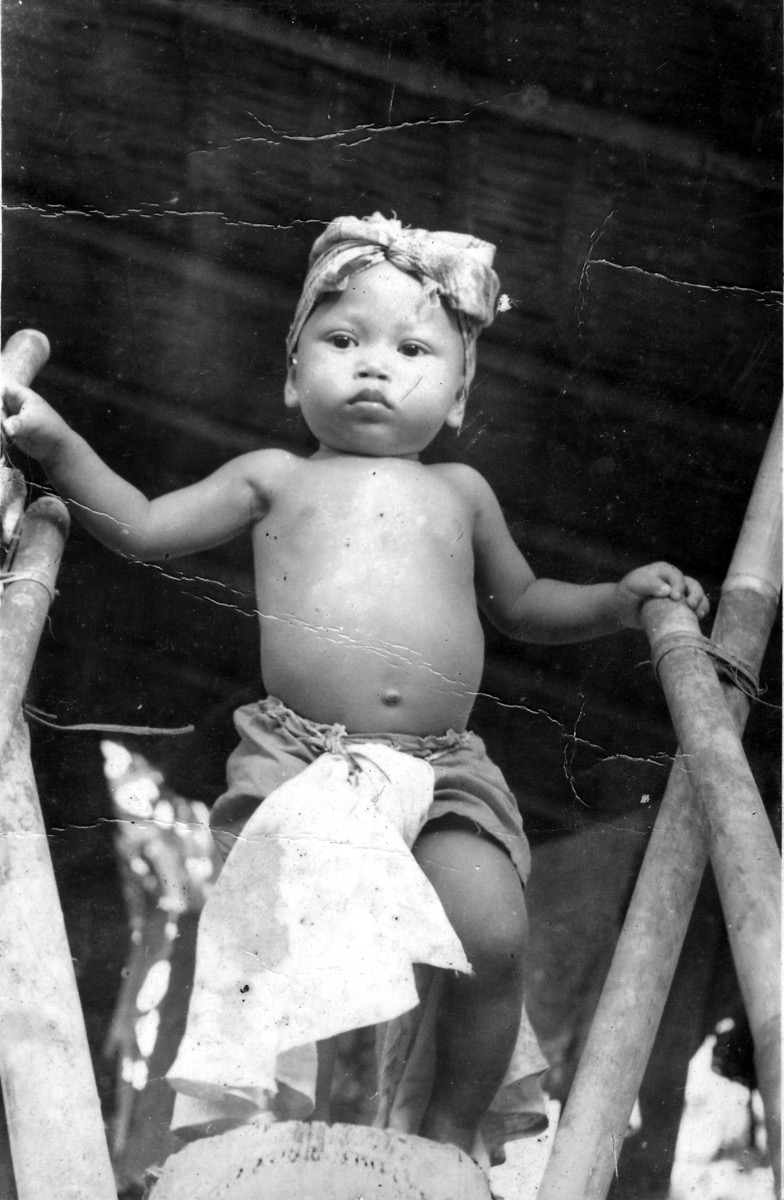
Toddler Kenid anak Paka, wearing a headscarf and shorts with a white cloth tied to them, stands at the top of a ladder consisting of notches cut into a single wooden pole, gripping the bamboo handrails on either side.
Behind him can be seen the attap roof of a raised shelter.
Place
SE Asia Borneo; Malaysia; Sarawak; Penrissen; Kampung Benuk [Kampung Segu Bunuk]
Cultural Affliation
Bidayuh [historically Land Dayak]
Named Person
Kenid anak Paka
Photographer
?Paka anak Otor
Collector / Expedition
Paka anak Otor
Date
circa 1965 - 1970
Collection Name
Paka anak Otor Collection
Source
Paka anak OtorChua, Liana
Format
Print Black & White
Primary Documentation
Other Information
Source: A selection of 185 prints from Paka anak Otor’s larger collection of approximately 500 prints was made by Liana Chua during fieldwork in Kampung Benuk, Sarawak, Malaysia, in 2005. The purchase of non-exclusive reproduction rights [RM 1845, £250] by the Museum to the family of Paka anak Otor [82 Kampung Benuk, Jalan Puncak Borneo, Kuching 93250, Sarawak, Malaysia], and digital copy photographs of the collection [RM 869, £125] were paid for by the Museum Acquisition Fund [£250] and part of a Crowther-Beynon grant [£125] for the collecting of Sarawak objects. The digital scans were made by Fung Huang Colour Photo Centre [153 Padungan Road, Kuching, Sarawak] in 2005. [Liana Chua 2/8/2007]
Inscription: The verse written on the reverse of the original print was added by Kenid anak Paka, the subject of the photograph, when he was older; according to him (2005), he did it for a bit of fun. “Semerah Padi” is a village in West Malaysia; but it could also be a reference to the famous P. Ramlee Malay film of the same name (1956). The idea of a child meeting a djinn and becoming a panglima may be reflective of stories in the Bidayuh (and more generally, the Malayic) world, in which people acquire certain skills or status as a result of encountering a magical creature, spirit or god. His transformation into a panglima specifically, however, is a pun on the Malay word for ‘five’, lima. [Liana Chua 29/8/2007]
This catalogue record has been updated with the support of the Getty Grant Program Two. [Liana Chua 29/8/2007]
FM:236644
Images (Click to view full size):