IDNO
DG.101986.PAO
Description
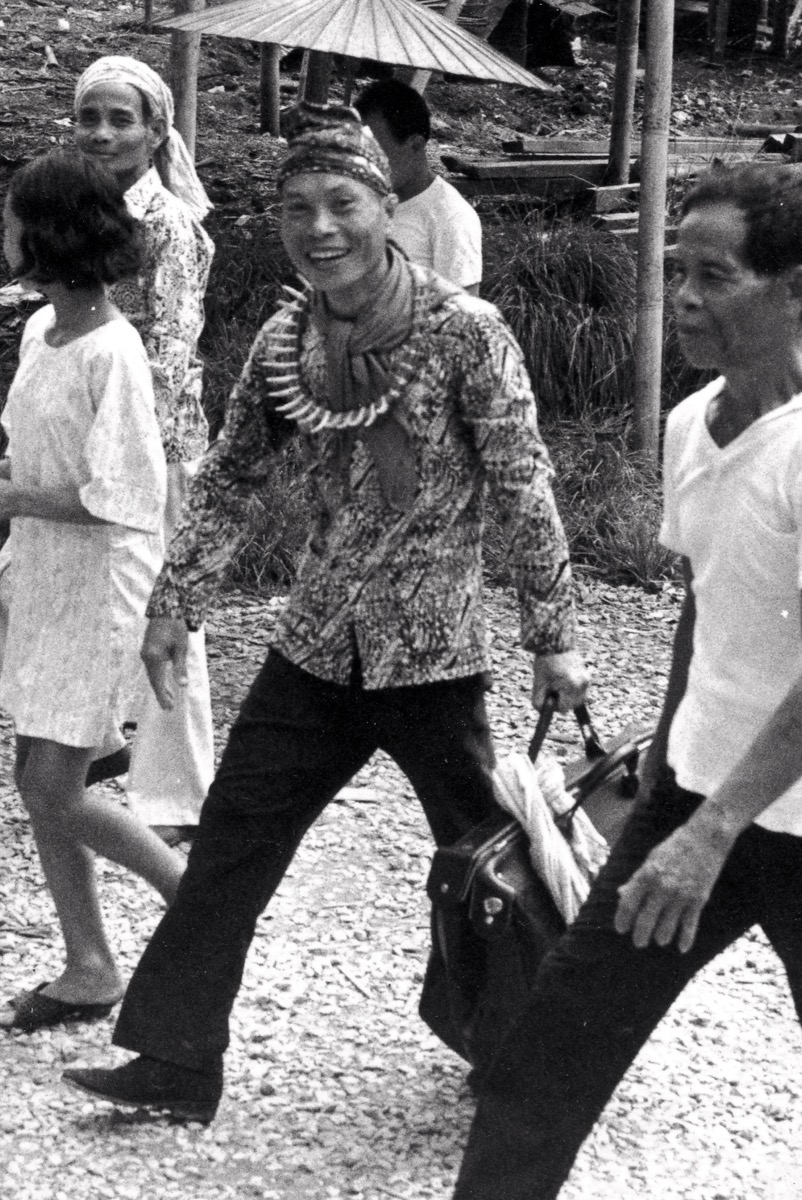
Paka anak Otor, wearing his tua gawai (ritual head) stagi (leopard teeth necklace), a batik shirt, neckerchief, trousers, shoes and headscarf, walks along a gravel path carrying a large briefcase, possibly filled with adat gawai (pre-Christian rituals) objects. Two women and two men walk alongside him.
In the background is possibly a construction area or part of the longhouse, with a pile of planks lying on the ground beneath a ?raised platform.
Place
SE Asia Borneo; Malaysia; Sarawak; Penrissen; Kampung Benuk [Kampung Segu Bunuk]
Cultural Affliation
Bidayuh [historically Land Dayak]
Named Person
Paka anak Otor
Photographer
None
Collector / Expedition
Paka anak Otor
Date
8 June 1974
Collection Name
Paka anak Otor Collection
Source
Paka anak OtorChua, Liana
Format
Print Black & White
Primary Documentation
Other Information
Source: A selection of 185 prints from Paka anak Otor’s larger collection of approximately 500 prints was made by Liana Chua during fieldwork in Kampung Benuk, Sarawak, Malaysia, in 2005. The purchase of non-exclusive reproduction rights [RM 1845, £250] by the Museum to the family of Paka anak Otor [82 Kampung Benuk, Jalan Puncak Borneo, Kuching 93250, Sarawak, Malaysia], and digital copy photographs of the collection [RM 869, £125] were paid for by the Museum Acquisition Fund [£250] and part of a Crowther-Beynon grant [£125] for the collecting of Sarawak objects. The digital scans were made by Fung Huang Colour Photo Centre [153 Padungan Road, Kuching, Sarawak] in 2005. [Liana Chua 2/8/2007]
Context: Adat gawai is a generic term for the complex of indigenous rituals practised in Bidayuh villages prior to widespread Christian conversion from the 1970s and 1980s. Today (2007) it is still observed by rapidly diminishing handfuls of elderly people in various villages. Most rituals revolved around the cultivation of rice, taking place throughout the year at major stages of the rice cycle. Other rituals were held, for example, to mark various life stages, such as adolescence, marriage and death, and to cure illnesses. Adat gawai is premised on the existence of a rather remote ‘Supreme Being’, Tapa, and more importantly, a variety of different spirits – the most important of which is the rice spirit – to whom offerings are made and invocations chanted. Such rituals entangle adat gawai practitioners and spirits alike in webs of obligations and strict protocols, including lengthy ‘taboo’ periods (pantang) which impose restrictions or demands on people’s movement and dietary habits. The key aim of adat gawai is to maintain a state of modud (‘coolness’) in the world: of stability, safety and wellness. [Liana Chua 29/8/2007]
Biographical Information: Paka anak Otor (1927-2004), was a former tua gawai (ritual chief) and owner of Paka’s Mini-Muzium in Kampung Benuk, a Bidayuh village in Penrissen, Sarawak, Malaysian Borneo. [Liana Chua 29/8/2007]
Context: Kampung Benuk has been a small-scale tourist attraction since the 1960s, being particularly famous for its longhouse. Its first visitors were often members of the British, Australian and American armed forces stationed nearby during the Confrontation years between Indonesia and Malaysia (1963-1966); later visitors included civilian tourists, foreign dignitaries, UNESCO representatives, film crews, and government officials. Paka and his family often played host to these visitors, performing adat gawai-based dances and rituals for their entertainment. According to Paka’s family, this photograph may have been taken during the filming of a documentary on adat gawai in Kampung Benuk.
Benuk’s visitor numbers appear to have peaked around the 1970s and 1980s, especially with increasing domestic and Asian tourism and the state government’s tourist promotion efforts. Today it remains a fairly popular attraction despite its much diminished longhouse. [Liana Chua 29/8/2007]
This catalogue record has been updated with the support of the Getty Grant Program Two. [Liana Chua 29/8/2007]
FM:236636
Images (Click to view full size):