IDNO
DG.101982.PAO
Description
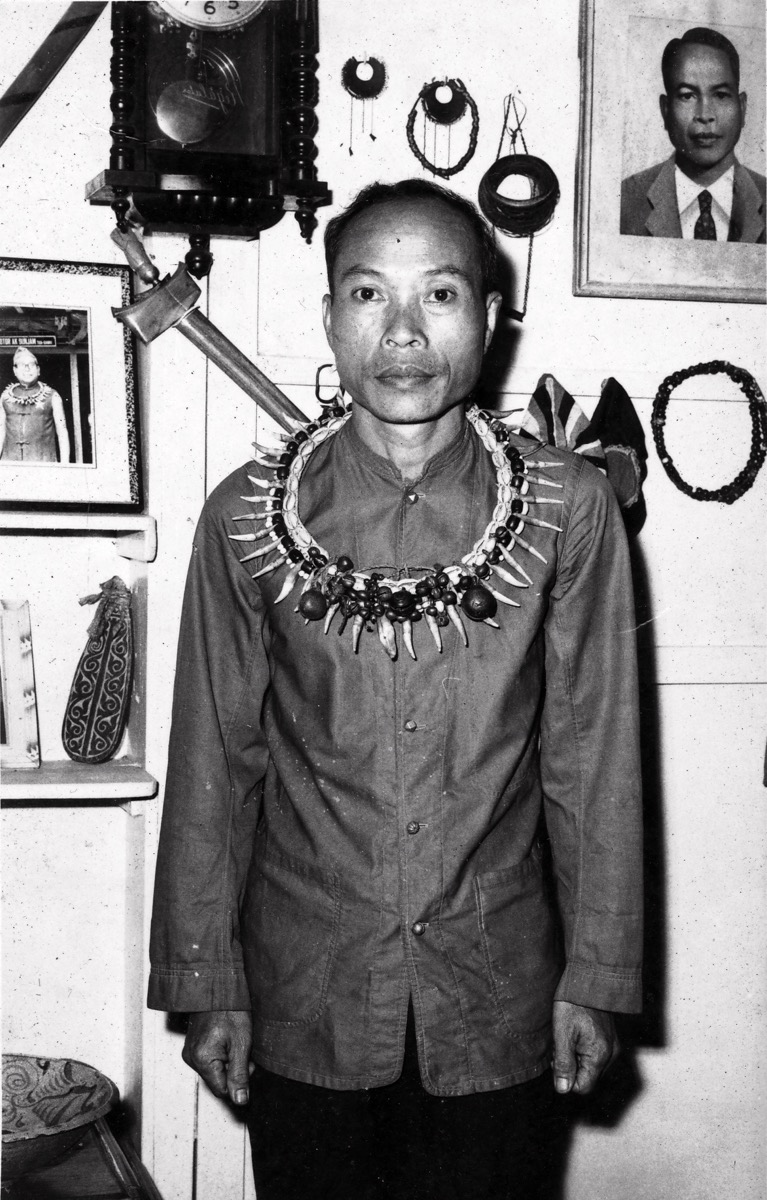
Portrait of Paka anak Otor shown from the knees up, standing in front of a small wall display of photographs and ritual and other objects. He wears a long-sleeved high-collared Chinese-style shirt and trousers, and a stagan (leopard teeth necklace) around his neck.
On the wall behind him are two framed photographs of his father, Otor anak Sunjam, one of him dressed in his tua gawai (ritual chief) outfit, the other of him in a suit and tie. Above Paka is a pendulum wall clock, with a sword mounted beneath it. Next to them is suspended a descending series of necklaces and brass coils. Behind Paka are two sepiya (round ritual cloth caps worn by women) and bead necklaces.
On the left is a shelf with a miniature decorated nengin (shield) on it. In the bottom left corner can be seen the top of a large earthenware jar with a painted ceramic dish serving as the lid.
Place
SE Asia Borneo; Malaysia; Sarawak; Penrissen; Kampung Benuk [Kampung Segu Bunuk]
Cultural Affliation
Bidayuh [historically Land Dayak]
Named Person
Paka anak Otor
Photographer
None
Collector / Expedition
Paka anak Otor
Date
22 September 1978
Collection Name
Paka anak Otor Collection
Source
Paka anak OtorChua, Liana
Format
Print Black & White
Primary Documentation
Other Information
Source: A selection of 185 prints from Paka anak Otor’s larger collection of approximately 500 prints was made by Liana Chua during fieldwork in Kampung Benuk, Sarawak, Malaysia, in 2005. The purchase of non-exclusive reproduction rights [RM 1845, £250] by the Museum to the family of Paka anak Otor [82 Kampung Benuk, Jalan Puncak Borneo, Kuching 93250, Sarawak, Malaysia], and digital copy photographs of the collection [RM 869, £125] were paid for by the Museum Acquisition Fund [£250] and part of a Crowther-Beynon grant [£125] for the collecting of Sarawak objects. The digital scans were made by Fung Huang Colour Photo Centre [153 Padungan Road, Kuching, Sarawak] in 2005. [Liana Chua 2/8/2007]
Biographical Information: Paka anak Otor (1927-2004), was a former tua gawai (ritual chief) and owner of Paka’s Mini-Muzium in Kampung Benuk, a Bidayuh village in Penrissen, Sarawak, Malaysian Borneo. The mini-museum began as Paka’s small personal collection of family heirlooms (including gongs and Chinese trade porcelain) and other objects which he “liked to look at”, including those shown on the wall behind him. It later became a tourist attraction in its own right, and is still maintained by his family today (2007). For more information on Paka’s mini-museum, see Chua, Liana. 2006. Antiques and Adat: the changing face of Paka’s mini-museum, Kampung Benuk, Penrissen, Kuching. Institute of East Asian Studies Working Paper No. 11. Kota Samarahan: Universiti Malaysia Sarawak. [Liana Chua 29/8/2007]
Biographical Information: Otor anak Sunjam (d. 1978) was the father of Paka and the village’s tua gawai (ritual chief). From the 1960s he often played host to visitors from the British, Australian and American navies, dignitaries, tourists and government officials. During this time, he had many photographs taken of him, clad in both his ‘traditional’ tua gawai gear and more ‘modern’ Western clothing. These photographs have since become part of Paka’s mini-museum, as both proof and substance of his family’s status over the years. [Liana Chua 29/8/2007]
Object: The stagi (leopard teeth necklace) worn by Paka in the photograph is probably the one that previously belonged to Otor, who died in 1978. It is possible that in taking this photograph, Paka was staking his (somewhat controversial) claim to inheriting his father’s position as the most senior tua gawai of Kampung Benuk. [Liana Chua 29/8/2007]
This catalogue record has been updated with the support of the Getty Grant Program Two. [Liana Chua 29/8/2007]
FM:236632
Images (Click to view full size):