IDNO
DG.101961.PAO
Description
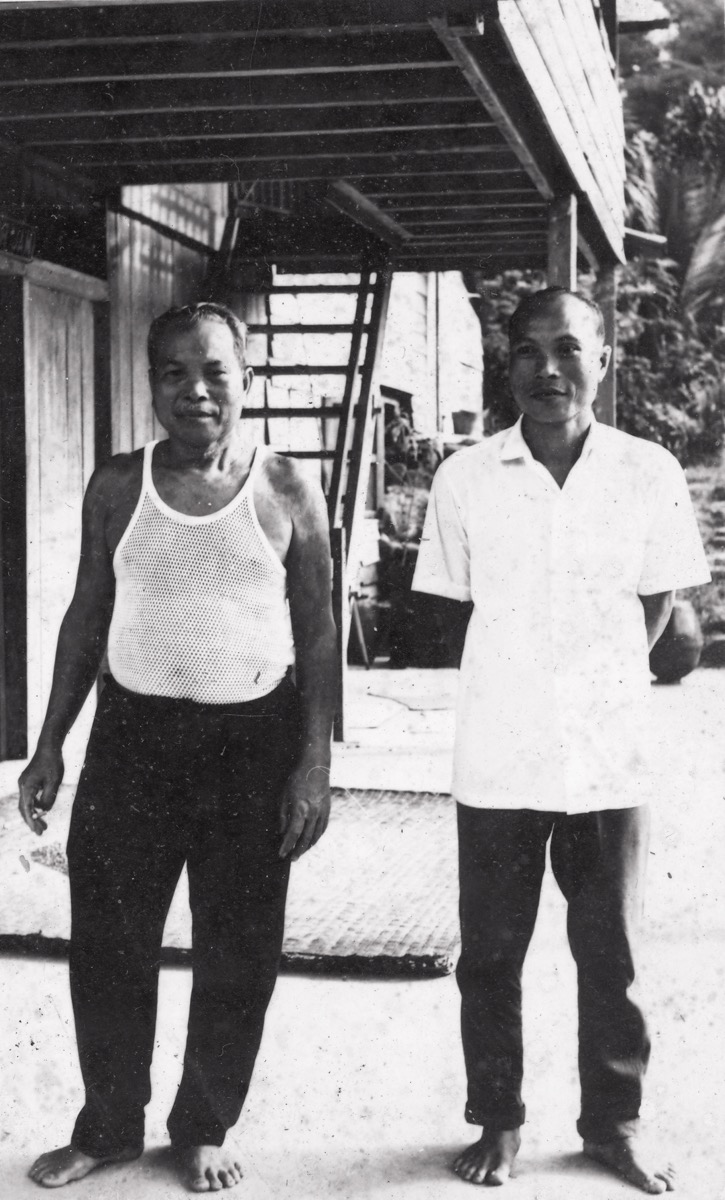
Portrait of Otor anak Sunjam and his son Paka anak Otor, standing on the cement ground floor porch of their family home on a hill overlooking the longhouse at Kampung Benuk. Otor wears a singlet and trousers, and Paka wears a short-sleeved shirt and trousers.
The house is made mainly of wooden planks. Behind them is a wooden plank ladder leading up to the upper floor of the house. To the left is the ground-floor space beneath the house, which was probably Otor’s provision shop at the time.
On the floor behind them is a kasah (rattan and bark mat). There are potted plants and other foliage in the background.
Place
SE Asia Borneo; Malaysia; Sarawak; Penrissen; Kampung Benuk [Kampung Segu Bunuk]
Cultural Affliation
Bidayuh [historically Land Dayak]
Named Person
Otor anak Sunjam; Paka anak Otor
Photographer
None
Collector / Expedition
Paka anak Otor
Date
5 July 1967
Collection Name
Paka anak Otor Collection
Source
Paka anak OtorChua, Liana
Format
Print Black & White
Primary Documentation
Other Information
Source: A selection of 185 prints from Paka anak Otor’s larger collection of approximately 500 prints was made by Liana Chua during fieldwork in Kampung Benuk, Sarawak, Malaysia, in 2005. The purchase of non-exclusive reproduction rights [RM 1845, £250] by the Museum to the family of Paka anak Otor [82 Kampung Benuk, Jalan Puncak Borneo, Kuching 93250, Sarawak, Malaysia], and digital copy photographs of the collection [RM 869, £125] were paid for by the Museum Acquisition Fund [£250] and part of a Crowther-Beynon grant [£125] for the collecting of Sarawak objects. The digital scans were made by Fung Huang Colour Photo Centre [153 Padungan Road, Kuching, Sarawak] in 2005. [Liana Chua 2/8/2007]
Biographical Information: Paka anak Otor (1927-2004), was a former tua gawai (ritual chief) and owner of Paka’s Mini-Muzium in Kampung Benuk, a Bidayuh village in Penrissen, Sarawak, Malaysian Borneo. Otor anak Sunjam (d. 1978) was his father. He was also the village’s tua gawai (ritual chief), and often played host to visitors from the British, Australian and American navies, dignitaries, tourists and government officials. [Liana Chua 28/8/2007]
Place: Otor and Paka’s family were among the first to move out of the longhouse at Kampung Benuk, shifting in 1954 to a detached wooden house on a hill at one end of the village. Otor cemented the ground floor of the house and ran it as a provision shop - one of the first in the village - until the mid-1970s. After this, the space became occupied by what is now the mini-museum, containing the family’s heirlooms, gifts from previous visitors, and Paka’s personal collection. [Liana Chua 24/8/2007]
This catalogue record has been updated with the support of the Getty Grant Program Two. [Liana Chua 28/8/2007]
FM:236611
Images (Click to view full size):