IDNO
DG.101956.PAO
Description
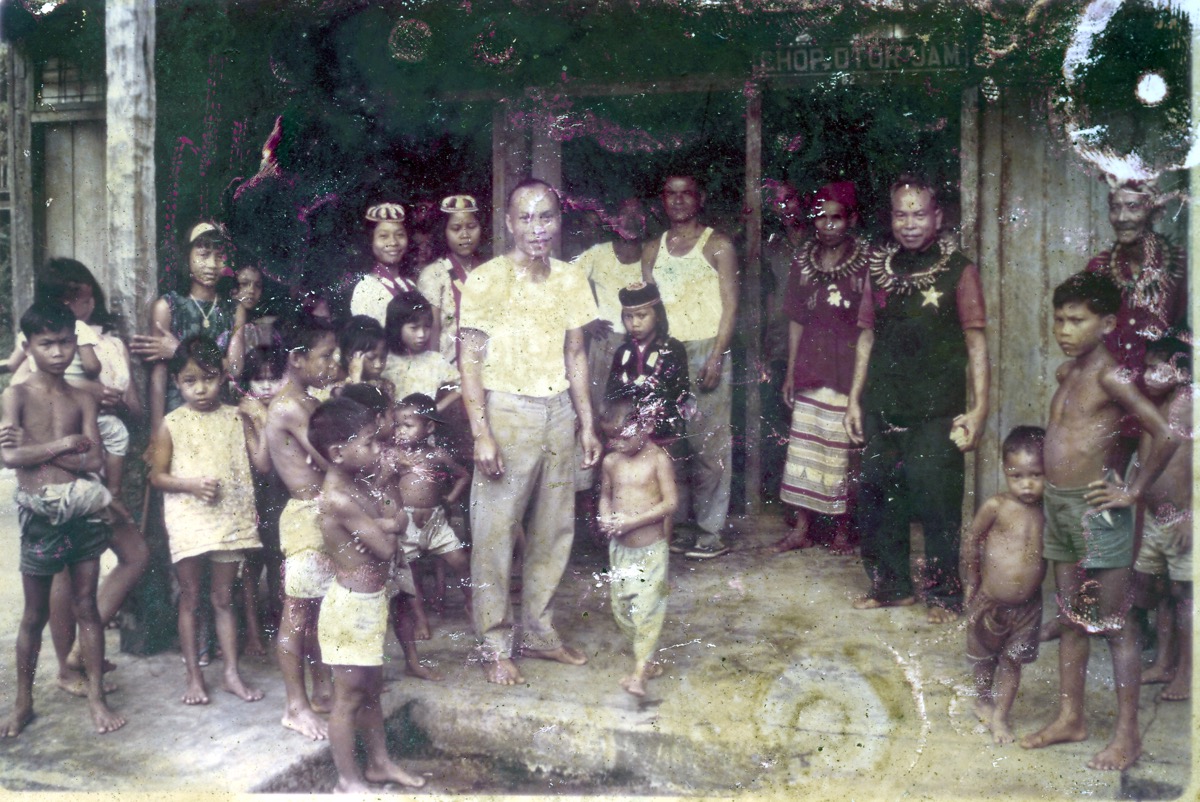
Paka anak Otor and his family stand outside his father Otor anak Sunjam’s shop on the ground floor of their home, surrounded by a large group of children and other people, possibly after a performance for visitors to Kampung Benuk.
Paka wears a tee-shirt and trousers; most of the children wear shorts or dresses. The performers stand behind Paka in a row outside the shop. On the left are two young women wearing sepiya (round cloth caps with red, black and white stripes and back flaps) and stagi (elliptical bead necklaces), Serayang (left) and Minuau (right). On the right, wearing vests with stars woven onto them and stagan (circular leopard teeth necklaces), are three elderly men, Babai Punjo, Otor anak Sunjam and Babai Nasia. Standing next to Paka is his daughter Kena anak Paka, wearing a sepiya, dark jacket and stagi.
In the background is the entrance to Otor’s shop, with a sign hanging over the door that reads “CHOP * OTOR * JAM”.
Place
SE Asia Borneo; Malaysia; Sarawak; Penrissen; Kampung Benuk [Kampung Segu Bunuk]
Cultural Affliation
Bidayuh [historically Land Dayak]
Named Person
Paka anak Otor; Otor anak Sunjam; Serayang; Minuau; Babai Punjo; Babai Nasia; Kena anak Paka; Kenid anak Paka; Miko anak Paka
Photographer
None
Collector / Expedition
Paka anak Otor
Date
circa 1965 - 1970
Collection Name
Paka anak Otor Collection
Source
Paka anak OtorChua, Liana
Format
Print Black & White
Primary Documentation
Other Information
Source: A selection of 185 prints from Paka anak Otor’s larger collection of approximately 500 prints was made by Liana Chua during fieldwork in Kampung Benuk, Sarawak, Malaysia, in 2005. The purchase of non-exclusive reproduction rights [RM 1845, £250] by the Museum to the family of Paka anak Otor [82 Kampung Benuk, Jalan Puncak Borneo, Kuching 93250, Sarawak, Malaysia], and digital copy photographs of the collection [RM 869, £125] were paid for by the Museum Acquisition Fund [£250] and part of a Crowther-Beynon grant [£125] for the collecting of Sarawak objects. The digital scans were made by Fung Huang Colour Photo Centre [153 Padungan Road, Kuching, Sarawak] in 2005. [Liana Chua 2/8/2007]
Place: Otor and Paka’s family were among the first to move out of the longhouse at Kampung Benuk, shifting in 1954 to a detached wooden house on a hill at one end of the village. Otor cemented the ground floor of the house and ran it as a provision shop - one of the first in the village - until the mid-1970s. After this, the space became occupied by what is now the mini-museum, containing the family’s heirlooms, gifts from previous visitors, and Paka’s personal collection.
“Chop” on the signboard is probably a phonetic rendering of the English “Shop”. “Jam” could simply be a shortening of “Sunjam” from Otor’s full name. The two stars on the board are probably a reference to the stars woven onto Otor’s (and other tua gawai’s) ritual vest, a reflection of his status as a head ritual chief of the village. [Liana Chua 24/8/2007]
Contextual information: From the 1960s, Kampung Benuk became a popular tourist destination famous for its longhouse. Paka’s family were central to this nascent industry, playing host to armed forces, civilian tourists, visiting dignitaries and officials. They commonly performed dances for these visitors which were based on adat gawai (pre-Christian rituals) ceremonies. [Liana Chua 28/8/2007]
This catalogue record has been updated with the support of the Getty Grant Program Two. [Liana Chua 28/8/2007]
FM:236606
Images (Click to view full size):