IDNO
DG.101951.PAO
Description
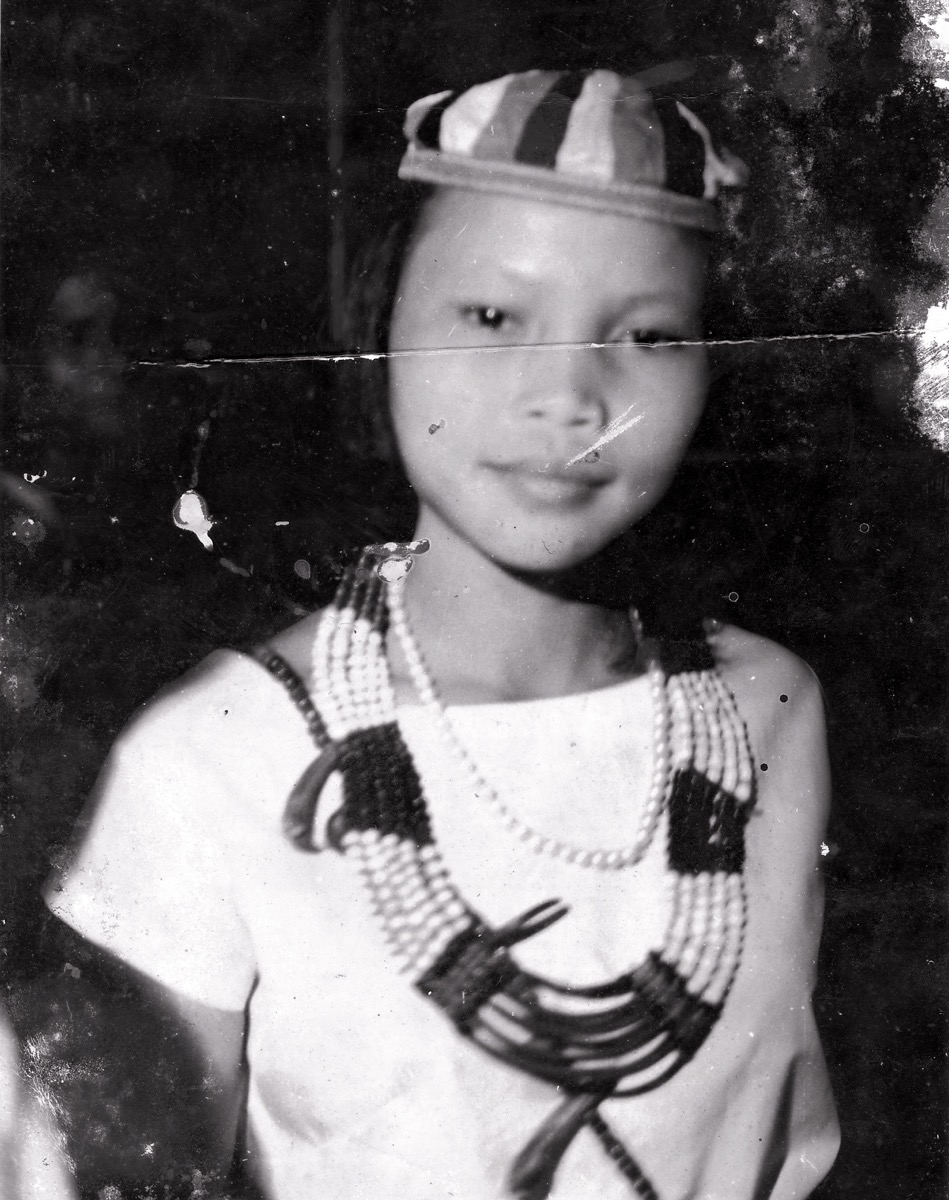
Portrait of Simau anak Paka, Paka anak Otor’s daughter, dressed in adat gawai (pre-Christian rituals) clothing, probably at a dance performance for visitors to Kampung Benuk. She wears a sepiya (round cloth cap with red, black and white stripes and a flap at the back), a short-sleeved white blouse, a stagi (elliptical bead necklace) and sembun (string of beads with canine teeth attached, slung around the shoulder).
Place
SE Asia Borneo; Malaysia; Sarawak; Penrissen; Kampung Benuk [Kampung Segu Bunuk]
Cultural Affliation
Bidayuh [historically Land Dayak]
Named Person
Simau anak Paka
Photographer
None
Collector / Expedition
Paka anak Otor
Date
circa 1960 - 1970
Collection Name
Paka anak Otor Collection
Source
Paka anak OtorChua, Liana
Format
Print Black & White
Primary Documentation
Other Information
Source: A selection of 185 prints from Paka anak Otor’s larger collection of approximately 500 prints was made by Liana Chua during fieldwork in Kampung Benuk, Sarawak, Malaysia, in 2005. The purchase of non-exclusive reproduction rights [RM 1845, £250] by the Museum to the family of Paka anak Otor [82 Kampung Benuk, Jalan Puncak Borneo, Kuching 93250, Sarawak, Malaysia], and digital copy photographs of the collection [RM 869, £125] were paid for by the Museum Acquisition Fund [£250] and part of a Crowther-Beynon grant [£125] for the collecting of Sarawak objects. The digital scans were made by Fung Huang Colour Photo Centre [153 Padungan Road, Kuching, Sarawak] in 2005. [Liana Chua 2/8/2007]
Biographical Information: Paka anak Otor (1927-2004), was a former tua gawai (ritual chief) and owner of Paka’s Mini-Muzium in Kampung Benuk, a Bidayuh village in Penrissen, Sarawak, Malaysian Borneo.
Contextual information: From the 1960s, Kampung Benuk became a popular tourist destination famous for its longhouse. Paka’s family were central to this nascent industry, playing host to armed forces, civilian tourists, visiting dignitaries and officials. They commonly performed dances for these visitors which were based on adat gawai (pre-Christian rituals) ceremonies. Simau was probably dressed up and performing in one such dance when the photograph was taken. [Liana Chua 28/8/2007]
This catalogue record has been updated with the support of the Getty Grant Program Two. [Liana Chua 28/8/2007]
FM:236601
Images (Click to view full size):