IDNO
DG.101948.PAO
Description
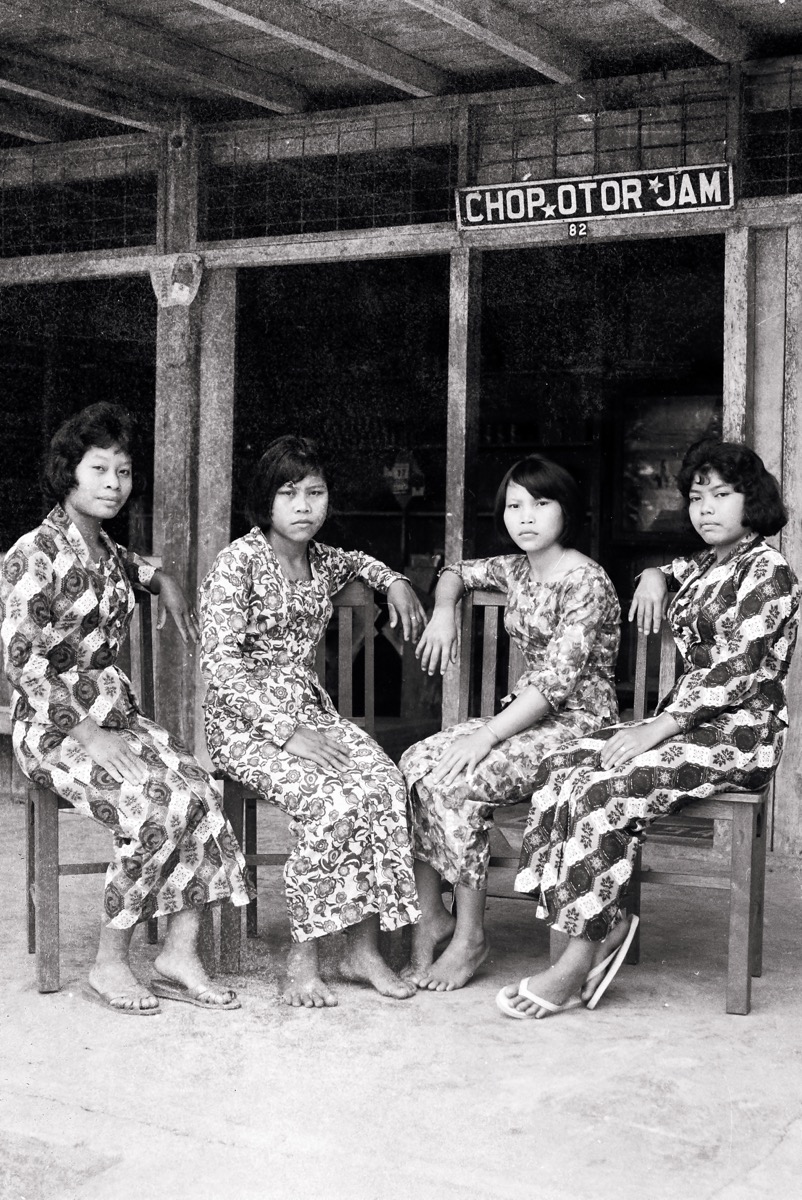
Portrait of a group of four young women, all dressed in patterned long-sleeved blouses and ankle-length skirts, sitting on wooden chairs outside the shop of Otor anak Sunjam. From left to right: Serayang, Minuau, Simau anak Paka, unknown.
Behind them is the shop, located on the ground floor of Otor’s family house. A sign, “CHOP*OTOR*JAM” and “82” (the house number) hang over the wooden doorway.
Place
SE Asia Borneo; Malaysia; Sarawak; Penrissen; Kampung Benuk [Kampung Segu Bunuk]
Cultural Affliation
Bidayuh [historically Land Dayak]
Named Person
Serayang; Minuau; Simau
Photographer
?Paka anak Otor
Collector / Expedition
Paka anak Otor
Date
circa 1960 - 1970
Collection Name
Paka anak Otor Collection
Source
Paka anak OtorChua, Liana
Format
Print Black & White
Primary Documentation
Other Information
Source: A selection of 185 prints from Paka anak Otor’s larger collection of approximately 500 prints was made by Liana Chua during fieldwork in Kampung Benuk, Sarawak, Malaysia, in 2005. The purchase of non-exclusive reproduction rights [RM 1845, £250] by the Museum to the family of Paka anak Otor [82 Kampung Benuk, Jalan Puncak Borneo, Kuching 93250, Sarawak, Malaysia], and digital copy photographs of the collection [RM 869, £125] were paid for by the Museum Acquisition Fund [£250] and part of a Crowther-Beynon grant [£125] for the collecting of Sarawak objects. The digital scans were made by Fung Huang Colour Photo Centre [153 Padungan Road, Kuching, Sarawak] in 2005. [Liana Chua 2/8/2007]
Place: Otor and Paka’s family were among the first to move out of the longhouse at Kampung Benuk, shifting in 1954 to a detached wooden house on a hill at one end of the village. Otor cemented the ground floor of the house and ran it as a provision shop - one of the first in the village - until the mid-1970s. After this, the space became occupied by what is now the mini-museum, containing the family’s heirlooms, gifts from previous visitors, and Paka’s personal collection.
“Chop” on the signboard is probably a phonetic rendering of the English “Shop”. “Jam” could simply be a shortening of “Sunjam” from Otor’s full name. The two stars on the board are probably a reference to the stars woven onto Otor’s (and other tua gawai’s) ritual vest, a reflection of his status as a head ritual chief of the village. [Liana Chua 24/8/2007]
This catalogue record has been updated with the support of the Getty Grant Program Two. [Liana Chua 24/8/2007]
FM:236598
Images (Click to view full size):