IDNO
DG.101915.PAO
Description
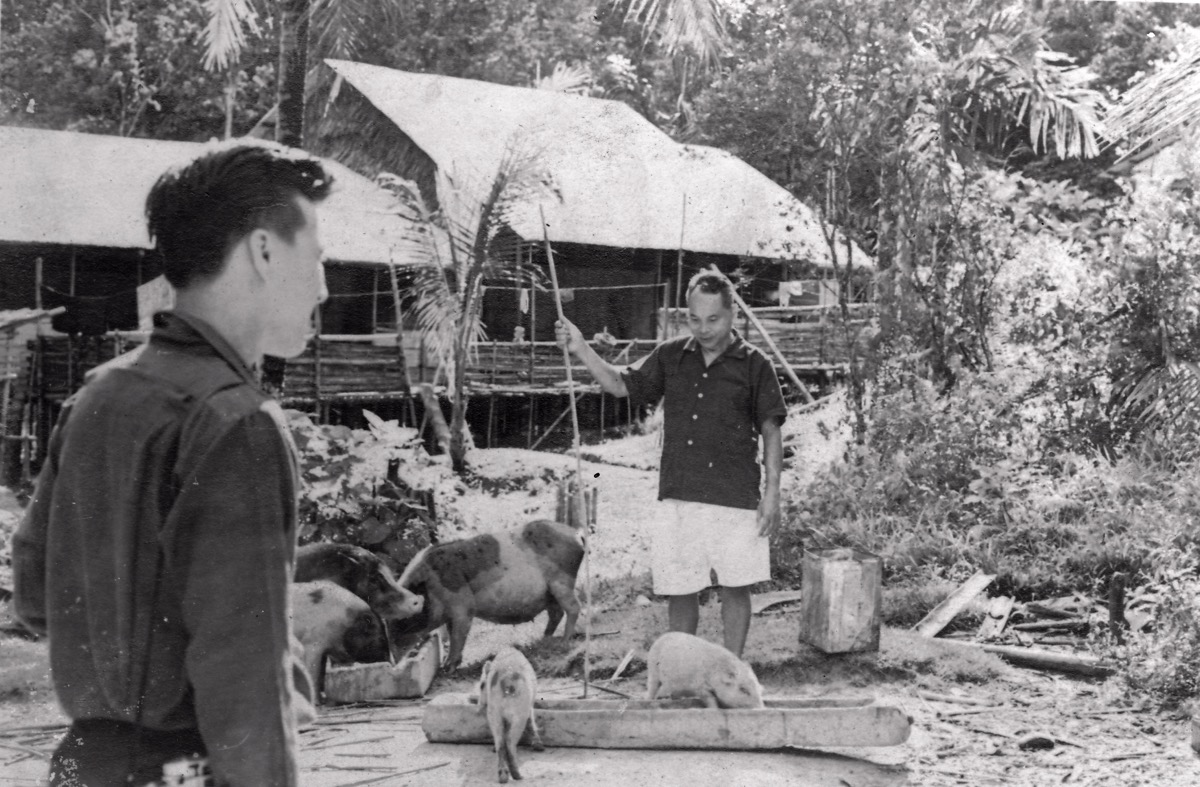
Otor anak Sunjam stands over a group of his pigs and piglets which are feeding from two troughs. He wears a short-sleeved shirt and shorts and carries a thin stick. Watching on the left is Lee, a Chinese man from Penang who stayed with Otor’s family for a year.
The men stand in a clearing surrounded by foliage. In the background is part of the longhouse at Kampung Benuk, with raised bamboo platforms and triangular thatched attap roofs.
Place
SE Asia Borneo; Malaysia; Sarawak; Penrissen; Kampung Benuk [Kampung Segu Bunuk]
Cultural Affliation
Bidayuh [historically Land Dayak]
Named Person
Otor anak Sunjam; Lee
Photographer
?Paka anak Otor
Collector / Expedition
Paka anak Otor
Date
5 August 1956
Collection Name
Paka anak Otor Collection
Source
Paka anak OtorChua, Liana
Format
Print Black & White
Primary Documentation
Other Information
Source: A selection of 185 prints from Paka anak Otor’s larger collection of approximately 500 prints was made by Liana Chua during fieldwork in Kampung Benuk, Sarawak, Malaysia, in 2005. The purchase of non-exclusive reproduction rights [RM 1845, £250] by the Museum to the family of Paka anak Otor [82 Kampung Benuk, Jalan Puncak Borneo, Kuching 93250, Sarawak, Malaysia], and digital copy photographs of the collection [RM 869, £125] were paid for by the Museum Acquisition Fund [£250] and part of a Crowther-Beynon grant [£125] for the collecting of Sarawak objects. The digital scans were made by Fung Huang Colour Photo Centre [153 Padungan Road, Kuching, Sarawak] in 2005. [Liana Chua 2/8/2007]
Biographical Information: Otor anak Sunjam (d. 1978) was the father of Paka anak Otor, who owned the mini-museum in Kampung Benuk. He was also the village’s tua gawai (ritual chief), and often played host to visitors from the British, Australian and American navies, dignitaries, tourists and government officials. [Liana Chua 2/8/2007]
Context: Pigs were a common sight in Kampung Benuk and other villages until around the 1970s. They roamed freely around the village and under the longhouse, often consuming all the household waste that was thrown through the wooden floors or round the back. When people began moving to detached concrete houses and government intervention increased in rural areas, it became impossible to continue rearing pigs in the village. Pork, however, remains an important part of the Bidayuh diet and major rituals. [Liana Chua 24/8/2007]
This catalogue record has been updated with the support of the Getty Grant Program Two. [Liana Chua 23/8/2007]
FM:236565
Images (Click to view full size):