IDNO
DG.101894.PAO
Description
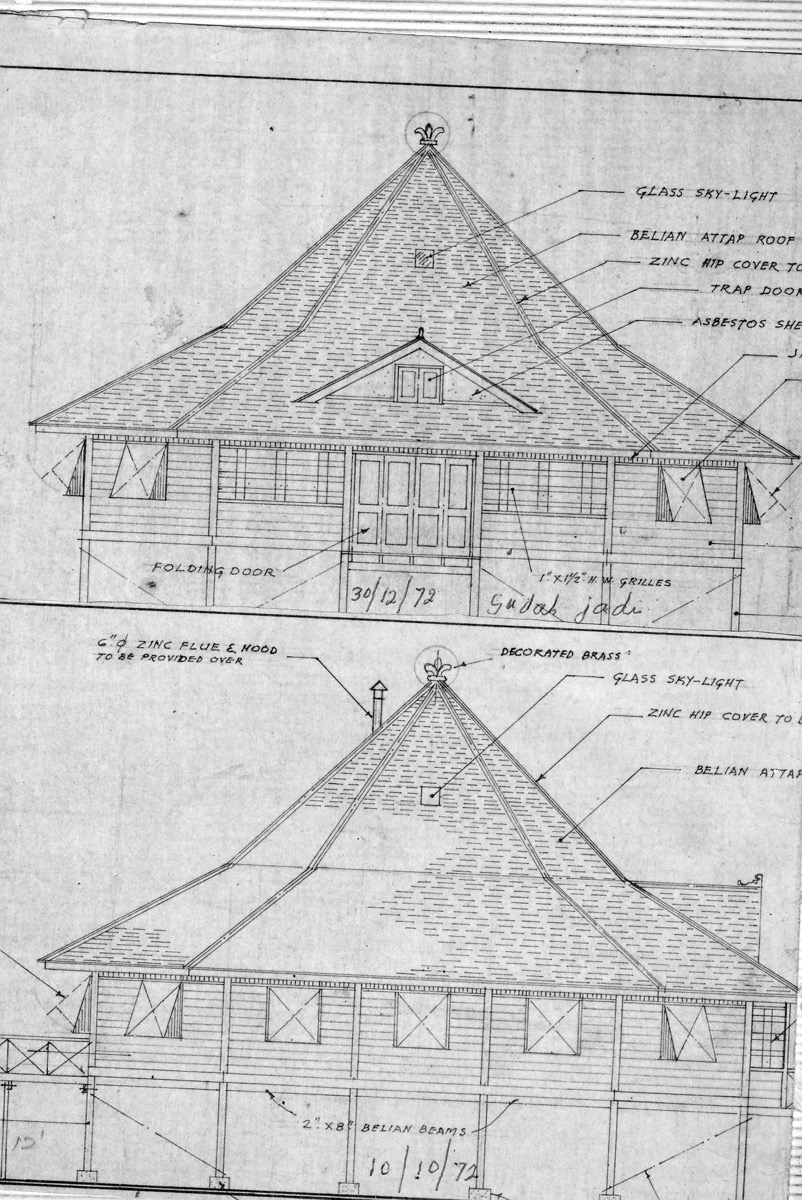
Photographic scans of two sets of hand-drawn plans for the construction of the new panggah (meeting and ritual house) in Kampung Benuk in 1972. The plan at the top shows the front of the panggah; the plan below the back. There are handwritten terms and arrows corresponding to each component of the building.
The panggah has a panelled, roughly conical wood-shingled roof made of belian (ironwood), interspersed with zinc hip covers along the ridges. Near the top of the roof is a small square glass skylight. Just over the folding door is a triangular gable-like space for a trapdoor, surrounded by asbestos sheeting. A zinc flue protrudes from the side of the roof. The main building is covered with slatted wood. It is roughly ?octagonal, with window flaps on each of its panels, and sets of grilles on either side of the door. At the tip of the roof is a decorated brass object in the shape of a fleur-de-lis, unlike most other such buildings, which often have hornbills in the same position.
Handwriting at the bottom of the first plan notes that the building was completed (“sudah jadi”) on 30/12/72. At the bottom of the second plan is written “10/10/72”.
Place
SE Asia Borneo; Malaysia; Sarawak; Penrissen; Kampung Benuk [Kampung Segu Bunuk]
Cultural Affliation
Bidayuh [historically Land Dayak]
Named Person
Otor anak Sunjam
Photographer
None
Collector / Expedition
Paka anak Otor
Date
1972
Collection Name
Paka anak Otor Collection
Source
Paka anak OtorChua, Liana
Format
Print Black & White
Primary Documentation
Other Information
Source: A selection of 185 prints from Paka anak Otor’s larger collection of approximately 500 prints was made by Liana Chua during fieldwork in Kampung Benuk, Sarawak, Malaysia, in 2005. The purchase of non-exclusive reproduction rights [RM 1845, £250] by the Museum to the family of Paka anak Otor [82 Kampung Benuk, Jalan Puncak Borneo, Kuching 93250, Sarawak, Malaysia], and digital copy photographs of the collection [RM 869, £125] were paid for by the Museum Acquisition Fund [£250] and part of a Crowther-Beynon grant [£125] for the collecting of Sarawak objects. The digital scans were made by Fung Huang Colour Photo Centre [153 Padungan Road, Kuching, Sarawak] in 2005. [Liana Chua 2/8/2007]
Image: Photograph is a scan made of two hand-drawn plans for the construction of the new panggah (see below) at Kampung Benuk, probably created by members of the Malay regiment who built it in 1972. These plans were pasted into a scrapbook put together by Otor anak Sunjam, the then-ritual head of the village who oversaw its construction. The handwritten dates on the plans probably belong to him. [Liana Chua 23/8/2007]
Place: The panggah was traditionally a meeting-hall, sleeping place for visitors and bachelors and men’s ritual space in various Bidayuh villages. It was also where the village’s collection of skulls was kept, hence its identification by 19th century European writers and administrators as the “head-house”. Benuk’s present panggah, as outlined in the plans, was constructed by a Malay army regiment in 1972, to replace the older attap-roof building. Local accounts of the origin of the ten skulls vary; but most seem to agree that they belong to enemies from Singai (another Bidayuh area) who carried out a severe raid on the village. In retaliation, the men of the village killed them and hung their heads in the panggah, at which point their spirits were inveighed to guard the village from misfortune. Every year (as of 2007), the skulls are ‘bathed’ with ritual substances and ‘fed’ with offerings in a ritual performed by the few remaining adat gawai (pre-Christian rituals) practitioners in the village. [Liana Chua 23/8/2007]
Biographical Information: Otor anak Sunjam (d. 1978) was the father of Paka anak Otor, who owned the mini-museum in Kampung Benuk. He was also the village’s tua gawai (ritual chief), and often played host to visitors from the British, Australian and American navies, dignitaries, tourists and government officials. He also seemed to have various acquaintances in the newly-formed Malaysian armed forces and police, who were responsible at various stages for facilitating infrastructural developments in the village, such as the tarring of a road and the erection of road signs. [Liana Chua 23/8/2007]
This catalogue record has been updated with the support of the Getty Grant Program Two. [Liana Chua 23/8/2007]
FM:236544
Images (Click to view full size):