IDNO
DG.101892.PAO
Description
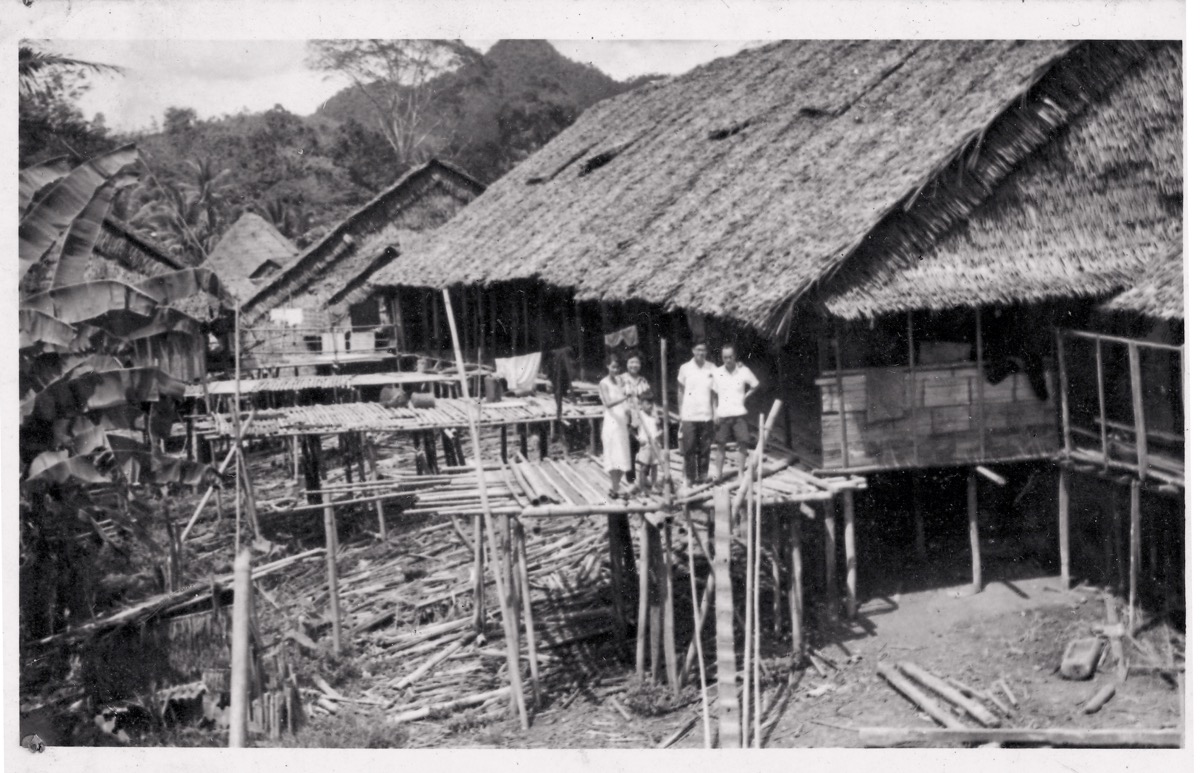
A group of six people, consisting of probably a family of Chinese tourists and Paka anak Otor (far right), stand on the ?unfinished tanju (open gallery) on one end of the longhouse at Kampung Benuk. The men wear short-sleeved shirts or tee-shirts and trousers; one woman wears a sleeveless knee-length skirt.
The tanju consists of bamboo slats laid crosswise over a raised bamboo platform. In this case, alternating sections of the tanju, corresponding to individual apartments on the right, are missing, possibly because they are being replaced. On the right is the sloping thatched attap roof of the longhouse, with small rectangular ‘skylights’ cut into it. Beneath it are the individual apartments and shared awah (covered gallery).
In the background to the left can be seen the conical attap roof of the old panggah (meeting and ritual house), which was replaced by a wood shingled roof in 1972. Behind it are mountains and foliage. Banana trees are planted alongside the longhouse on the left.
Place
SE Asia Borneo; Malaysia; Sarawak; Penrissen; Kampung Benuk [Kampung Segu Bunuk]
Cultural Affliation
Bidayuh [historically Land Dayak]
Named Person
?Paka anak Otor
Photographer
None
Collector / Expedition
Paka anak Otor
Date
circa 1960 - 1972
Collection Name
Paka anak Otor Collection
Source
Paka anak OtorChua, Liana
Format
Print Black & White
Primary Documentation
Other Information
Source: A selection of 185 prints from Paka anak Otor’s larger collection of approximately 500 prints was made by Liana Chua during fieldwork in Kampung Benuk, Sarawak, Malaysia, in 2005. The purchase of non-exclusive reproduction rights [RM 1845, £250] by the Museum to the family of Paka anak Otor [82 Kampung Benuk, Jalan Puncak Borneo, Kuching 93250, Sarawak, Malaysia], and digital copy photographs of the collection [RM 869, £125] were paid for by the Museum Acquisition Fund [£250] and part of a Crowther-Beynon grant [£125] for the collecting of Sarawak objects. The digital scans were made by Fung Huang Colour Photo Centre [153 Padungan Road, Kuching, Sarawak] in 2005. [Liana Chua 2/8/2007]
Context: Kampung Benuk has been a small-scale tourist attraction since the 1960s, being particularly famous for its longhouse. Its first visitors were often members of the British, Australian and American armed forces stationed nearby during the Confrontation years between Indonesia and Malaysia (1963-1966); later visitors included civilian tourists, foreign dignitaries, UNESCO representatives, film crews, and government officials. Benuk’s visitor numbers appear to have peaked around the 1970s and 1980s, especially with increasing domestic and Asian tourism and the state government’s tourist promotion efforts. Today it remains a fairly popular attraction despite its much diminished longhouse. [Liana Chua 6/8/2007]
Place: The panggah was traditionally a meeting-hall, sleeping place for visitors and bachelors and men’s ritual space in various Bidayuh villages. It was also where the village’s collection of skulls was kept, hence its identification by 19th century European writers and administrators as the “head-house”. Benuk’s present panggah was constructed by a Malay army regiment in 1972, to replace the older attap-roof building. Local accounts of the origin of the ten skulls vary; but most seem to agree that they belong to enemies from Singai (another Bidayuh area) who carried out a severe raid on the village. In retaliation, the men of the village killed them and hung their heads in the panggah, at which point their spirits were inveighed to guard the village from misfortune. Every year (as of 2007), the skulls are ‘bathed’ with ritual substances and ‘fed’ with offerings in a ritual performed by the few remaining adat gawai (pre-Christian rituals) practitioners in the village. [Liana Chua 23/8/2007]
This catalogue record has been updated with the support of the Getty Grant Program Two. [Liana Chua 23/8/2007]
FM:236542
Images (Click to view full size):