IDNO
DG.101870.PAO
Description
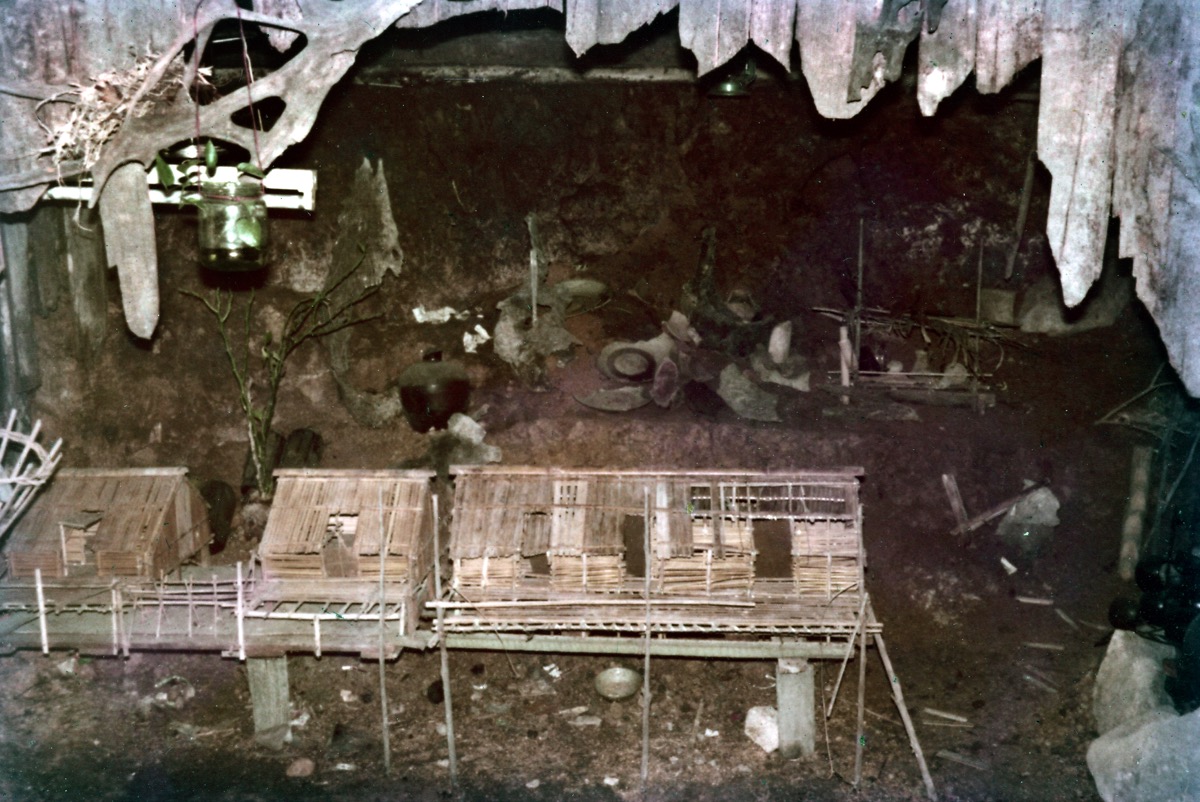
Photograph of a miniature longhouse standing in a recreation of Kampung Benuk’s ancestral cave in Paka’s mini-museum.
Wooden planks are used to form ‘stalactites’ around a small niche in a corner of the ground-floor room.
The model longhouse is made of wooden twigs and split bamboo, and features a tanju (shared open gallery) and a series of individual ramin (apartments) with sloping roofs and cut-out ‘skylights’. Resting against the model in the left-hand corner is a life-size tikarak (bamboo torch with a split v-shaped upper end), traditionally used to light the longhouse.
In the background is a raised earthen surface with ceramic sherds and a model of a ?farming hut on it. An oil lamp hangs over the model in the background on the left.
Place
SE Asia Borneo; Malaysia; Sarawak; Penrissen; Kampung Benuk [Kampung Segu Bunuk]
Cultural Affliation
Bidayuh [historically Land Dayak]
Named Person
Paka anak Otor
Photographer
None
Collector / Expedition
Paka anak Otor
Date
circa 1970 - 1990
Collection Name
Paka anak Otor Collection
Source
Paka anak OtorChua, Liana
Format
Print Colour
Primary Documentation
Other Information
Source: A selection of 185 prints from Paka anak Otor’s larger collection of approximately 500 prints was made by Liana Chua during fieldwork in Kampung Benuk, Sarawak, Malaysia, in 2005. These photographs were taken, sent to and collected by Paka over about fifty years (circa 1950-2000). The purchase of non-exclusive reproduction rights [RM 1845, £250] by the Museum to the family of Paka anak Otor [82 Kampung Benuk, Jalan Puncak Borneo, Kuching 93250, Sarawak, Malaysia], and digital copy photographs of the collection [RM 869, £125] were paid for by the Museum Acquisition Fund [£250] and part of a Crowther-Beynon grant [£125] for the collecting of Sarawak objects. The digital scans were made by Fung Huang Colour Photo Centre [153 Padungan Road, Kuching, Sarawak] in 2005. [Liana Chua 2/8/2007]
Biographical and Contextual Information: Paka anak Otor (1927-2004), was a former tua gawai (ritual chief) and owner of Paka’s Mini-Muzium in Kampung Benuk, a Bidayuh village in Penrissen, Sarawak, Malaysian Borneo. The mini-museum began as Paka’s small personal collection of family heirlooms (including gongs and Chinese trade porcelain) and other objects which he “liked to look at”. During the ‘Confrontation’ years between Malaysia and Indonesia (1963-1966) Kampung Benuk became a popular recreational destination for British, Australian and American servicemen stationed nearby at the Malaysian-Indonesian border. Paka’s household - then run by his charismatic tua gawai father Otor anak Sunjam (d. 1978) - was one of their main ports of call, and often the recipient of their gifts and souvenirs, including military plaques, film reels, cameras and sweets. These items were incorporated into Paka’s collection, which also came to include locally made artefacts such as baskets, tools and water carriers, and various natural objects like snakeskins, branches and stones. From the 1970s, Kampung Benuk became a popular tourist destination famous for its longhouse. Paka’s family remained central to this nascent industry, playing host to civilian tourists, visiting dignitaries and officials. As Paka’s collection grew, visitors began calling it a ‘mini-museum’; the name has since stuck. Paka passed away in 2004, but his widow and family continue to run the mini-museum, which is visited mainly by tourists. For more information on Paka’s mini-museum, see Chua, Liana. 2006. Antiques and Adat: the changing face of Paka’s mini-museum, Kampung Benuk, Penrissen, Kuching. Institute of East Asian Studies Working Paper No. 11. Kota Samarahan: Universiti Malaysia Sarawak. [Liana Chua 2/8/2007]
Object: The longhouse and cave model were personally constructed by Paka to illustrate the local story of how the village’s ancestors ended up settling in Kampung Benuk. Paka explained that the earliest Bidayuhs lived in caves for security from animals and enemy attacks until the coming of the Brooke Rajahs (1841-1946). They were then persuaded to settle in longhouses and begin practising subsistence agriculture, eventually ending up in Kampung Benuk’s present site. [Liana Chua 2/8/2007]
This catalogue record has been updated with the support of the Getty Grant Program Two. [Liana Chua 2/8/2007]
FM:236520
Images (Click to view full size):