IDNO
P.74536.ACH2
Description
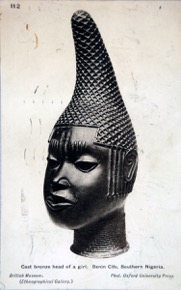
Documentary photograph of a commemorative head of a Queen Mother from Benin City, Southern Nigeria. The sixteenth-century lost-wax cast in brass cast is now in the care of the British Museum, reference Af1897,1011.1. [JD 18/10/2021]
Place
W Africa; Europe British Isles; Nigeria; United Kingdom; Southern Nigeria; Benin City; England; London; British Museum
Cultural Affliation
Edo
Named Person
Photographer
None
Collector / Expedition
Ingram, William James (Sir) [Object donor to British Museum]
Date
Collection Name
Unmounted Haddon Collection
Source
Rishbeth, Kathleen (nee Haddon)
Format
Postcard
Primary Documentation
Other Information
This print was found in envelope now numbered C463/ which was found in Bay C Drawer 39.
A letter to Mrs Rishbeth from ?H G D Fitzgerald dated 23/11/?47 was also found in envelope now numbered C463 which relates to prints P.74509.ACH2 to P.74519.ACH2 and also to prints P.74526. ACH2 and P.74527.ACH2. See Archive reference.
Related Object: The commenorative head is in the collections of the British Museum, reference Af1897,1011.1, with the following information:
"Description
Commemorative head of Queen Mother; lost-wax cast in brass. Naturalistic, almost life-size female head with curving conical hairstyle covered with openwork coral bead net; long strings of coral beads at sides and back. Wears high coral bead collar. Two vertical marks on forehead originally inset with iron; four scarification marks above each eye. Pupils inlaid with iron.
Production ethnic group: Made by: Edo
Production date: 16thC(early)
Made in: Benin City
Materials: brass; iron
Technique: lost-wax cast; inlaid
Dimensions: Height: Height: 41 centimetres
Weight: Weight: 3.70 kilograms
Weight: Weight: 3.90 kilograms
Width: Width: 15.50 centimetres
Depth: Depth: 17 centimetres
Curator's comments: A brass head representing Queen Idia was made to be placed in her altar following her death. It is said that Oba Esigie instituted the title of Queen Mother and established the tradition of casting heads of this type in honour of her military and ritual powers. Such heads were placed in altars in the palace and in the Queen Mother's residence.
Read & Dalton 1899:
Head of a young woman. She wears a high pointed head-dress formed of a network of beads, from the lower end of which depends a fringe formed of strings of similar beads. Like Af1897,1217.3 she has four cicatrices on each eyebrow, and two bands between, but these latter, like the pupils of the eyes, are inlaid with iron.
The perfection of the work both from the technical and the artistic points of view would indicate that it belongs to the earlier period of these works of art.
This specimen, presented by Sir William Ingram, Bart., in 1897, appears like Af1897,1217.3 to be of considerable antiquity, being covered in the same way with a fine green patina.
From Exhibition Label "commemorative head for altar, probably representing Idia, the mother of Oba (King) Esigie of Benin".
Bibliographic references: Read & Dalton 1899 / Antiquities from the City of Benin and from other parts of West Africa in the British Museum (pl IX.4)
Exhibition history Exhibited:
1970-1973, London, Museum of Mankind, Divine Kingship in Africa
1991 Feb-Apr, Norwich, Sainsbury Centre for Visual Arts, Man and Metal in Ancient Nigeria
1997-1998 Sep-Jan, Osaka, National Museum of Ethnology, Images of Other Cultures
1998, Feb-Apr, Tokyo, Setagaya Art Museum, Images of Other Cultures
2013 July-November, Cambridge, Fitzwilliam Museum, Origins of the Afro Comb
Associated names: Representation of: Queen Mother Idia (?)
Acquisition name: Donated by: Sir William James Ingram
Acquisition date: 1897." [Source: https://www.britishmuseum.org/collection/object/E_Af1897-1011-1, JD 18/10/2021]
FM:209186
Images (Click to view full size):