IDNO
N.71480.GIJ
Description
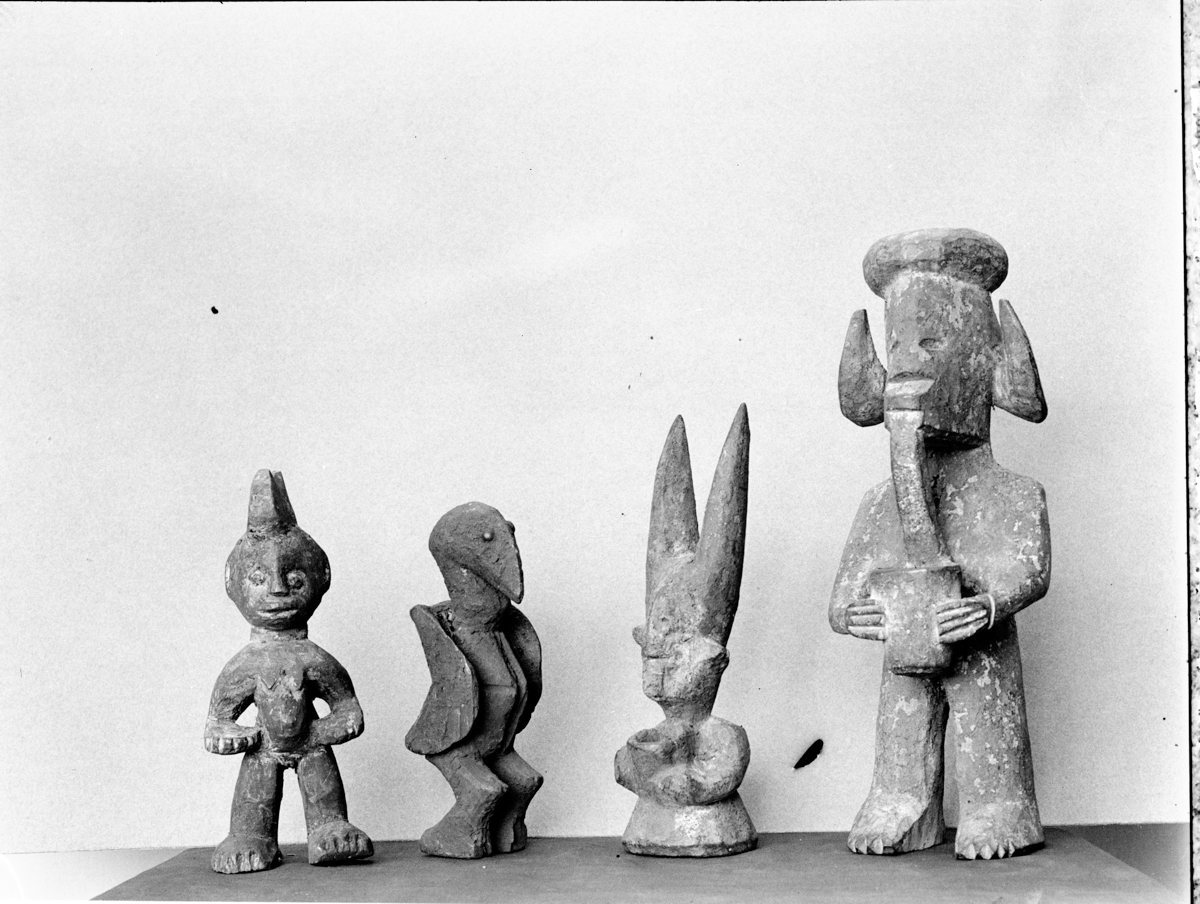
Four wooden Agwu Nsi figures. From left to right:
Place
W Africa; Nigeria; South Eastern Nigeria; Onitsha province; ?Nri Awka
Cultural Affliation
Igbo [historically Ibo]
Named Person
Photographer
Jones, Gwilliam Iwan (known as G.I.)
Collector / Expedition
Date
circa 1930 - 1939
Collection Name
Jones collection
Source
Jones, Gwilliam Iwan (known as G.I.)
Format
Film Negative Black & White
Primary Documentation
Other Information
This negative was found in pocket 93 of the negative album now numbered C16/.
Publication: Same image published on John McCall’s G.I. Jones website with the following information: [Source: www.siu.edu/~anthro/mccall/jones/, AF ]
1. Index to Igbo music, shrines, architecture and other cultural artifacts
2. Agwu Nsi Figures
3. Agwu Nsi figures (Dibia) Nri-Awka Igbo (2nd image).
Context: Jones writes about these figures and explains they were used by diviners. “Quite as importantly, particularly in the Lower Niger area, were the figures representing personal deities decorating the meeting houses of wealthy Northern Ibo men, who vied each other in such displays. The best known of these cults was the Ikenga. Northern and Southern Ibo diviners carried with them as part of their paraphernalia their Agu Nsi, small carvings of humans, animals, Ikenga and other ritual objects which were believed to help them in their divination.” (Jones, 1989, p.38)
Context: As the Owerri creation story indicates, the deity Agwushi is a a critical force in Igbo life, standing between mankind and the various gods and ancestors. The priest/doctor/diviner, dibia, consults Agwushi to interpret the needs and dissatifactions of other deities. Diviners are wise, educated men who can elicit the meanings of things and see the past, present and future with clarity. They prescribe ritual procedures and sacrifices and prepare substances - magical medicines, ogwu - which correct mistakes, cure diseases, and otherwise bring the world of the client back into proper balance. Some of these medicinal preparations are rubbed on a patient or swallowed, but others are considered just for their existence. Agwushi creates order by arbitrating between mankind and the gods, giving something to each (Cole and Aniakor, 1984, pp. 16-17.)
Bibliographical Reference: Jones, G.I. Ibo Art. 1989 (Shire);
Cole, H. & C. Aniakor, 1984. Igbo Arts: Community and Cosmos (Museum of Cultural History, University of California)
This catalogue record has been updated with the support of the Getty Grant Program Two. [Alicia Fentiman 4/3/2008]
FM:206130
Images (Click to view full size):