IDNO
T.67683.MFL
Description
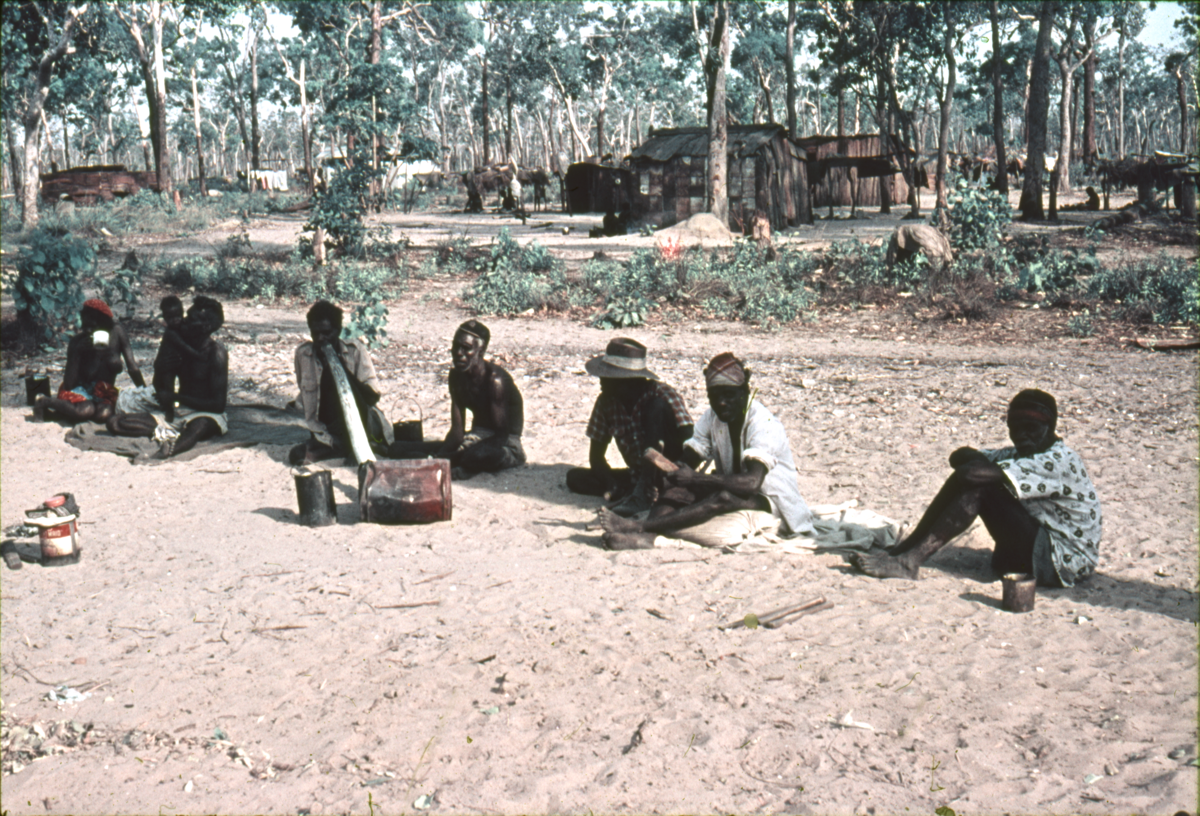
Six Arnhem Land men, a woman and an infant sitting in a line behind a sand drawing. One of the men is playing a didgeridoo.
Sand sculpture for a purification ceremony at Maningrida. The leafy branches that are on the ground are for the smoking ceremony that is also part of the purification. These ceremonies are part of Yolngu funeral ceremonies and involve purifying the dead person’s clothes and belongings as well as cleansing or freeing people who are associated with the dead person. After the belongings and participants have been cleansed with smoke, water is poured into the holes that have been made in the sand. This is a public ceremony and the photograph does not need to be restricted. [Knowledge shared by Joe Neparrnga Gumbula, Arnhem Land, with notes by Rachael Murphy and JD 10/7/2012]
Place
Oceania Australasia; Australia; Northern Territory; Arnhem Land; Maningrida
Cultural Affliation
Named Person
Photographer
None
Collector / Expedition
Date
1960
Collection Name
Macfarlane Collection
Source
Macfarlane, Alan
Format
Transparency
Primary Documentation
Other Information
T.67481 to T.68999 and T.74937 to T.74998 were found in the box now numbered C494/.
T.67682 to T.67695 were found in the plastic slide sheet now numbered C494/11/.
Place: Maningrida settlement, to the east of Darwin, was set up as a Government welfare department settlement after World War II. People from other areas in north east Arnhem Land would use it as a place to meet. Some of the photographs are from the settlement and Maningrida beach. It is now a town. [Knowledge shared by Joe Neparrnga Gumbula, Arnhem Land, with notes by Rachael Murphy and JD 10/7/2012]
Context: Sand sculpture for a purification ceremony at Maningrida. The leafy branches that are on the ground are for the smoking ceremony that is also part of the purification. These ceremonies are part of Yolngu funeral ceremonies and involve purifying the dead person’s clothes and belongings as well as cleansing or freeing people who are associated with the dead person. After the belongings and participants have been cleansed with smoke, water is poured into the holes that have been made in the sand. This is a public ceremony and the photograph does not need to be restricted. [Knowledge shared by Joe Neparrnga Gumbula, Arnhem Land, with notes by Rachael Murphy and JD 10/7/2012]
FM:202333
Images (Click to view full size):