IDNO
D.50943.
Description
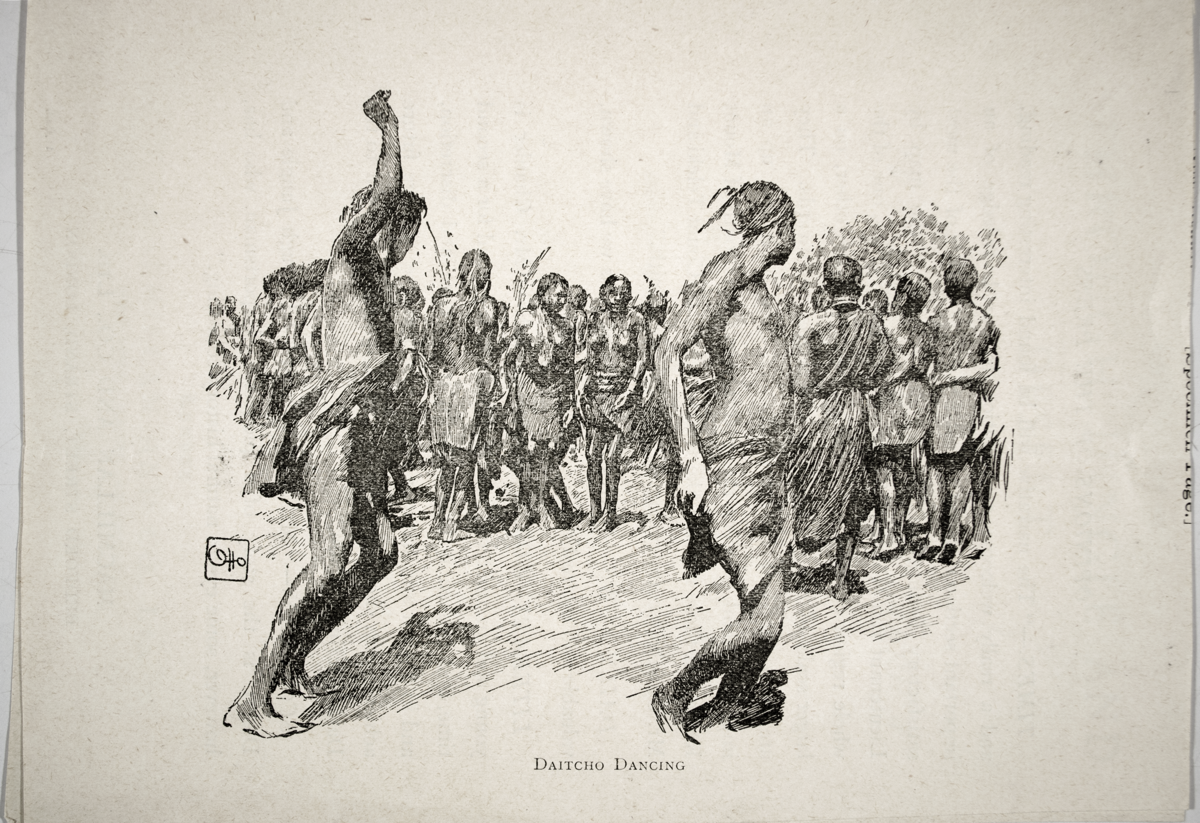
Drawing of a group of Daitcho men and women dancing. [JD 15/12/2025]
Place
E Africa; Kenya; Embe County
Cultural Affliation
Daitcho
Named Person
Photographer
Chanler, William Astor
Collector / Expedition
Date
October 1896
Collection Name
Source
Format
Photomechanical Book Illustration
Primary Documentation
Other Information
This drawing was found in an envelope now marked C220/ which came from the wooden drawer I.
Publication: D.50943. and D.50944. were reproduced in - 1896 by Chanler, William Astor, 1986. 'Through Jungle and Desert: Travels in Eastern Africa', (London and New York, Macmillan and Co., Ltd), p.411 and captioned "Daitcho Dancing."
Related text notes "We heard that a tribe called Daitcho inhabited the eastern slopes of the range lying between the Embe country and the plain where the Mackenzie River winds its way (p.191)."
"One day I received a message from Bykender, that the natives of his village were about to hold a dance, and he wished me to come and see it; my presence would not only please the natives, but would enhance his influence over them. The dance was held at a spot about thirty minutes’ walk from my camp. The pleasant sound of male voices in song guided me to a little clearing in the thick bush, and I there found gathered together some 500 natives of all ages and both sexes. I was welcomed with smiles, and room was made for me under a spreading tree, about ten feet from the nearest dancers.
The dance was simple in its movement, consisting of a sharp rise upon the toes, the heels returning with a dull thud to the earth; the shock of which was diminished by bending the knees, and inclining the upper part of the body forward. The dancers were ranged in three double circles (one within the other), each circle consisting of pairs of youths and maidens. They faced their partners, each placing hands upon the shoulders of the other. In the middle stood the master of ceremonies, an elderly man wearing a monkey-skin headdress of vast proportions. He beat time on a huge drum, and led the songs in a high, falsetto voice. The dance began at sunrise, and lasted with but little intermission until sunset. Occasionally a dancer stepped out of the ranks to rest for a moment or two; but even at such time his sympathy with his fellows kept his legs on the move and his voice in time. Surely the movement must be most fatiguing, and doubtless is one of the causes of the fine development noticeable in Daitcho legs. The singing was continuous, but the songs changed abruptly and with frequency; still, as the Daitcho register does not comprise a great variety of notes, to a European the songs all sounded alike.
The dance is an important function, and, being a full-dress affair, it brings to view all the finery the dancers possess. The men daub themselves from head to foot with red clay and grease; in this they are imitated by the women and girls. The men wear a waist-cloth, and the women clothe themselves from waist to knee with skins, to which a liberal coating of clay and grease is applied. All the girls wear their hair dressed into curious little balls, about the size of an ordinary marble. This effect is produced by gathering their wool into separate tufts, and then plastering each knob with clay and grease. Some of the
women had veils made of iron chain covering the face from the roots of the hair to just above the eyes. The effect produced was pleasing. In all, there were about 250 men and women engaged in the dance. The air was filled with sound, dust, and the odour of the many perspiring bodies; but one’s senses become blunted after a stay in Africa, and the unpleasantness passes unnoticed, if there is the least evidence of happiness or pleasure on the faces of the simple savages (pp.412 - 414). [Full text available at https://archive.org/stream/throughjungledes00chan/throughjungledes00chan_djvu.txt, JD 15/12/2025]
FM:185593
Images (Click to view full size):