IDNO
LS.34539.HRG
Description
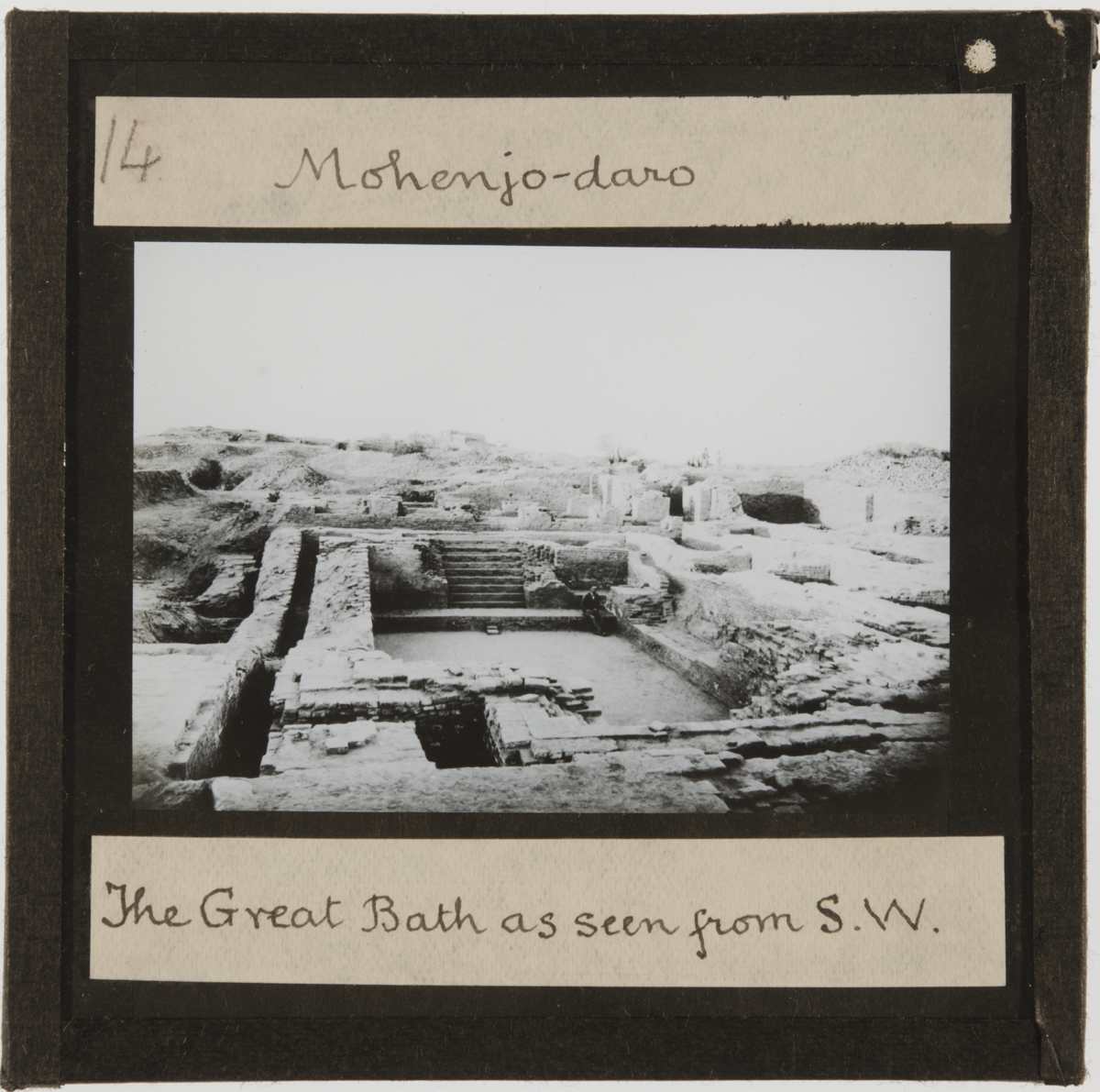
The great bath at Mohenjodaro.
The bath was discovered in 1925. A large rectangular tank measuring 12 x7 m and 2.4 m deep to which two flights of ten steps each led down, one flight at the northern end, and one at the southern end.
This photograph was clearly taken before excavations cleared the area shown in the published image (pl. VIII, 1931, LS.34539.HRG) which shows John Marshall sitting in one of the corners of the structure. Description from record P.15582.HRG, JD 29/05/2018]
Place
S Asia; Pakistan; Sind Province; Larkana District; Mohenjodaro
Cultural Affliation
Named Person
?John Marshall
Photographer
Archaeological Survey of India
Collector / Expedition
Hargreaves, Harold
Date
1925 - 1926
Collection Name
Hargreaves Collection
Source
Morton, Mary
Format
Lantern Slide Black & White
Primary Documentation
Other Information
LS.34498. HRG to LS.34505.HRG were in lantern slide box C245/2/ which was found inside a cardboard box now numbered C245/. The latter was previously numbered batch 163.
Publication: Published as plate VIII in Marshall 1931 and captioned "The Great Bath, as seen from the south-west." [SG 8/6/2004]
Bibliographical Reference: Recent interpretations for the structure (http://www.harappa.com/indus/8.html):
The "great bath" is without doubt the earliest public water tank in the ancient world. The tank itself measures approximately 12 meters north-south and 7 meters wide, with a maximum depth of 2.4 meters. Two wide staircases lead down into the tank from the north and south and small sockets at the edges of the stairs are thought to have held wooden planks or treads. At the foot of the stairs is a small ledge with a brick edging that extends the entire width of the pool. People coming down the stairs could move along this ledge without actually stepping into the pool itself.
The floor of the tank is water tight due to finely fitted bricks laid on edge with gypsum plaster and the side walls were constructed in a similar manner. To make the tank even more water tight, a thick layer of bitumen (natural tar) was laid along the sides of the tank and presumably also beneath the floor. Brick colonnades were discovered on the eastern, northern and southern edges. The preserved columns have stepped edges that may have held wooden screens or window frames. Two large doors lead into the complex from the south and other access was from the north and east. A series of rooms are located along the eastern edge of the building and in one room is a well that may have supplied some of the water needed to fill the tank. Rainwater also may have been collected for this purposes, but no inlet drains have been found.
Most scholars agree that this tank would have been used for special religious functions where water was used to purify and renew the well being of the bathers (J.M. Kenoyer). [SG 8/6/2004]
Collector / Expedition: These are lantern slides of the objects found in the excavations at Mohenjodaro and Harappa in the 1920s. [SG 8/6/2004]
This record was updated during research supported by Getty Grant Program One. [SG 8/6/2004]
FM:169189
Images (Click to view full size):