IDNO
N.26772.WHI
Description
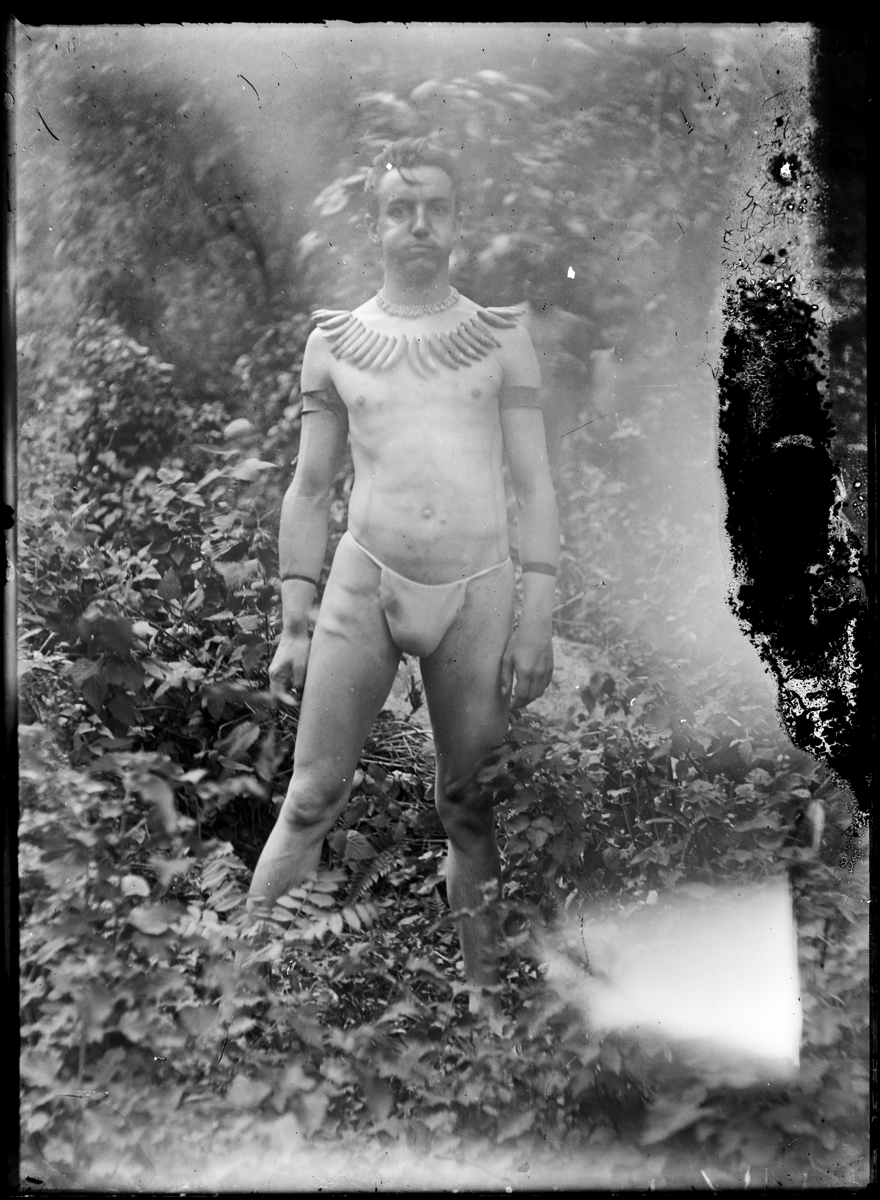
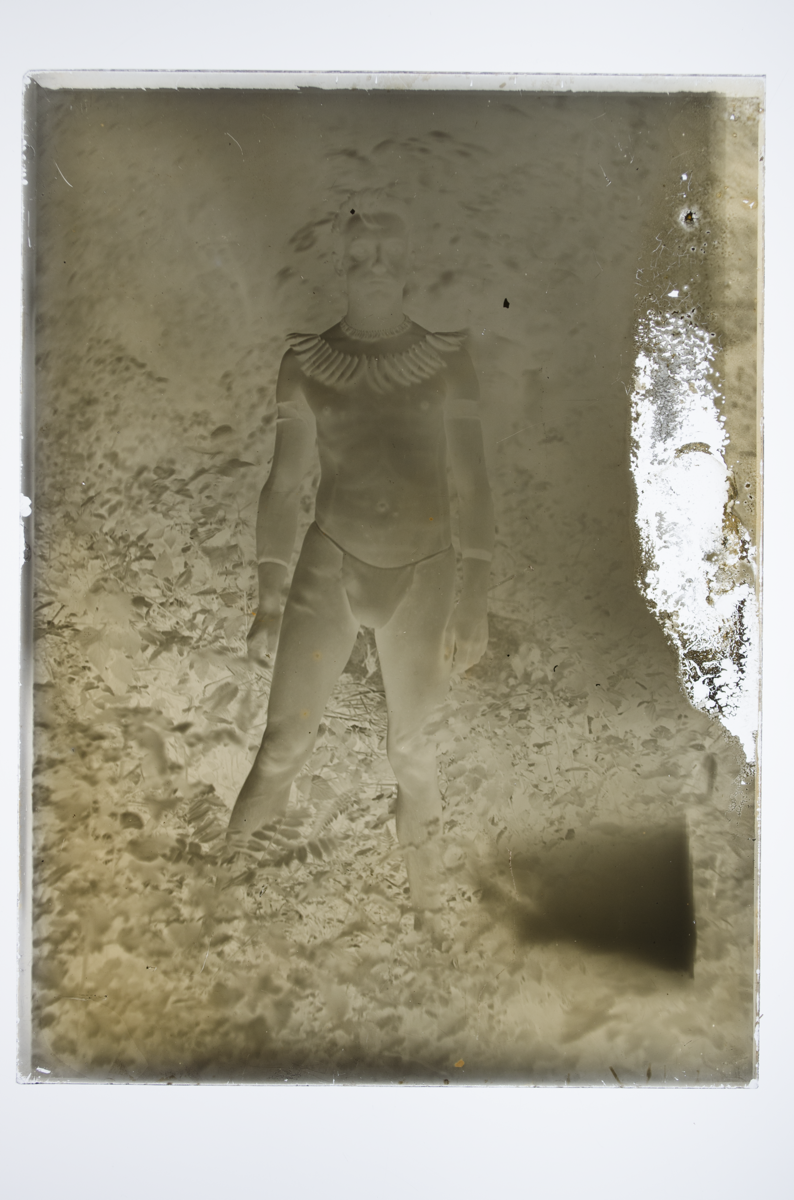
Full-length portrait of Thomas Whiffen dressed in a Witotoan, South American Indian, man’s clothing. He is wearing a jaguar teeth necklace and a second necklace of smaller animal teeth, upper-arm ligatures, wrist-ornaments, and a doh-hen (loin-cloth). Whiffen's cheeks are puffed up, possibly due to wads of stimulants? Whiffen is standing posing facing the camera amongst foliage.
Image effected by light-leak in camera on bottom right corner. [TC 09/06/1999, updated JD 21/10/2019]
Place
S America; Colombia; North West Amazon
Cultural Affliation
British; South American Indian; Witotoan
Named Person
Thomas William Whiffen
Photographer
None
Collector / Expedition
Whiffen, Thomas William
Date
1908 - 1909
Collection Name
Whiffen Collection
Source
Format
Glass Negative Halfplate
Primary Documentation
Other Information
Related Object: The Whiffen collection at MAA contains similar - perhaps the same - necklaces and ligatures. For example, see 1934.620 "Long necklace of teeth with incised patterns. The teeth are all Puma or jaguar canines, the largest are jaguar" currently on display in the Maudslay Gallery.
Also, for example, see 1934.602 "Narrow ligature with raised diamond pattern. Blackened." [TC 09/06/1999, updated JD 21/10/2019]
Bibliographical Reference: Whiffen explains that "the men wear little or nothing but what the Witoto call a moh-hen, that is, a strip of beaten bark-cloth carried from front to rear between the legs and tucked in at either end over a string or strap of bark-cloth bound about the waist" (Whiffen, T. W., 1915: 72). He informs us that "the Amazonian boy is first provided with a breech-cloth when he is five years old. His earliest lesson is in its manufacture, for every Indian fashions his own clothing" (ibid: 73). He then describes how the loin-cloth is manufactured and notes that it is never removed "in the sight of man or woman" and is buried with a man when he dies (ibid: 74). Steward notes that boys and men "wear a bark-cloth breech-clout after the age of five or six years (1963: 753). [TC 01/06/1999]
Bibliographical Reference: Whiffen describes the preparation and method of taking of stimulants (Whiffen 1915, pp.141-142). "By far the most important of the stimulants taken by
these peoples are the preparations made from the leaves of the common coca shrub. Coca is the mescal of the Indian, and possibly a heritance from the Inca invaders of bygone centuries. The use of coca is habitual, not intermittent. An Indian will take as much as two ounces a day. All Indians use it, the Bara in especial being heroic coca-takers ...
The Indian by means of a folded leaf shoots the powder into the cheeks on one or both sides. This when moistened forms a hard ball, and with such a wad stuffed between the cheek and the teeth he can go without sleep, food, or drink, for several days. Coca is not swallowed, but gradually absorbed and passed down with the saliva." [JD 21/10/2019]
The glass negatives in the Whiffen Collection were previously stored in two wooden trays numbered “Trays 105” on Shelf 3. Some of the glass negatives were found by the cataloguer in one of these trays, which was numbered C59/ by the cataloguer. The others were loose in piles on the shelf. An address label found in C59/ is addressed to a member of the Whiffen family and dated 1960. The label is now in the UCMAA archive, reference number W19/1/1. Each glass negative was stored, with duplicate glass negatives if any, in a museum archival bag. The bags containing images for which there is a corresponding mounted print in the Haddon Collection were marked with the original number of that print. A note by Gwil Owen which distinguished the printed and unprinted piles of glass negatives is now in the UCMAA archive, reference number W19/1/2. For full details see the Whiffen Collection record.
FM:161422
Images (Click to view full size):