IDNO
LS.26757.WHI
Description
On catalogue card: "N.W. Amazon. 175.73 - 76.
(Tribes not identified)
4 groups.
(4 slides)."
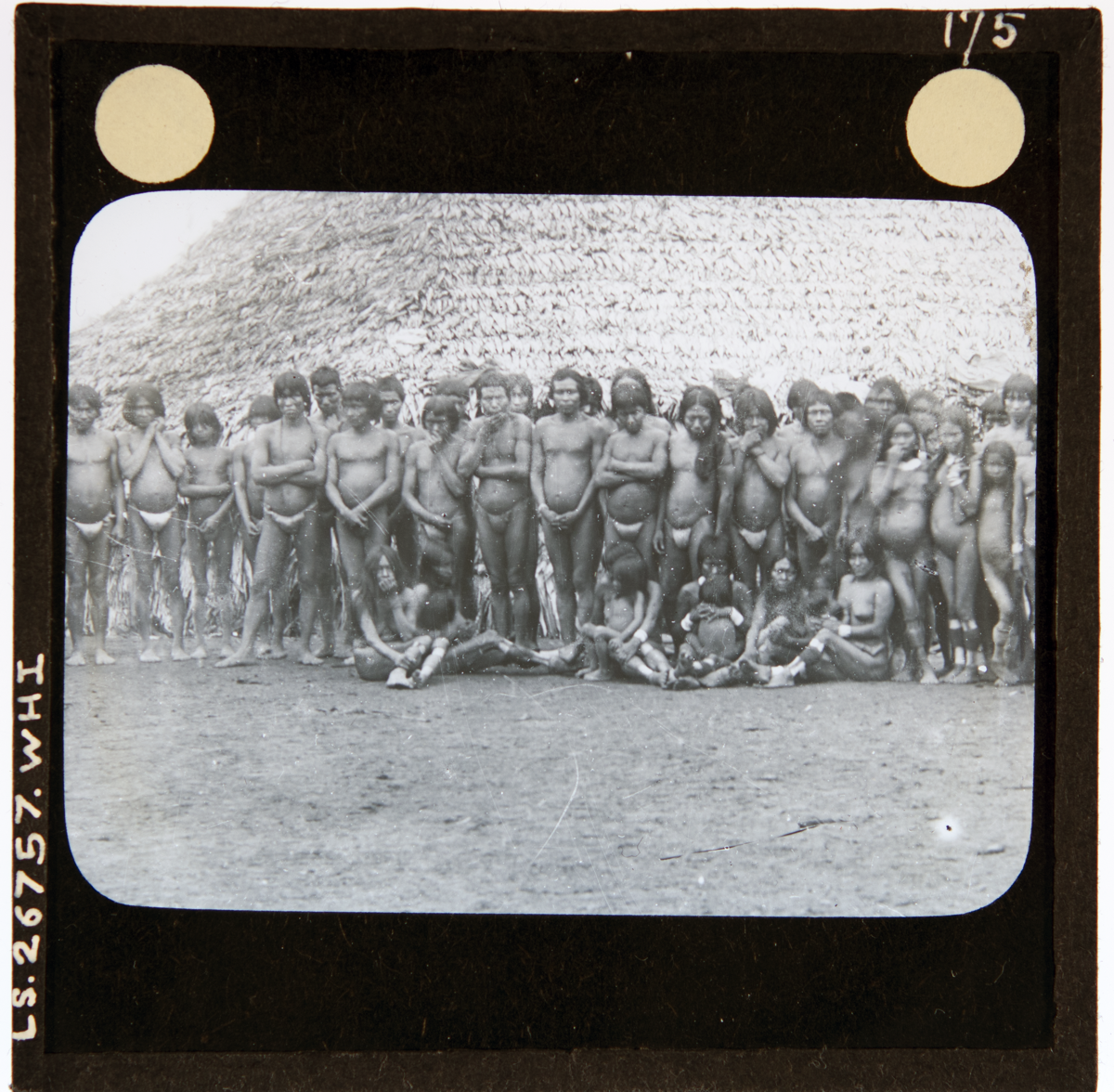
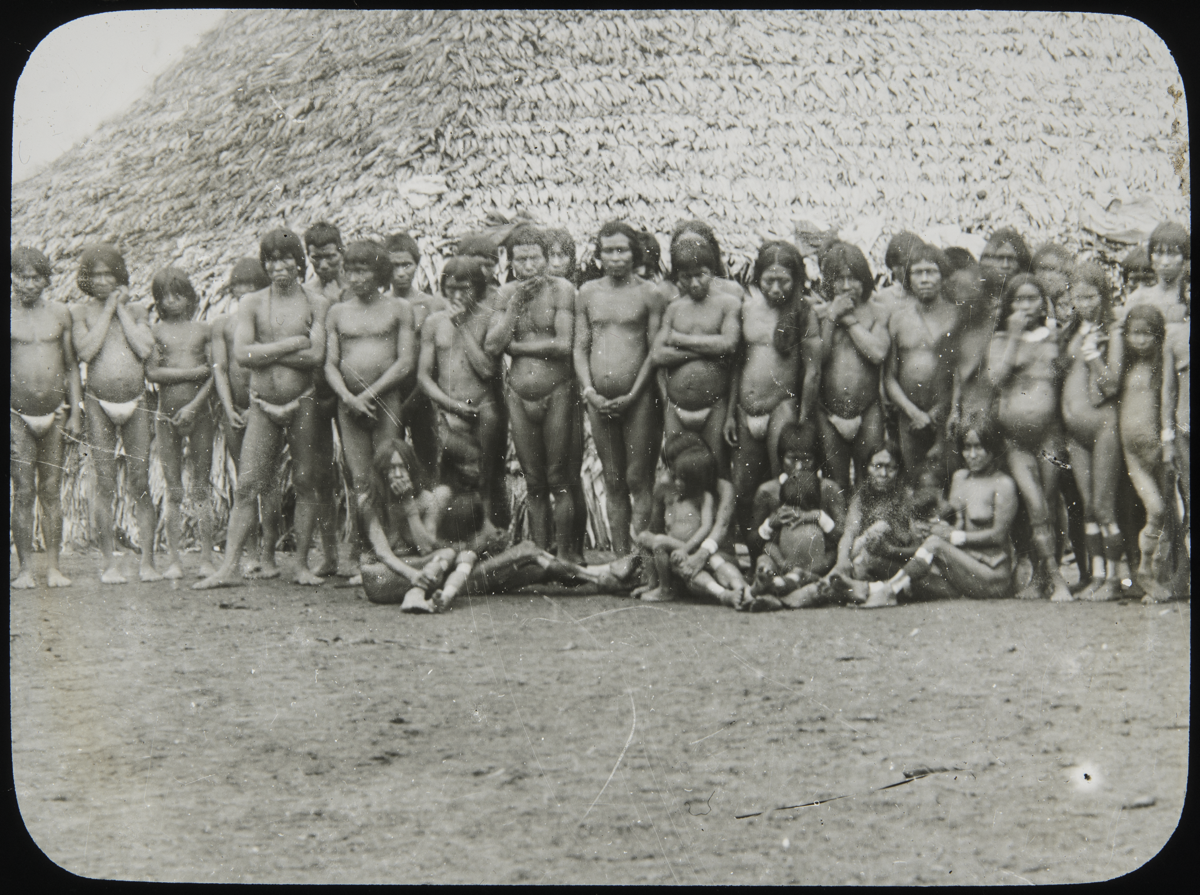
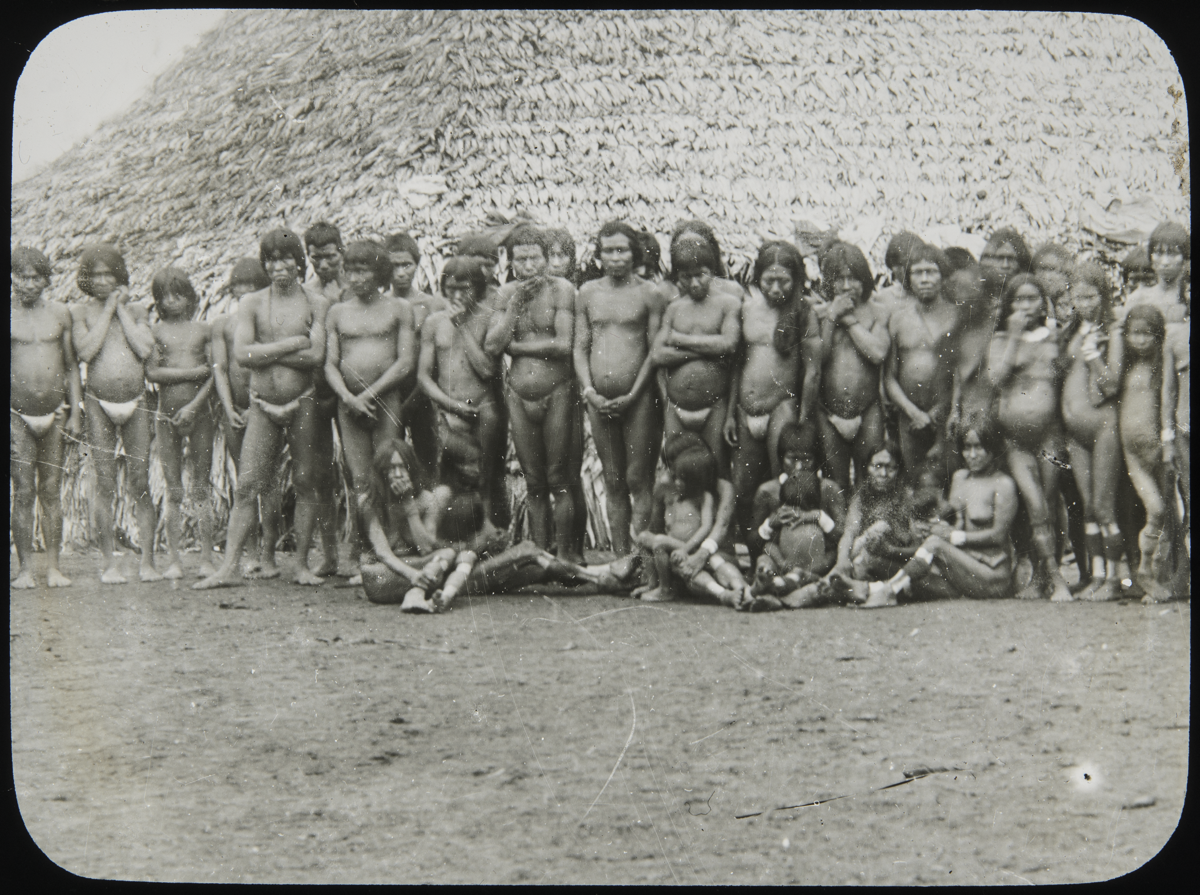
A portrait of large group of Resigero standing and sitting in front of a malokas (Indian communal house). The men, wearing moh-hen (loin-cloths) are mostly standing, with a small group of women and children sitting in front and standing at right. The women are wearing personal ornaments including leg and ankle ligatures, neck-ornaments and wrist-ornaments. Five of the seated women, and some of the women standing, are holding young children. [TC 09/06/1999, updated JD 23/10/2019]
Place
S America; Colombia; North West Amazon
Cultural Affliation
South American Indian; Witotoan; Resigero [Rosigaro; Ressigaro; Ricigaro; Rrahanihin; Mehinaku]
Named Person
Photographer
Whiffen, Thomas William
Collector / Expedition
Date
1908 - 1909
Collection Name
Whiffen CollectionTeaching Slide Collection
Source
Whiffen, Nöel H.
Format
Lantern Slide Black & White
Primary Documentation
Other Information
Related Image: A duplicate print is at the RAI, reference 36185, and annotated by Whiffen in pencil on the reverse as "Resigero."
Photocopies of Whiffen prints at the RAI are in the UCMAA archive, reference W19/1/3. See Whiffen Collection record for further details on RAI collection. [JD 02/10/2019]
Bibliography Reference: Whiffen discusses Indian communal houses (malokas) at length (Whiffen, T. W., 1915: 40-48). He notes that in the homestead "there is but one great house, thatched and ridge-roofed like a gigantic hay-rick ... this is the home of some three score Indians" in which "there are no divisions for each family" (ibid: 40). He notes that the house is a temporary dwelling which falls into disrepair and is burnt every two to three years, at which point the inhabitants move to new location (ibid: 41-42). He then discusses how the site is chosen and the building constructed (ibid: 42-44). He notes that "the far end of the house - where there is usually another small entrance - is the portion reserved for the chief and his family" (ibid: 46) and that "each family has its own fire" (ibid: 47), with their hammocks slung around it and possessions slung in the rafters above. He explains that "at ordinary times there will be possibly from fifty to sixty people in the tribal house, but on the occasion of any festivity as many as two hundred will crowd in" (ibid: 48). He also provides plans and diagrams of the house (ibid: 41, 43, 45,46) and an illustration of the type of palm used for thatching (ibid: pl. VI). Menimehe houses, he notes, are "more open" than those of other groups (ibid: 51). [TC 01/06/199]
Bibliography Reference: Steward also discusses Witotoan villages and houses, explaining that "the typical Witotoan community consists of a single large multifamily house, though some villages have several large houses" and that these are built on "a dry site ... some distance from the river" (1963: 752). Plate 81 depicts a "Witoto communal house" similar to those depicted in the Whiffen Collection photographs. Steward notes that "the sociopolitical unit is the exogamous, patrilocal community which usually occupies a single large house and is divided into family groups. Local exogamy seems to prevail even when the community has several houses" (ibid: 755). Steward and Faron (1959: 314) also discusses Witotoan houses. More recent analyses, such as that by Hugh-Jones on Barasana cosmology, demonstrate that the Indian house can be interpreted structurally as a significant metaphorical representation of the cosmos, myth and society (Hugh-Jones.S. 1979). [TC 01/06/199]
Source: In MAA Correspondence Box 1934 is a letter from Noel Whiffen donating his "brother's collection of lantern slides" to the museum, on behalf of the Whiffen family. Louis Clarke replied. The gift is also noted in the annual report for that year in the list of accessions (UCMAA 1934: 3), which mentions that "the collection of lantern slides has also been increased by gifts from ... Mr N. H. Whiffen ... "
For full details see Whiffen Collection record. [TC 09/06/1999, updated, JD 02/10/2019]
FM:161407
Images (Click to view full size):