IDNO
LS.26745.WHI
Description
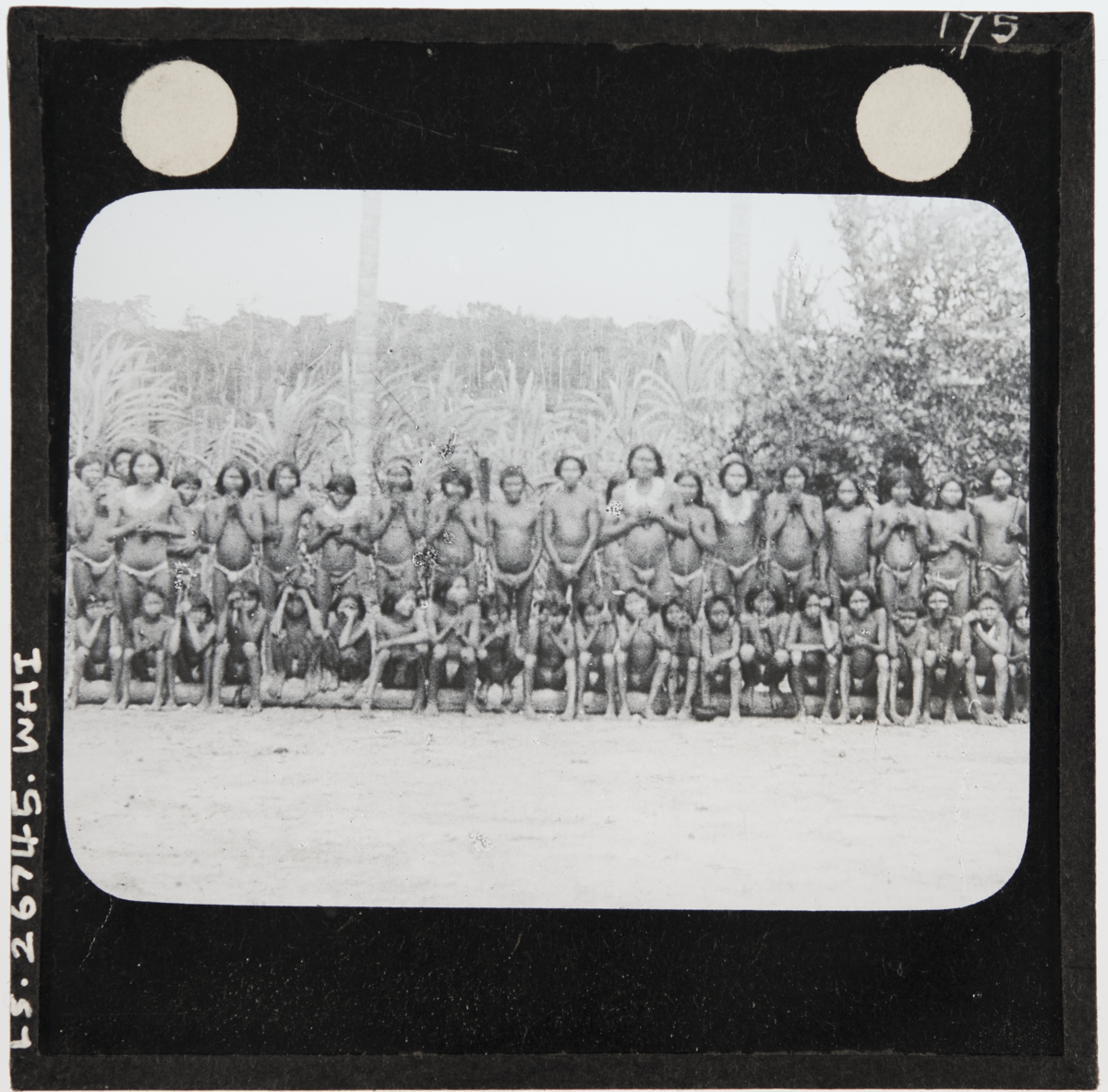
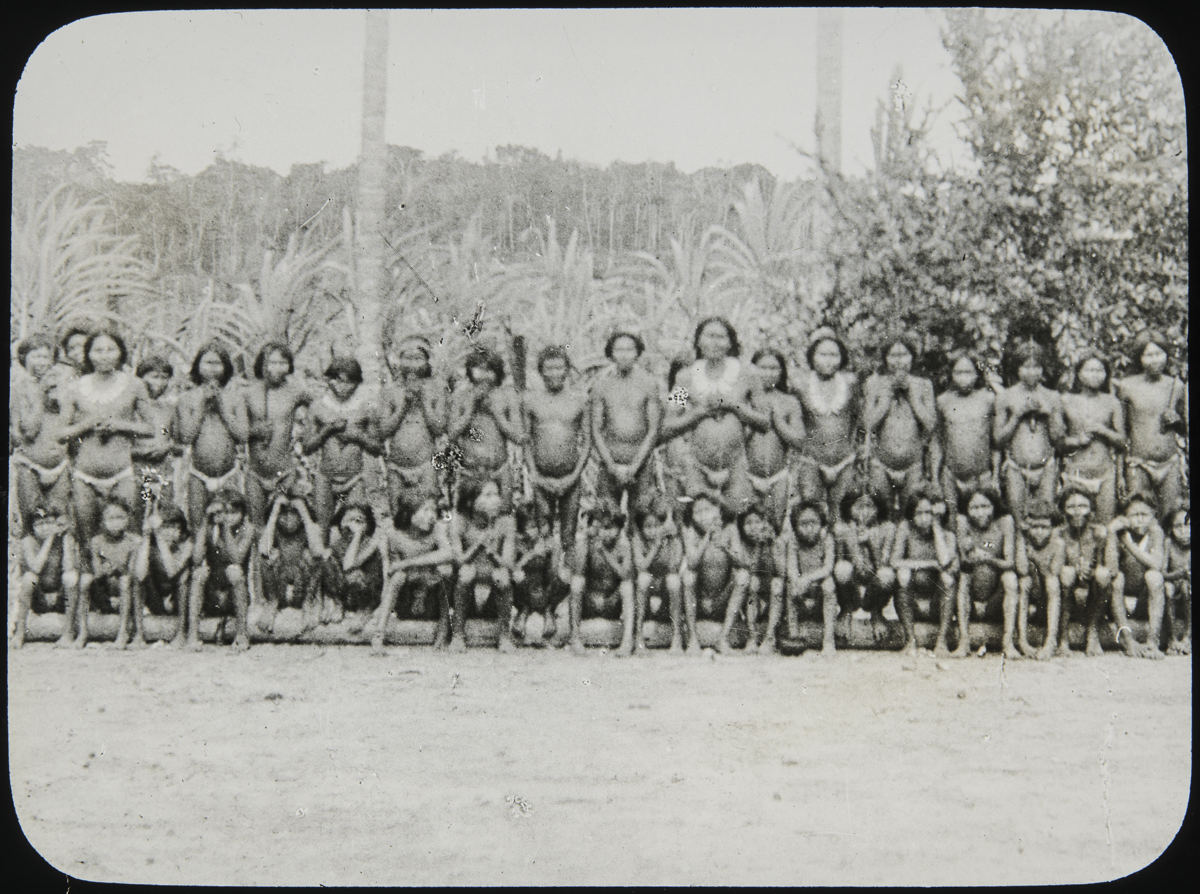
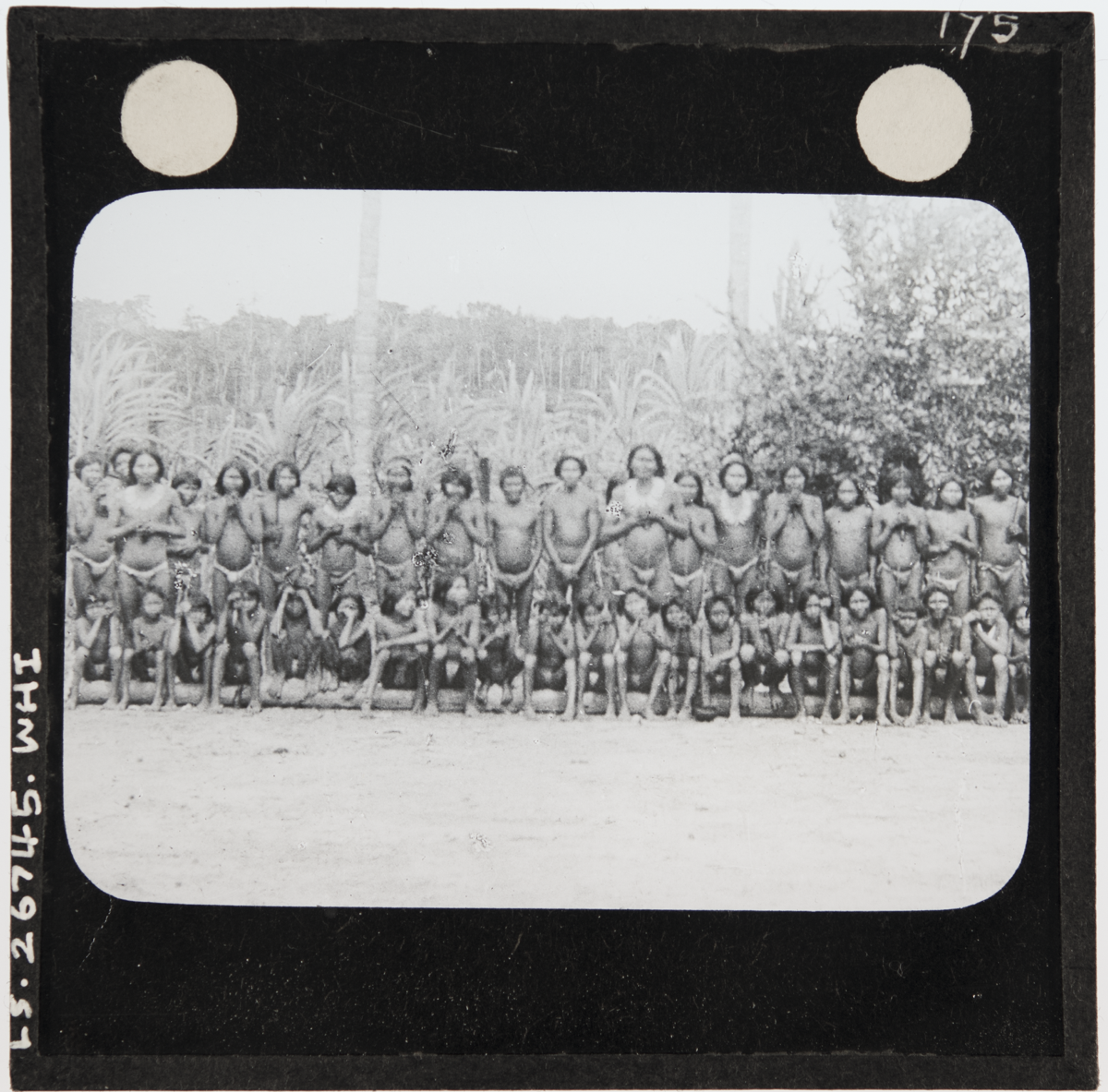
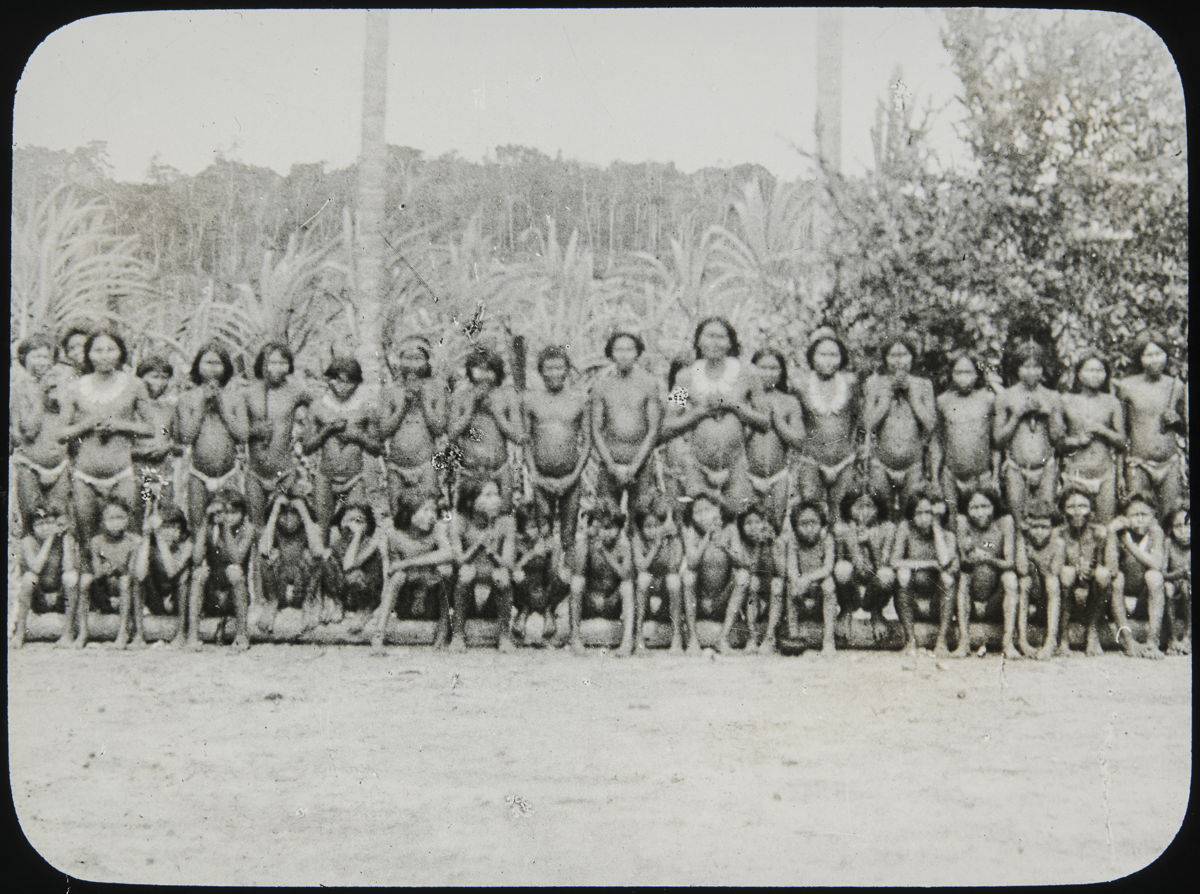
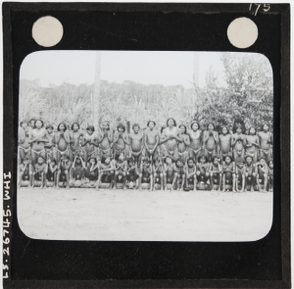
On catalogue card: "N.W. Amazon. 175.62, 63.
Group of Witoto men, by double-stemmed palm tree.
- Group of Witoto women.
(2 slides)."
On Catalogue Card for duplicate print P.9264.ACH1: "Group of Witoto men by double stemmed palm tree."
A large group portrait of approximately sixty-three Witoto men and boys in two rows, with the men in the back row standing and the boys in the front row seated. All are wearing doh-hen (loin-cloths) and several of the men standing are wearing jaguar? teeth necklaces. The group is posing for the camera in front of a 'respected and prized' double-stemmed palm tree, with other trees in the background. [TC 09/06/1999, updated JD 02/10/2019]
Place
S America; Colombia; North West Amazon
Cultural Affliation
South American Indian; Witotoan; Witoto [Huitoto; Uitoto; Ouitoto; Fitita; Guitoto; Hitote; Huitata; Huito; Huitato; Huitota; Komiuvedu; Komiovedu; Murui-Muinane]
Named Person
Photographer
Whiffen, Thomas William
Collector / Expedition
Date
1908 - 1909
Collection Name
Whiffen CollectionTeaching Slide Collection
Source
Whiffen, Nöel H.
Format
Lantern Slide Black & White
Primary Documentation
Other Information
Publication: Reproduced in Whiffen, T. W., 1915 as Pl. L with the caption "Group of Witoto men by double-stemmed palm tree". The lantern slide is a detail of the image in the book, which extends further horizontally and vertically, to include more figures on the left and right and a double-stemmed palm-tree on the left.
Related Image: A duplicate print is at the RAI, reference 36174, and annotated by Whiffen in pencil on the reverse as "Witoto."
Photocopies of Whiffen prints at the RAI are in the UCMAA archive, reference W19/1/3. See Whiffen Collection record for further details on RAI collection. [TC 09/06/1999, updated JD 02/10/2019]
Bibliographical Reference: In discussing "the attitude of the Indian towards the abnormal" (Whiffen 1915, p.233), Whiffen relates how "a certain Witoto tribe have a tree that they regard as an object almost of veneration. This palm, as may be seen in the photographs, has a forked stem, the trunk dividing into two some few feet above the ground. I met with no more formulated sign of tree-worship than this ... though they did not worship ... the Witoto looked upon this tree as a thing to be respected, prized, and if it were not meted proper treatment perchance to be feared." [TC 09/06/1999]
Bibliographical Reference: Whiffen notes (1915, pp.81-81) "The necklaces are matters of importance, for they disclose the status of the wearers. The skill of a warrior as a hunter, his bravery in war, is proved by the character of the teeth that drde his neck : the more successful the hunter the finer the teeth he wears, the more numerous the adornments of his family ... a man wears only the teeth of foes or game that he himself has killed, and at his death they will be buried with him, unless he fall at the hands of a foe, and his string of teeth go to swell the spoils of the victor ... Other teeth are spaced out with discs, some made of bone, others of shell obtained from river mussels, or even with knots in the fibre thread ... The handsome jaguar tooth necklace loses some of its artistic values in a black-and-white reproduction, which inevitably cannot do justice to the creamy ivory, shading to rich browns, of the teeth, makmg effective show against the red and blue of the beads, the dull colourlessness of the pieces of bone. Some of the teeth have a very primitive criss-cross grooving scratched on the fang end, others have a more elaborate attempt at a carved design. Each design differs, but the same idea of involuted curves is traceable in all." [JD 21/10/2019]
Bibliographical Reference: Whiffen explains that "the men wear little or nothing but what the Witoto call a moh-hen, that is, a strip of beaten bark-cloth carried from front to rear between the legs and tucked in at either end over a string or strap of bark-cloth bound about the waist" (Whiffen 1915, p.72). He informs us that "the Amazonian boy is first provided with a breech-cloth when he is five years old. His earliest lesson is in its manufacture, for every Indian fashions his own clothing" (Whiffen 1915, p.73). He then describes how the loin-cloth is manufactured and notes that it is never removed "in the sight of man or woman" and is buried with a man when he dies (Whiief 1915, p.74). Steward notes that boys and men "wear a bark-cloth breech-clout after the age of five or six years (1963: 753). [TC 01/06/1999]
Source: In MAA Correspondence Box 1934 is a letter from Noel Whiffen donating his "brother's collection of lantern slides" to the museum, on behalf of the Whiffen family. Louis Clarke replied. The gift is also noted in the annual report for that year in the list of accessions (UCMAA 1934: 3), which mentions that "the collection of lantern slides has also been increased by gifts from ... Mr N. H. Whiffen ... "
For full details see Whiffen Collection record. [TC 09/06/1999, updated, JD 02/10/2019]
FM:161395
Images (Click to view full size):