IDNO
LS.26735.WHI
Description
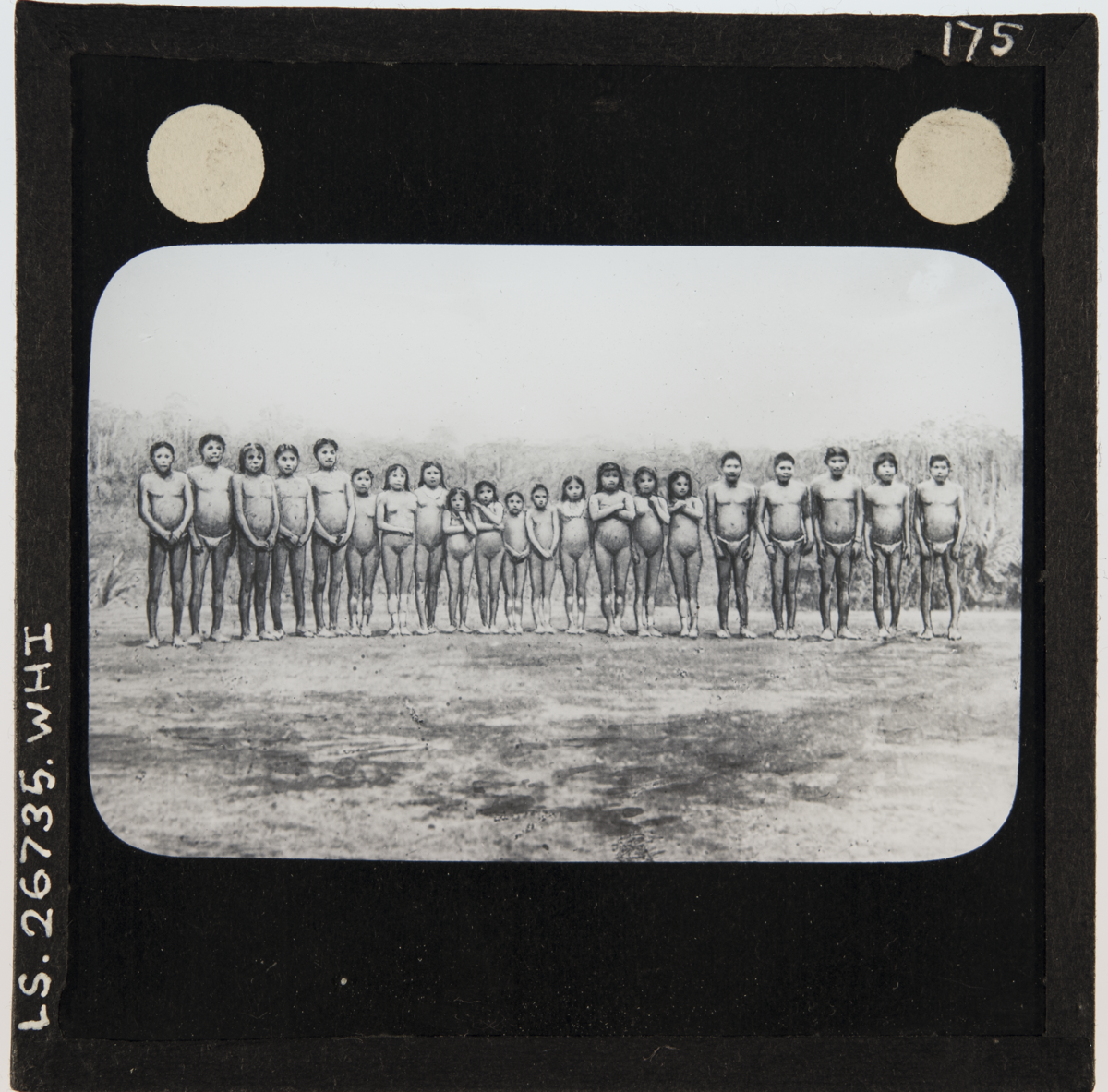
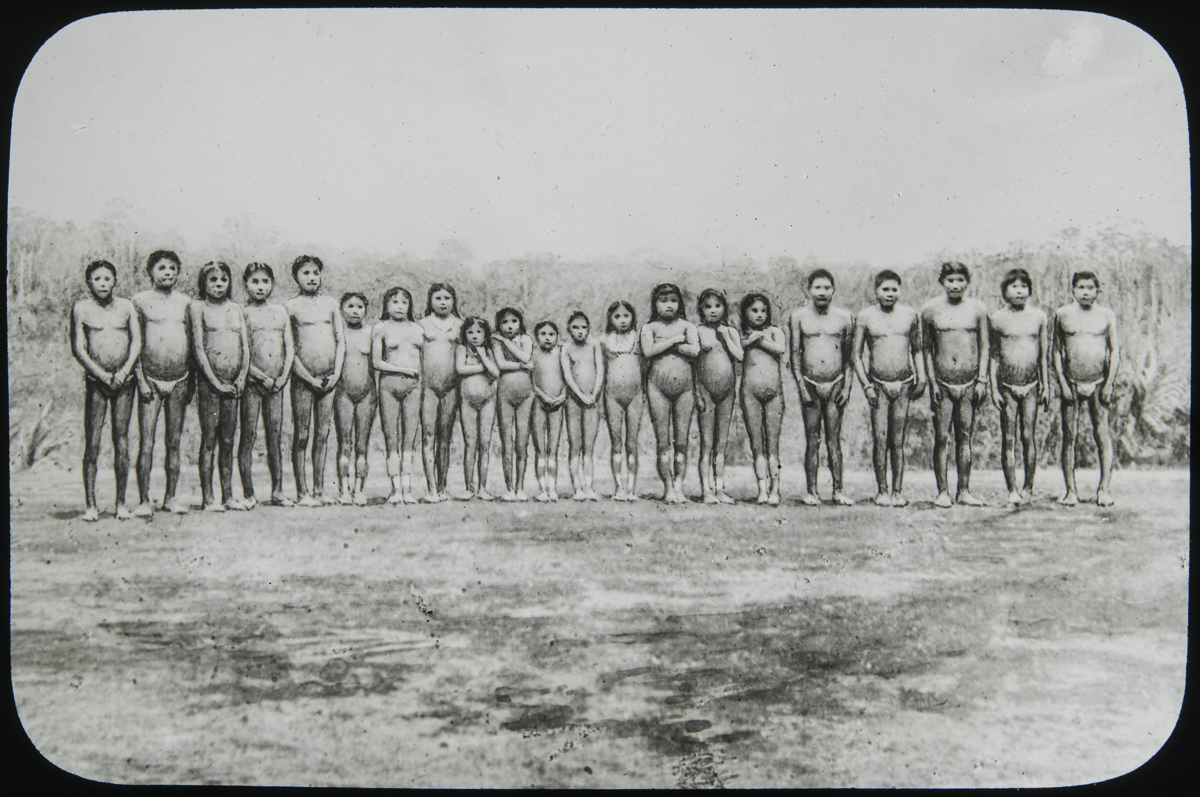
On catalogue card: "N.W. Amazon. 175.50.
Nonuya - Group of men & women."
On Catalogue Card for duplicate print P.9293.ACH1: "Group of Nonuya men and women".
A group portrait of Nonuya men, women, and children standing in a line outdoors. The men, standing to the left and right, are wearing moh-hen (loin-cloths). The women, standing towards the centre, are wearing leg and ankle ligatures and some are wearing necklaces. Five children are standing in the centre.
The image has been heavily overdrawn to provide details to the group. [TC 01/06/1999, updated JD 02/10/2019]
Place
S America; Colombia; North West Amazon
Cultural Affliation
South American Indian; Witotoan; Nonuya [Achote; Achiote; Nanuya]
Named Person
Photographer
Whiffen, Thomas William
Collector / Expedition
Date
1908 - 1909
Collection Name
Whiffen CollectionTeaching Slide Collection
Source
Whiffen, Nöel H.
Format
Lantern Slide Black & White
Primary Documentation
Other Information
Publication: Reproduced in Whiffen, T. W., 1915 as Pl. XLV with the caption "Group of Nonuya, men and women". [TC 09/06/1999]
Related Image: A duplicate print is at the RAI, reference 36140, and annotated by Whiffen in pencil on the reverse as "Nunya (enlargement)."
Photocopies of Whiffen prints at the RAI are now in the UCMAA archive, reference W19/1/3. See Whiffen Collection record for further details on RAI collection. [JD 02/10/2019]
Bibliographical Reference: Whiffen explains that "the men wear little or nothing but what the Witoto call a moh-hen, that is, a strip of beaten bark-cloth carried from front to rear between the legs and tucked in at either end over a string or strap of bark-cloth bound about the waist" (Whiffen, T. W., 1915: 72). He informs us that "the Amazonian boy is first provided with a breech-cloth when he is five years old. His earliest lesson is in its manufacture, for every Indian fashions his own clothing" (ibid: 73). He then describes how the loin-cloth is manufactured and notes that it is never removed "in the sight of man or woman" and is buried with a man when he dies (ibid: 74). Steward notes that boys and men "wear a bark-cloth breech-clout after the age of five or six years (1963: 753). [TC 01/06/1999]
Source: In MAA Correspondence Box 1934 is a letter from Noel Whiffen donating his "brother's collection of lantern slides" to the museum, on behalf of the Whiffen family. Louis Clarke replied. The gift is also noted in the annual report for that year in the list of accessions (UCMAA 1934: 3), which mentions that "the collection of lantern slides has also been increased by gifts from ... Mr N. H. Whiffen ... "
For full details see Whiffen Collection record. [TC 09/06/1999, updated, JD 02/10/2019]
FM:161385
Images (Click to view full size):