IDNO
LS.26731.WHI
Description
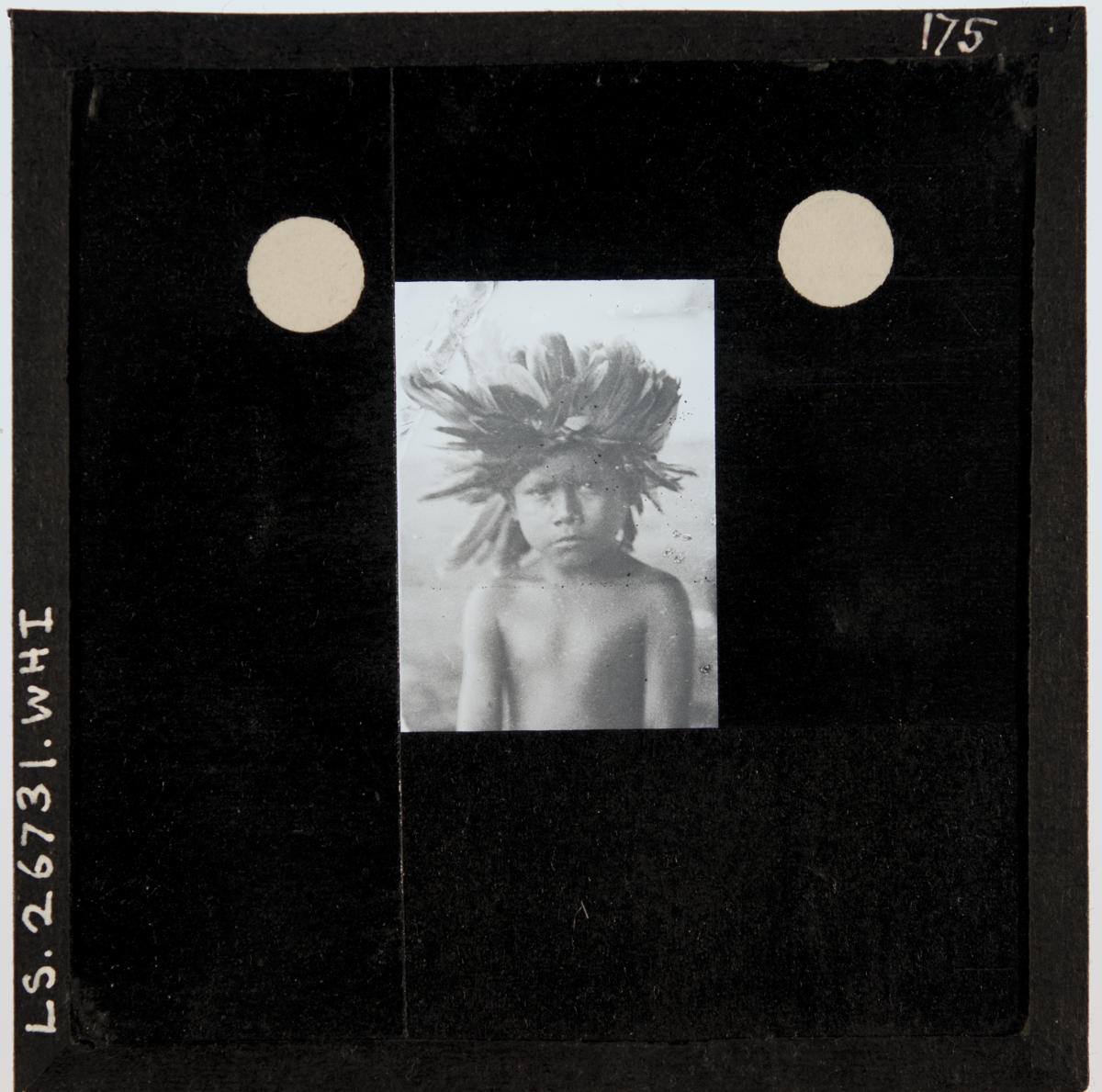
On catalogue card: "N.W. Amazon. 175.44.
Muenane Chief’s son, wearing feather head-dress."
On Catalogue Card for duplicate print P.9275.ACH1: "Chief’s son, wearing feather Headress, Muenane."
A half-length portrait of young Muenane boy, annotated as being a 'Chief's son'. He is wearing a large feather headdress, and sitting facing the camera.
The portrait is a detail made from a group portrait, which also includes two women and two children, all wearing European-style clothing. See N.26839.WHI and P.100404.WHI. [TC 09/06/1999, updated JD 02/10/2019]
Place
S America; Colombia; North West Amazon
Cultural Affliation
South American Indian; Witotoan; Muenane [Muinane; Muename; Muinana; Muinani; Moenane; Menekateno]
Named Person
Photographer
Whiffen, Thomas William
Collector / Expedition
Date
1908 - 1909
Collection Name
Whiffen CollectionTeaching Slide Collection
Source
Whiffen, Nöel H.
Format
Lantern Slide Black & White
Primary Documentation
Other Information
Publication: Reproduced in Whiffen, T. W., 1915 as inset to Pl. XIII, with the caption "Chief’s son wearing feather head-dress". [TC 09/06/1999]
Related Image: For details of full image from which this detail is made, see N.26839.WHI record. [TC 09/06/1999]
Related Image: A duplicate print is at the RAI, reference 36181, and annotated by Whiffen in pencil on the reverse as "Chief's Son, Muenane."
Photocopies of Whiffen prints at the RAI are in the UCMAA archive, reference W19/1/3. See Whiffen Collection record for further details on RAI collection. [TC 09/06/1999, updated JD 02/10/2019]
Bibliographical Reference: Whiffen discusses feather ornaments, which are donned especially for dances, and their construction (Whiffen, T. W., 1915: 75-77). He notes that in the Issa-Japura region, "whatever they can get in the way of gay plumage, feathers of the parrot, the macaw, or the toucan ... be the colour what it may, is employed indiscriminately". He continues, "the chief's head-dress is more lavish than those of his warriors. The only boy I ever saw wearing one was the young son of a chief. Women do not wear feather head-dresses ..." (ibid: 76).
It may be presumed that he is referring to the boy in this photograph. This is the only photograph in the Whiffen Collection in which a feather head-dress is worn and he explains that "they will never part with them, as they are communal, not personal, possessions, and I found they objected extremely to any attempt I made to photograph them when wearing their dancing feathers" (ibid: 77). Evidently, this head-dress is being worn in unusual circumstances, by a young boy in a setting which appears to be a rubber-station. The boy would have probably been destined to become a chief, as Whiffen explains that "on the death of a chief his successor must be elected by the tribe, and though the son as a rule is appointed, he does not become the chief as a matter of course" (ibid: 65). When a chief dies his head-dress and other ornaments are buried with him, and "the new chief comes forward ... wearing a weird and wonderful head-dress, to attract attention" (ibid: 176). [TC 09/06/1999]
Source: In MAA Correspondence Box 1934 is a letter from Noel Whiffen donating his "brother's collection of lantern slides" to the museum, on behalf of the Whiffen family. Louis Clarke replied. The gift is also noted in the annual report for that year in the list of accessions (UCMAA 1934: 3), which mentions that "the collection of lantern slides has also been increased by gifts from ... Mr N. H. Whiffen ... "
For full details see Whiffen Collection record. [TC 09/06/1999, updated, JD 02/10/2019]
MAA Exhibition: Lanternslide was displayed in Collected Sights in the section Visual Agency with the descriptive label:
"Lantern slide of the Muenane boy highlighted in the glass negative. The image appears as an inset in Whiffen’s book The North-West Amazons with the caption ‘Chief’s son wearing feather head-dress." [Sudeshna Guha 26/11/02]
FM:161381
Images (Click to view full size):