IDNO
LS.26718.WHI
Description
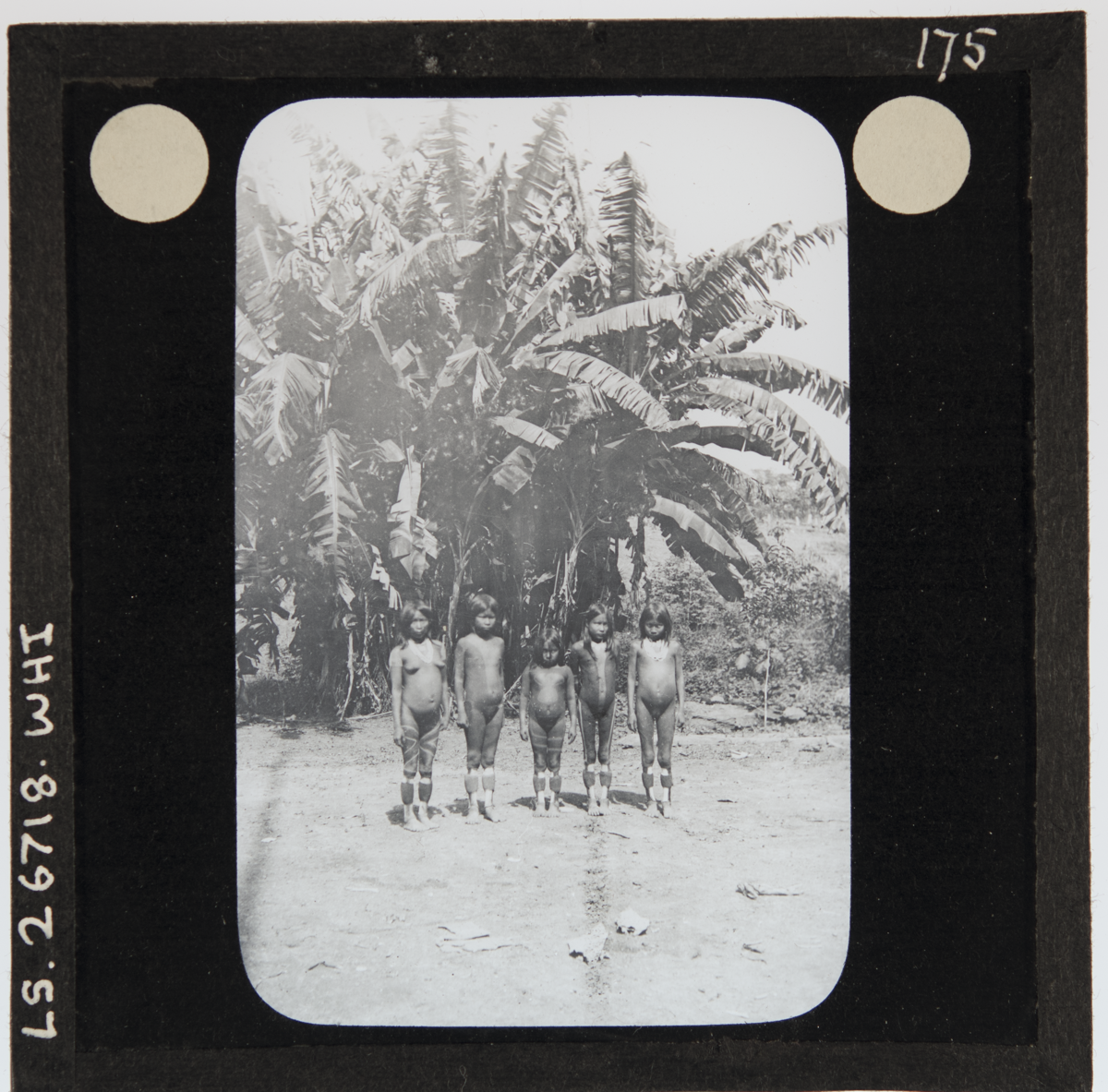
On catalogue card: "N.W. Amazon. 175.24.
S. Andoke girls."
Group portrait of five Andoke girls standing outdoors and facing the camera. The girls are wearing body-paint on their thighs, arms and torsos and ligatures on their calves and ankles. Three are wearing necklaces of beads and discs. Palm-trees in background. [TC 09/06/1999, updated JD 01/10/2019]
Place
S America; Colombia; North West Amazon
Cultural Affliation
South American Indian; Witotoan; Andoke [Andoque; Andaqui; Andaki; Paasiaha]
Named Person
Photographer
Whiffen, Thomas William
Collector / Expedition
Date
1908 - 1909
Collection Name
Whiffen CollectionTeaching Slide Collection
Source
Whiffen, Nöel H.
Format
Lantern Slide Black & White
Primary Documentation
Other Information
Reproduced in Whiffen, T. W. 1915 as Pl. XXI with the caption "Andoke girls".Publication: Reproduced in Whiffen, T. W. 1915 as Pl. XXI with the caption "Andoke girls".
Related Image: A duplicate print is at the RAI, reference 36170, and annotated by Whiffen in pencil on the reverse as "Andoke."
Photocopies of Whiffen prints at the RAI are in the UCMAA archive, reference W19/1/3. See Whiffen Collection record for further details on RAI collection. [TC 09/06/1999, updated JD 02/10/2019]
Bibliography Reference: The discs on the women's necklaces are probably coins. Whiffen explains that "smelting, or any description of metallurgy, cannot be looked for among the inhabitants of a country so singularly devoid of all metalliferous deposit or formation ... their only method of working metal when obtained is to heat and hammer it into various forms and shapes for ornaments" (Whiffen, T. W., 1915: 93-94). He states that "the pendants ... are mostly coins, depreciated Chilean dollars as a rule ... either given to the wearers by me or had filtered through from the Rubber Belt; a few ... through the medium of intertribal barter". He notes that "they are always the most rare and cherished possessions" (ibid: 80-81). [TC 01/06/1999]
Bibliography Reference: Whiffen discusses body-painting in the region (Whiffen, T. W., 1915: 87-89), noting that "if none tatoo, all paint". In a discussion of "the arts" (ibid: 91) he declares that "these people have no great use for colour and line beyond the ornamentation of their bodies". He goes on to describe the favourite colours of different groups - "as a rule the colours are red, yellow and black" and informs us of the different plants and minerals from which the pigments are obtained. He states that "a bright red, the commonest paint of all, is made from a prickly burr, or nut, that is for of seeds and red matter" (ibid: 87). He explains that "the women always paint themselves for a dance, and dances are so frequent that before the coat of paint is worn away another festivity will be in prospect, and fresh decorations have to be considered. They also paint on other occasions than a dance" (ibid: 88). He describes some of the designs (ibid: 88-89), noting that some Andoke designs are intended to be representational but among other groups vary in degrees of regularity. On gender, he notes that "the men are painted by their women before a dance, but never in the intricate patterns and variety of colour" (ibid: 89) used by the women, and that "painting is not a universal custom among the men as with the women". He notes, however, that a man is painted for a dance by his wife (ibid: 161). He also informs us that girls "learn to dance, to sing, and to paint themselves for festivals" at "secret lodges in the bush" (ibid: 157). He describes young women painting themselves for a dance, as they "squat in chattering crowds over the calabashes of vegetable dye, white, scarlet, black, or purple, with which they trace upon each other the cunning patterns ... " (ibid: 192). [TC 01/06/1999]
Context: In other Amazonian cultures, body-paints have a significance which goes beyond decoration. Guss, for example, discusses body-painting in relation to the Yekuana of the Venezuelan rain forest. In myth, a culture hero derives body-paints from "sacred trees ... brought to Earth specifically for this purpose" (Guss.D.M. 1989: 57) and "it is body paint, more than any other single object, which ... distinguishes the civilized from the wild" (ibid: 63). Body-paint marks the introduction of a newborn child, or the re-introduction of a young woman at menarche, into society (ibid: 65). Body-paints may also mark distinctions between groups of people - when the "First People left the Earth to turn into birds, it was their body paint that became the colourful markings distinguishing each species" (ibid: 65). In addition, the strength of a herbal medicine can be "enhanced by combining it with one of several paints which is then applied to the body" (ibid: 63). Whiffen does not mention the significance of body-paint beyond its decorative purpose. However, it seems unlikely that such significances do not exist, particularly as he notes that older women who assist young mothers at childbirth "have their faces painted red" (Whiffen, T. W., 1915: 149). [TC 01/06/1999]
Bibliography Reference: Witotoan body-painting is also mentioned by Steward (1963: 753, 758). Plates 85-88 depict people wearing body-paint very similar to that depicted in the Whiffen Collection photographs. Photographs in Steward and Faron's book also depict similar body-painting (1959: 354). [TC 01/06/1999]
Source: In MAA Correspondence Box 1934 is a letter from Noel Whiffen donating his "brother's collection of lantern slides" to the museum, on behalf of the Whiffen family. Louis Clarke replied. The gift is also noted in the annual report for that year in the list of accessions (UCMAA 1934: 3), which mentions that "the collection of lantern slides has also been increased by gifts from ... Mr N. H. Whiffen ... "
For full details see Whiffen Collection record. [TC 09/06/1999, updated, JD 02/10/2019]
FM:161368
Images (Click to view full size):