IDNO
N.13207.GIJ
Description
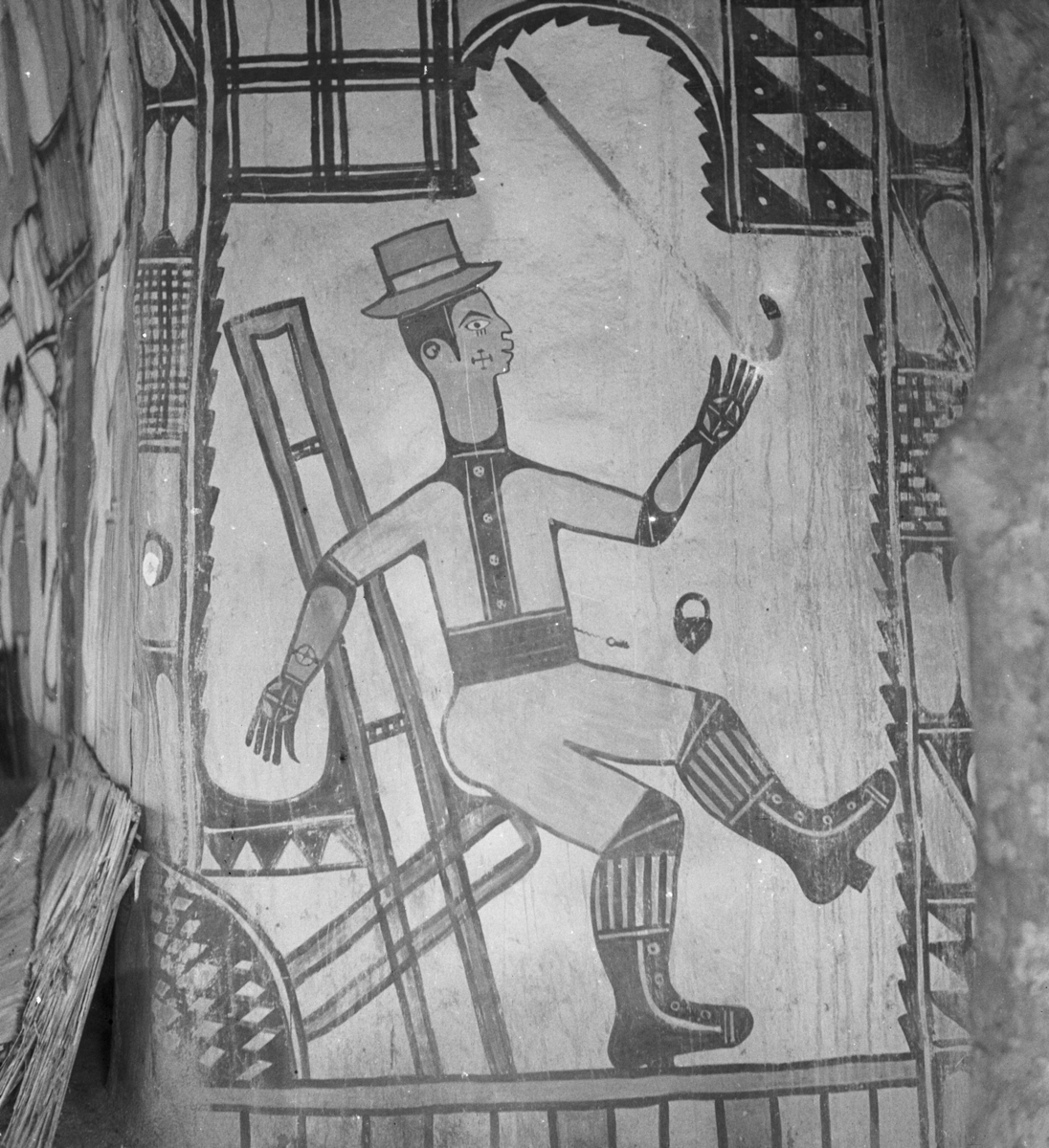
Close up photograph of wall painting in Okwu village painted by an Anang artist in the style of Ngwomo ghost houses. The wall painting depicts a figure (policeman?)perched on a ladder with his hand and leg raised. He is dressed in European style clothing which consists of white trousers, shirt and a hat. Geometric designs surround the figure.
Place
W Africa; Nigeria; South Eastern Nigeria; ?southern Cross River Area; ?Umuajatta village; ?Okwu village
Cultural Affliation
Igbo [historically Ibo]
Named Person
Photographer
Jones, Gwilliam Iwan (known as G.I.)
Collector / Expedition
Date
1932 - 1938
Collection Name
Jones Collection
Source
Jones, Gwilliam Iwan (known as G.I.)
Format
Film Negative Black & White
Primary Documentation
Other Information
This negative was kept in a film storage album labelled “IBIBIO & OKWU WALL” by G. I. Jones, and numbered “C12/” by the cataloguer.
Publication: Similar image in Cole and Aniakor, 1984, p.85, Figures 154 with the caption, “Painted wall in Okwu Olokoro”; Figure 155 with the caption, “Several scenes from the Olokoro wall, 1966.
Context: Jones writes about the meeting houses and the wall decorations he photographed in the 1930s. “The village of Umuajatta (Olokoro) contributed together to build the finest Ekpe (Egbo) society house of the area. The design was new and consisted of an ovoid outer wall surmounted by a very tall raffia mat roof. To beautify this wall they hired and Anang (Ibibio) artist to paint frescoes on it in the Ngwomo style. The house and particularly the frescoes were greatly admired locally and this inspired the people of Okwu village to replace their Mbaja wall with a permanent one decorated in the same manner. This village was already distinguished from other villages in the tribe by having a solid mud wall which they called Mbaja and which was regarded as a kind of public monument. The Old Mbaja had long since fallen down and the people decided to replace it with a permanent one which would display even bigger and better frescoes than those of the Umuajatta Ekpe lodge. They raised a fund to which all members of the village contributed, they bought the materials and hired a mason and carpenters, who built a wall with corrugated iron roof over it framing two sides of their market and pubic meeting-place. It was about ninety yards long, broken in the middle by a gateway giving on to the main road outside. The construction was of cement blocks plastered with cement on the inside, the roof was extended forward over this side to protect and form a kind of narrow gallery. They hired the same artist who had painted the Umuajatta Ekpe lodge to decorate the inside wall with Ngwomo-type frescoes but, in response to the demands of the Christians who had contributed to the fund, the bawdy topics which had enlivened the Umuajatta lodge were omitted. Also, and again in deference to Christian taboos, the new Mbaja was not associated with any secret society or juju.” (Jones, 1984, pp.106-108).
Context: With specific reference to the style of the wall paintings, Jones writes, “The frescoes on the locally famous wall at Okwu, a village of the Olokoro tribe a few miles from Umuahia township, illustrate this point. They were painted by an Anang (Ibibio) artist from Obot Akara village about 25 miles away in teh Ikot Ekpene division of the Anang province. It is in traditional Anang style used for painting ghost houses (Ngwomo) which are built as memorials for imporant female dead.” (Jones, 1973, p.60)
Context: Cole and Aniakor (1984) also discuss the famous wall paintings in Olokoro. “He executed more than twenty-five separate panels serially illustrating daily and ceremonial village life. Among his subjects are processions of finely appointed women, masqueraders, important men receiving guests, horsemen, cows adn other animals and warriors with knives and trophy heads. All motifs are schematic, outlined and painted on a white background without perspective or shading. Although strongly conventionallized (human figures are shown frontally or in profile, usually without overlapping limbs) the renderings, especially viewed as a group, are vivid and masterfully exectuted. The same artist had earlier painted murals in cult houses, some of which had explicit sexual imagery, probably both amusing and didactic depending on the viewer (Cole and Aniakor, 1984, p.86).
Bibliographical Reference: Jones, G.I., 1984. The Art of Eastern Nigeria (Cambridge University Press)
Jones, G.I. 1973. “Sculpture of the Umuahia Area of Nigeria”, African Arts 6(4); 58-63, 96.
Cole, H. & C. Aniakor, 1984. Igbo Arts: Community and Cosmos (Museum of Cultural History, University of California)
This catalogue record has been updated with the support of the Getty Grant Program Two. [Alicia Fentiman 12/2/2008]
Publication: The photograph has been digitised for the European Collected Library of Artistic Performance (ECLAP) and is accessible on the portal http://www.eclap.eu/drupal/. [SG 30/10/2012]
FM:147857
Images (Click to view full size):