IDNO
N.13150.GIJ
Description
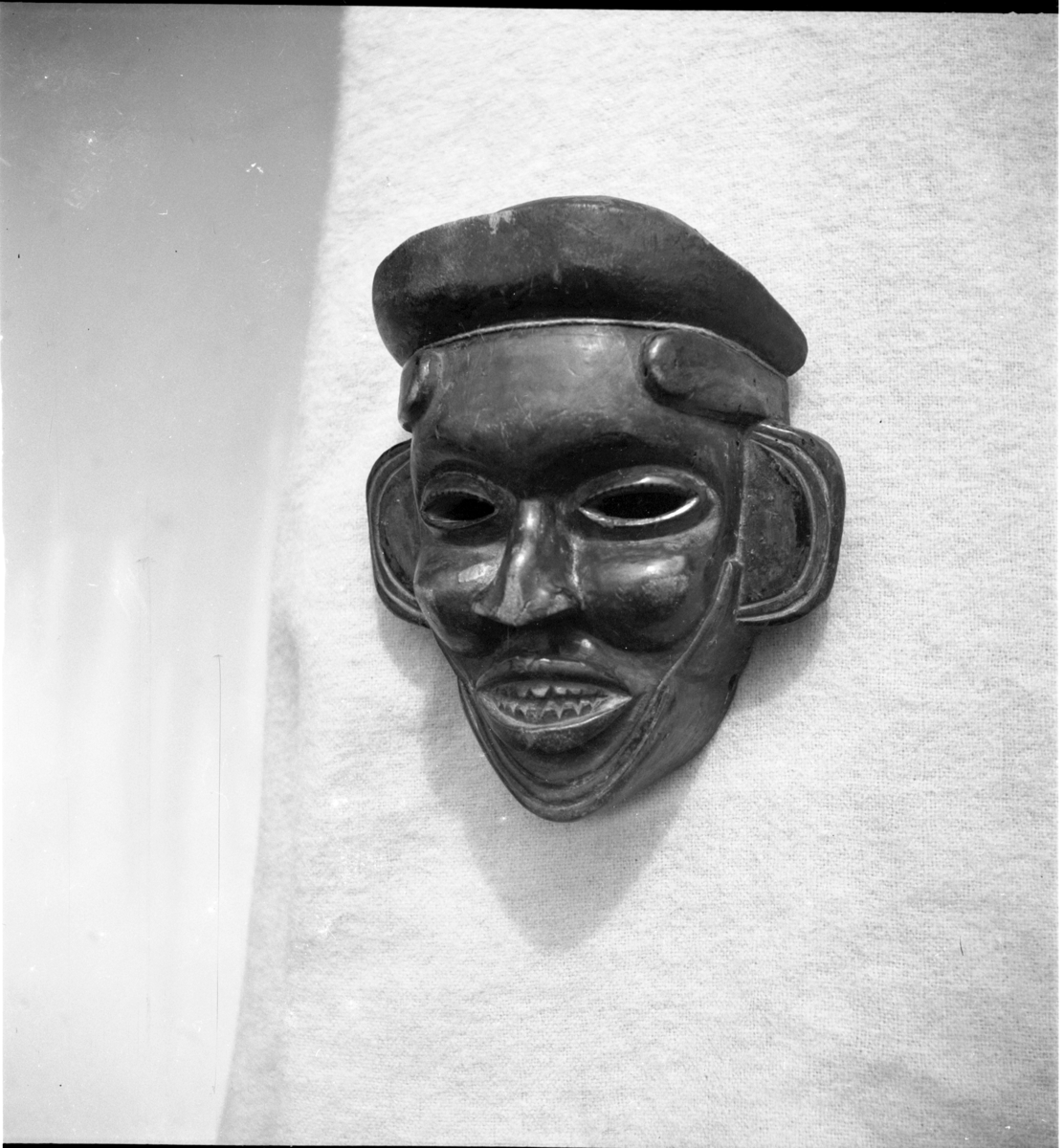
An Ibibio mask carved of wood. The mask depicts a human face and is angular in shape. The eyes are slit, long nose, open mouth with teeth, high cheekbones, large eliptical ears, and incised markings around the ears and chin. Around the forehead is a piece of twine and on top of the head is a square caved section representing the hair? It is made of highly polished darkened wood.
Place
W Africa; Nigeria; Eastern Nigeria; near Ikot Ekpene; ?Ikot Abia village
Cultural Affliation
Ibibio
Named Person
Photographer
Jones, Gwilliam Iwan (known as G.I.)
Collector / Expedition
Date
1932 - 1938
Collection Name
Jones Collection
Source
Jones, Gwilliam Iwan (known as G.I.)
Format
Film Negative Black & White
Primary Documentation
Other Information
This negative was kept in a film storage album labelled “IBIBIO & OKWU WALL” by G. I. Jones, and numbered “C12/” by the cataloguer.
Publication: A similar mask which was photographed with other Ibibio masks is shown in Plate 81, Jones, 1984, p.175. The caption reads “Kwa Ibo masks.”
Context: Jones devotes a chapter to The Anang (Ibibio) and other Ibibio styles. The style which is usually called Ibibio was concentrated in a single local area, that of the Anang, who were probably the most gifted artistically of all Eastern Nigerian people. Masks and figures in this style were carved in adjacent Eastern Ibibio and Ohuhu Ibo areas, but the great majority and certainly the finest were made in the Anang area and by the twentieth century they were being made in considerable numbers: For the superiority of these Anang masks was accepted throughout the Ibo and Ibibio countries and Anang (Ibibio) masks and carvings were distributed to most parts of the Eastern Region... The Ibibio style was only one of a number of styles found in the Anang area. It was in this area that Eastern Nigerian face masks attained their greatest development. They were heart-shaped, oval or rectangular in form and they could be carved on circular or on rectangular panels. they could have additional smaller faces carved on the forehead, on a superstructure above it or on panels hinged to its sides. While normally human in form, they could on occasion be in animal form or in a combination of human, animal or bird features in order to horrify and strike terror into the beholder. But another type of Anang mask achieved this even more successfully by depicting faces ravaged by disfiguring tropical diseases (for instance, rodent ulcers, gangosa, nodular leprosy). These ‘pathological’ masks were peculiar to the Ibibio (Jones, 1984, p. 175).
Bibliographical Reference: Jones, G.I., 1984. The Art of Eastern Nigeria (Cambridge University Press)
This catalogue record has been updated with the support of the Getty Grant Program Two. [Alicia Fentiman 19/11/2007]
Publication: The photograph has been digitised for the European Collected Library of Artistic Performance (ECLAP) and is accessible on the portal http://www.eclap.eu/drupal/. [SG 30/10/2012]
FM:147800
Images (Click to view full size):