IDNO
N.13100.GIJ
Description
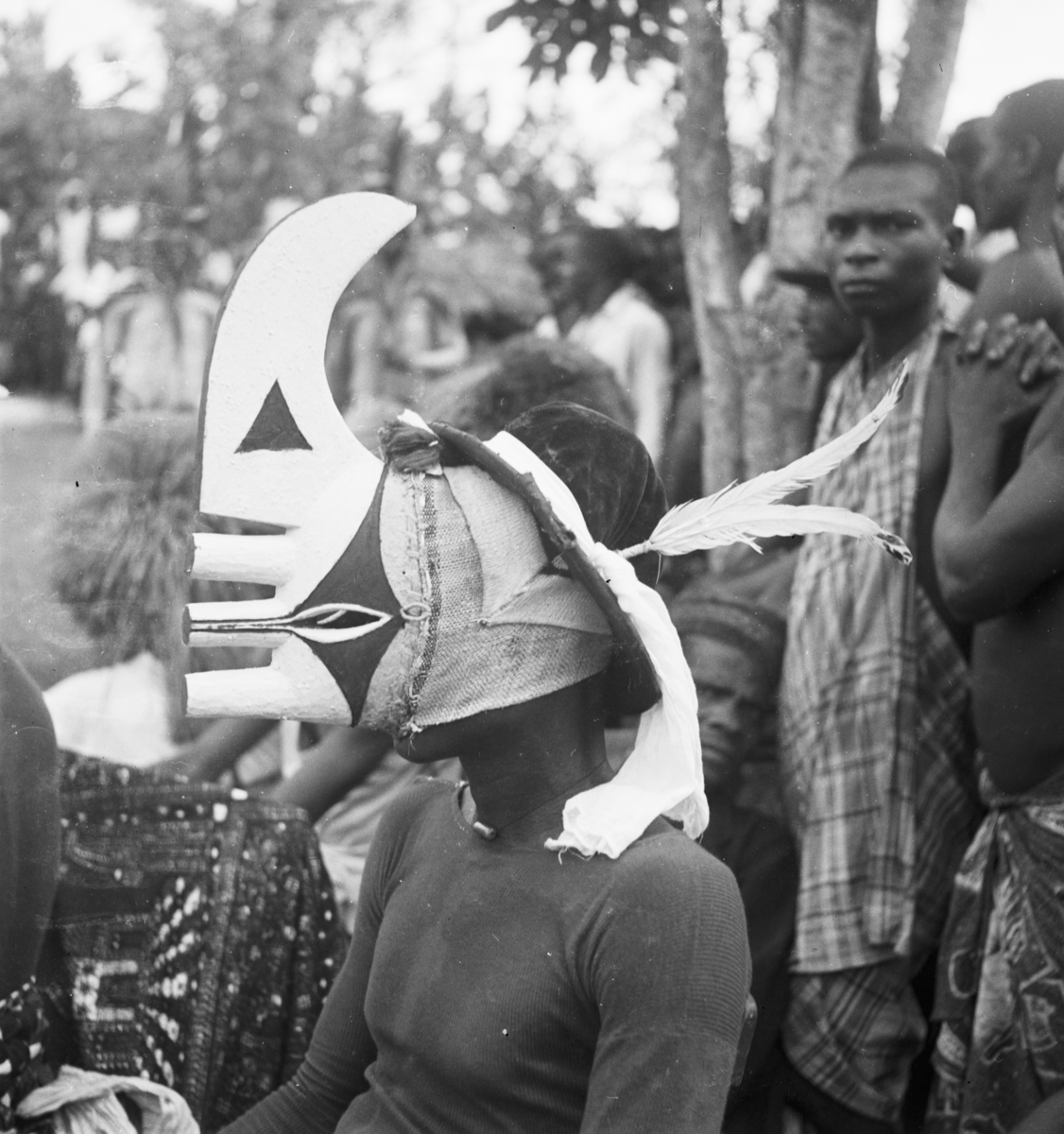
Part of the Nkporo Ifogu masquerade.
Head and shoulder portrait of a seated masquerader wearing an Ogu wooden face mask, with a knife-like protrusion from the forehead, three cylindrical protrusions, slits for the eyes painted in dark and light colours, and attached to a cloth backing. On top of the head is a dark felt hat with a white ribbon and feather sticking out. He is wearing a tight dark jersey and necklace. In the background are spectators and trees.
Physical Condition: Slight yellowing of buckling negative.
Place
W Africa; Nigeria; Eastern Nigeria; Cross River; Elugu village
Cultural Affliation
Igbo [historically Ibo]; Nkporo
Named Person
Photographer
Jones, Gwilliam Iwan (known as G.I.)
Collector / Expedition
Date
1932 - 1939
Collection Name
Jones Collection
Source
Jones, Gwilliam Iwan (known as G.I.)
Format
Film Negative Black & White
Primary Documentation
Other Information
This negative was kept in a film storage album labelled “Masks & Plays - Nkporo.” by G. I. Jones, and numbered “C11/” by the cataloguer.
Publication: Same image published on John McCall’s G.I. Jones website with the following information: [Source: www.siu.edu/~anthro/mccall/jones/, AF ]
1. Index to Nkporo Igbo
2. Ogu Mask, Boys initiation, Elugu (13th image).
Context: G. I. Jones describes the drama of the Ifogu Nkporo masquerade , “The band came first, with sweeping palm-leaf skirts, cotton singlets and great raffia headdresses which made them look like enormous maned baboons. Their faces were hidden behind black and white raffia bags and they played on slit drums, large and small, on wooden and iron gongs, and on a small membrane drum... . Then came out two main dancers, a pair of strange creatures with scarlet jerseys, black velvet hats with a white ribbon around them, and terrifying masks with human eyes, a sword coming out of the forehead and three conical projections beneath it, the whole suggesting vaguely the prow of a Melanesian war canoe. Each carried an egg in one hand and cross between a vanity bag and a rattle in the other. They danced in turn like fencers, advancing and retreating and ending abruptly poised on one foot, and with the egg thrust towards the person at whom they were dancing. When they were not dancing they rested on two chairs beside the band. Then the band was joined by some more drummers dressed in white and wearing the same masks as the red dancers. The bigger slit drums stopped and two clay pots and some lighter drums replaced them. The drumming grew more gentle and some of the band crooned a lilting song rather like a lullaby. (jones, 1939, p.120).
In the Ada Ibo area there were specific styles of masks which were used in initiation masquerades. The style resembled the Lower Niger but the particular forms used were their own, and in the case of the abstract ones, unique. In reference to the abstract masks he notes , “that they were composed of a white, red, and black arrangement of an oval face with the features reduced to a vertical row of three projecting cylinders surmounted by a knifelike crest and suggestive of the prow of a Venetian gondola (1984, p.211)
Bibliographical Reference: Jones, G.I., 1984. The Art of Eastern Nigeria (Cambridge University Press); Jones.G.I., 1989, Ibo Art, (Shire) pp. 64-65; Jones, G.I. Ifogu Nkporo, Nigerian Field, Vol. VIII, pp. 119-121.
Publication: The photograph has been digitised for the European Collected Library of Artistic Performance (ECLAP) and is accessible on the portal http://www.eclap.eu/drupal/. [SG 30/10/2012]
Exhibition: Digital reproduction of photograph exhibited in ‘Afrique, mille vies d’objects / Africa, a thousand lives of objects’ at Musée de Confluences, Lyon, France, from June 2023 – February 2024. See www.museedesconfluences.fr/en. [JD 25/01/2023]
This catalogue record has been updated with the support of the Getty Grant Program Two. [Alicia Fentiman 30/10/2007]
FM:147750
Images (Click to view full size):