IDNO
N.13052.GIJ
Description
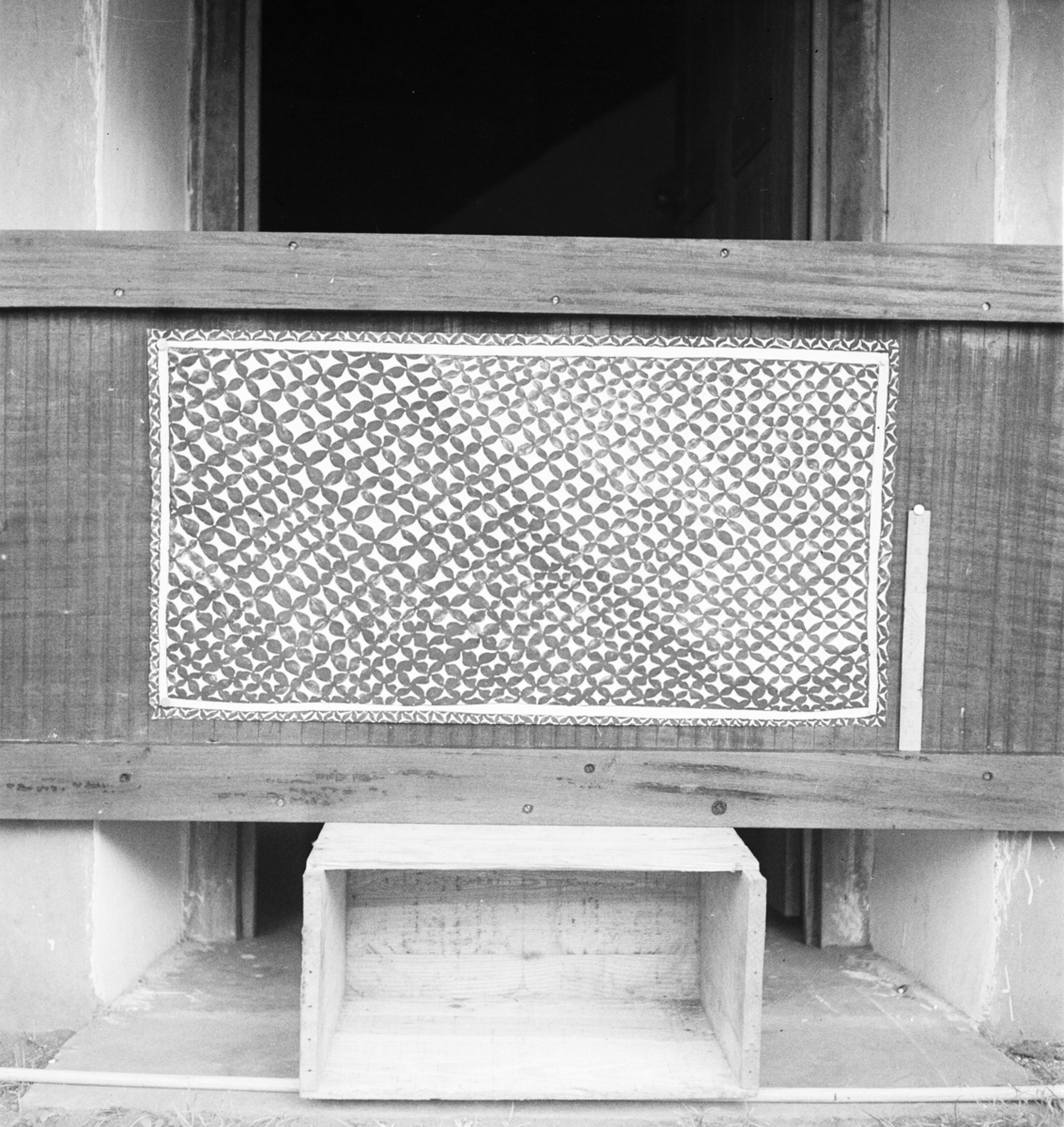
Uli design on paper pinned up on a wooden board resting on a crate in a doorway. Twelve inch ruler pinned beside paper.
Physical Condition: Slight yellowing of negative.
Place
W Africa; Nigeria; Eastern Nigeria; Bende
Cultural Affliation
Named Person
Photographer
Jones, Gwilliam Iwan (known as G.I.)
Collector / Expedition
Date
1932 - 1939
Collection Name
Jones Collection
Source
Jones, Gwilliam Iwan (known as G.I.)
Format
Film Negative Black & White
Primary Documentation
Other Information
This negative was kept in a film storage album labelled “Misc” by G. I. Jones, and numbered “C10/” by the cataloguer.
Context: Uli designs were common as body painting among the Ibo and Ibibio. The designs were curvilinear patters which were drawn on the skin of women and of children with dye obtained by the uli vine. (Jones,1984,p.33 )
Cole and Aniakor give a detailed description of uli, “Several techniques, pigments and styles are used by both men and women to dye and pattern their bodies for display. One of these is uli, cursive indigo patterns which have been recorded all over Igbo land. Uli is the women’s art par excellence and closely related to wall painting. These two graphic modes share many motifs and design principles despite the differences in surfaces embellished and pigments used. Uli is painted with a clear brownish liquid (made from the crushed seeds of several plants species) that turn dark blue when it has been on the skin for several minutes. Normally it is applied with a thin sliver of wood, mma nwuli, that enables the artist to create fine. delicate lines. The visual dynamism and sophistication of these styles stem from the conscious use of asymmetry, the tapering and swelling character of line and the syncopated rhythms created by a variety of hooked and curving patterns of different sizes and shapes. Uli artists are sensitively attuned to the appropriateness of designs for their human “canvases”. They will amplify a thin girl with bold patterns and modify corpulence with delicate ones, among other even more subtle approaches to this cosmetic art. Further, uli painters have developed a a fine sense of witty line-play on the shapes, creases, and modulations of the human body which emphasise its vitality, especially in motion. In these artistic celebrations of form and line, “play’ and “display” betray similar roots. The subtlety, sense of humour, and sheer inventiveness of many such paintings clearly manifest a deeply ingrained artistic sense widely shared among Igbo women. (Cole and Aniakor, 1984, pp. 38-46).
Bibliographical Reference: Jones, G.I., 1984. The Art of Eastern Nigeria (Cambridge University Press); Cole, H. & C. Aniakor, 1984. Igbo Arts: Community and Cosmos (Museum of Cultural History, University of California)
This catalogue record has been updated with the support of the Getty Grant Program Two. [Alicia Fentiman 11/10/2007]
FM:147702
Images (Click to view full size):