IDNO
N.13045.GIJ
Description
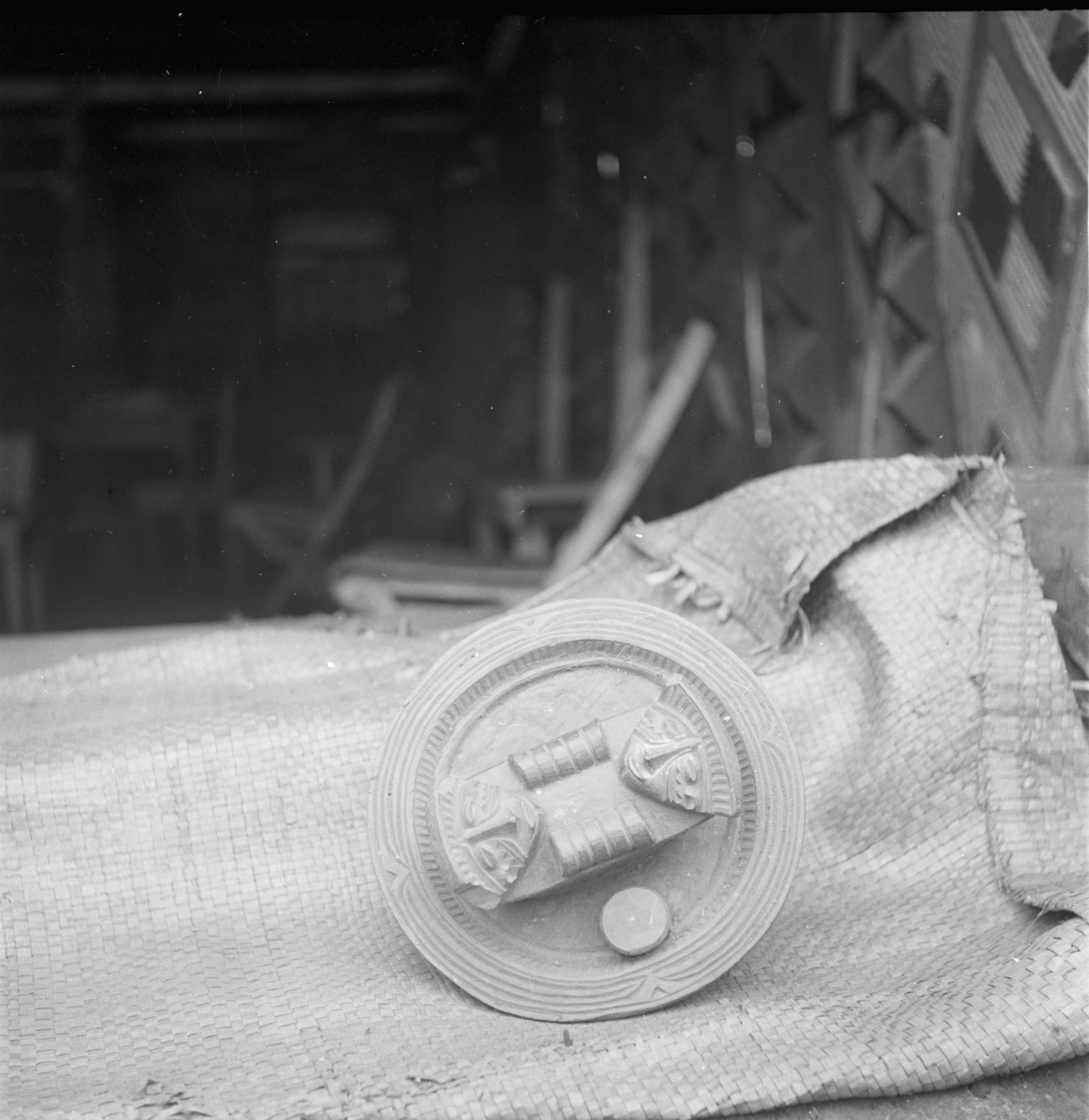
An okwa or ceremonial food bowl or platter made of wood propped up on a raffia mat. The bowl is circular in shape, and the outer rim is designed with incised striations and four V-shaped marks. In the centre of the bowl is a raised container with a lid decorated with two human carved heads; this forms the hollow in which a sauce was put. To the right is a small circular platform (for cutting meat).
Physical Condition: Slight yellowing and brittle crinkling of negative.
Place
W Africa; Nigeria; Eastern Nigeria
Cultural Affliation
Igbo [historically Ibo]; Ezza
Named Person
Photographer
Jones, Gwilliam Iwan (known as G.I.)
Collector / Expedition
Date
1932 - 1939
Collection Name
Jones Collection
Source
Jones, Gwilliam Iwan (known as G.I.)
Format
Film Negative Black & White
Primary Documentation
Other Information
This negative was kept in a film storage album labelled “Misc” by G. I. Jones, and numbered “C10/” by the cataloguer.
Publication: Same image published on John McCall’s G.I. Jones website with the following information: [Source: www.siu.edu/~anthro/mccall/jones/, AF ]
Context: Jones writes about the Ezza carvers and notes their fine okwa dishes with human faces on the lid in imitation of those made by the Nri/Akwa. The large ceremonial food dish was used by the host to make a token offering of food to a visitor. The central portion was raised to contain a separate hollow with a detachable lid covering it. This contained the sauce. The rest of the food, which was a small portion of meat or of boiled hide, was placed in the surrounding bowl, on which was a small raised circular platform on which to cut the meat. The lid over the sauce bowl was carved with representations of human or animal heads or bird forms. (Jones, 1984, pp. 120, 214).
Cole and Aniakor also discuss the importance attached with the ritual of hospitality associated with kola nut and chalk which is a prerequisite for any discussion of importance. They write,” Kola and chalk containers are often housed among the equipment of the family and community shrines where they seem to take on a certain sanctity by association, even if they are not necessarily sacred vessels in and of themselves. Artistically embellished containers also lend dignity to any ceremony, reflecting wealth and good taste of the person responsible. A hierarchy of such serving dishes exists, from eh simple and plain to elaborated examples. The finest kola bowls or platters, okwa oji, are those with a central lidded cavity in which condiments (such as pepper mashed with peanuts) are placed. (Cole and Aniakor, 1984, p. 63)
Bibliographical Reference: Jones, G.I., 1984. The Art of Eastern Nigeria (Cambridge University Press); Cole, H. & C. Aniakor, 1984. Igbo Arts: Community and Cosmos (Museum of Cultural History, University of California)
This catalogue record has been updated with the support of the Getty Grant Program Two. [Alicia Fentiman 16/10/2007]
FM:147695
Images (Click to view full size):