IDNO
P.9562.ACH1
Description
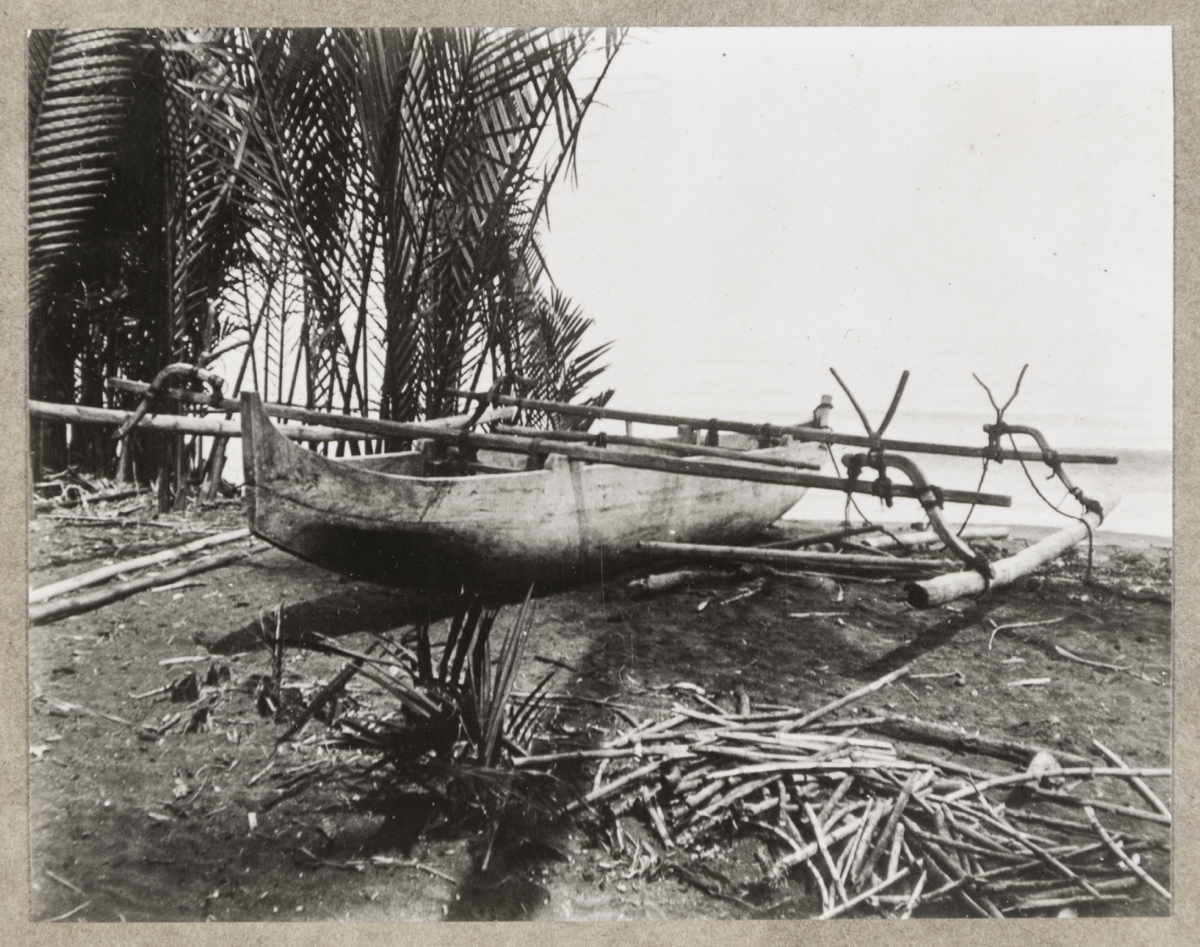
On Catalogue Card: "Fishing canoe. double outrigger. Halmaheran attachment. Menado. N. Celebes.
J. Hornell. Man. XIX. No. 55. Pl. G. B." [Typed Text]
On Catalogue Card for duplicate image LS.138446.TC1: "Celebes. 37.29. ['34-27 Menado N. Celebes' struck through]
Menado, N. Celebes.
Double outrigger, 2 booms."
Place
SE Asia; Indonesia; north Sulawesi; Manado [Celebes; Menado]
Cultural Affliation
Named Person
Photographer
Hornell, James
Collector / Expedition
Hornell, James
Date
1918
Collection Name
Mounted Haddon Collection
Source
Format
Print Black & White Mounted
Primary Documentation
Other Information
Publication: Image published in Hornell, James. “55. The Affinities of East African Outrigger Canoes.” Man, vol. 19, 1919, pp. 97–100, Pl. G and captioned: "Fig. B. - Menado (Zanzibar Type)." [JD 27/02/2023]
Publication: Image published in 'The Outrigger Canoes of Indonesia' by James Hornell. Madras Fisheries Department, Bulletin No. 12. Administration Report, 1918-19. A Statistical Analysis at Madras, 1919, pl.VIII and captioned:
"Fig. XV,—Fishing Canoe, E, Indonesian Type, Menado."
On 'Explanation of Plates' p.113, "Fig. XV. Fishing canoe of East Indonesian, type Menado, Celebes."
Related text on pp.80-81 notes "At Menado, the principal port, the three different types of outrigger in use on the Minahasa coast are seen in considerable numbers ...
The second type here is a stoutly built and usually fairly large dugout fitted with double outriggers of the East Indonesian pattern (PI. VIII, fig. XV). The hull is double ended, with little sheer, rather coarse at the extremities; the stem and stern are bent upwards a few inches only ; these are separate pieces added to the dugout hull. No ornament of any description is present. The booms are of squared timber supported on chocks resting on the gunwales; they are secured by lashing to thwarts near the bottom of the canoe ; the floats are strong bamboos. The angular secondaries have the lower limb rather more curved than is usual in the Molucca varieties ; in the Minahasa design the whole joint often assumes a loose S-shape, formed of two reversed curves. Another notable difference is the lack of any bracing pole in the Minahasa design. A curious substitute for the usual wooden secondary was seen once in a small-sized canoe of this description on the Menado river, the branched antler of a deer being used. It is just possible that in this we have the primitive form and material used to make the curved joint ; the natural curve of an antler is very suitable for the purpose, and its toughness furnishes the requisite strength. The use of antlers in fashioning canoe anchors is not uncommon in the Moluccas ; I noticed several instances.
In some cases a Y-crutch is lashed against the boom just beyond the head of the secondary to which it is also lashed (PI. VIII, fig. XV) ; this gives a certain additional stiffness to the joint but many are without it. Poles, paddles, and fishing rods not in use are conveniently placed out of the way in these rests.
These canoes are the weight carriers in fishing; they are far less handy and speedy than the third form yet to be described, but their stouter build fits them to carry heavy loads of nets. As a consequence these boats are used wherever seining is a fishing method much used, and that signifies nearly everywhere on the Minahasa coast. Frequently these canoes work in partnership with the light third type; the one shoots the heavy seine; the other carries one of the hauling ropes to the appointed place. In this way the seine can be used in deep water somewhat in the manner of the Danish trawl." [JD 25/02/2023]
FM:144212
Images (Click to view full size):