IDNO
P.9543.ACH1
Description
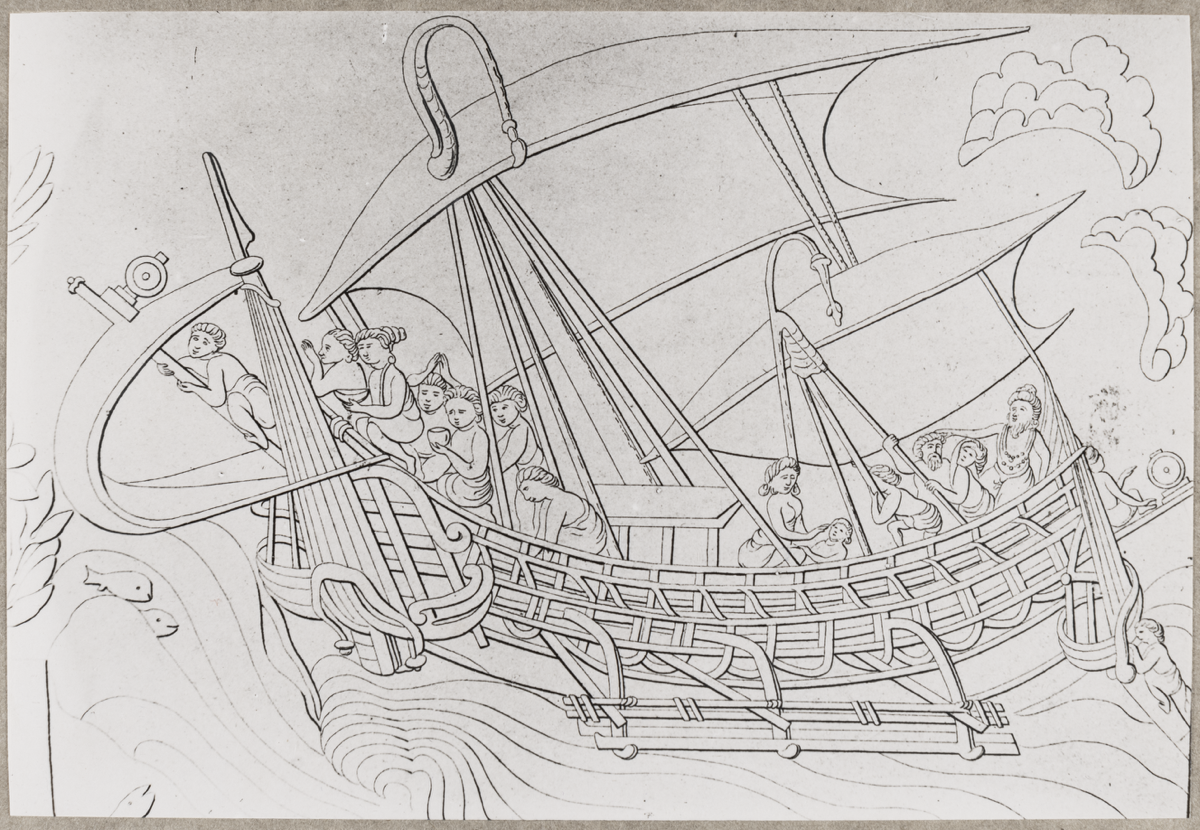
On Catalogue Card: "Indo-Javanese ships. Boro-Budur (neg.)" [Typed Text]
On Catalogue Card for duplicate lanternslide LS.138456.TC1: "Java. 37.39a.
8 drawings & 2 photographs [37.38 - 45] of stone carvings of ships (8 - 9 cent.) at Boro-Budur.
(39B & 42B are drawings by J. Hornell, cf 39A & 42A, made on the spot)."
Drawing of a "Indo-Javanese ship: two masts, three straight booms which pass between the two longitudinal spars, three curved booms which appear to pass between the longitudinal spars, they pass between the two elements of the double float and curl up towards the upper aspect of the outer element of the float. (Leemans, p1. Ci, 172)" [Haddon 1920, Fig. 25]
Place
SE Asia; Indonesia; Central Java; Borobudur Temple [Jawa; Boroboedoer]
Cultural Affliation
Named Person
Photographer
?Leemans, C. [Author]; ?After Hornell, James;
Collector / Expedition
Date
?1873; ?1918; 1935
Collection Name
Mounted Haddon Collection
Source
Format
Print Black & White Mounted
Primary Documentation
Other Information
Publication: Image published in 'The Outrigger Canoes of Indonesia' by James Hornell. Madras Fisheries Department, Bulletin No. 12. Administration Report, 1918-19. A Statistical Analysis at Madras, 1919, pl.I and captioned:
"Fig. I. Original restoration of a large Javanese two-masted outrigger vessel of the 8th or 9th century A.D. From a sculptured panel at Boro Budur, Java."
In 'Explanation of Plates' p.112, "Fig. I. Original restoration of a large Javanese two-masted outrigger vessel of the 8th or 9th century A.D. From a sculptured panel at Boro Budur, Java."
Related text on p.53 notes "In larger canoes where the increased size of the sail renders it impossible for the crew to lift it high enough to hitch the loop over the mast-head peg, a hole is cut in the projecting end of one of the paired mast legs which is cut longer at the top than the other ; through this hole a rope is rove and by this means the sail is hoisted. The sail is oblong with a bamboo yard along the upper edge,and a similar pole along the lower. This is the same style of sail seen in the Buddhist sculptures in the Boro Budur ruins in Central Java, a building dating from the eighth and ninth centuries of our era (Frontispiece)."
Related text on p.101 notes "In the Boro Budur ships the masts appear to be double, and in the restoration which I have attempted (Frontispiece), they are shown thus." [JD 25/02/2023]
Publication: Image published in Haddon, A. C. “The Outriggers of Indonesian Canoes.” The Journal of the Royal Anthropological Institute of Great Britain and Ireland, vol. 50, 1920, pp. 69–134, and captioned: "Fig. 25. Indo-Javanese ship: two masts, three straight booms which pass between the two longitudinal spars, three curved booms which appear to pass between the longitudinal spars, they pass between the two elements of the double float and curl up towards the upper aspect of the outer element of the float (Leemans, p1. Ci, 172)."
Related text on pp.101-104 notes: "Representations of seven ships are given in Leemans' atlas of 'Boro-Boedoer' [Leiden 1873] ... two ships (25, 27) the ends of these booms lie well above the float, in one (26) they appear to pass behind the inner element of the double float, and in a fourth (24) they appear to pass in front of both elements ... in two cases (25, 27) the curved booms pass between the two elements of the double float and curl under and more or less to the front of the outer element". [Full text available on https://doi.org/10.2307/2843375 JD 03/03/2023]
FM:144193
Images (Click to view full size):