IDNO
P.9400.ACH1
Description
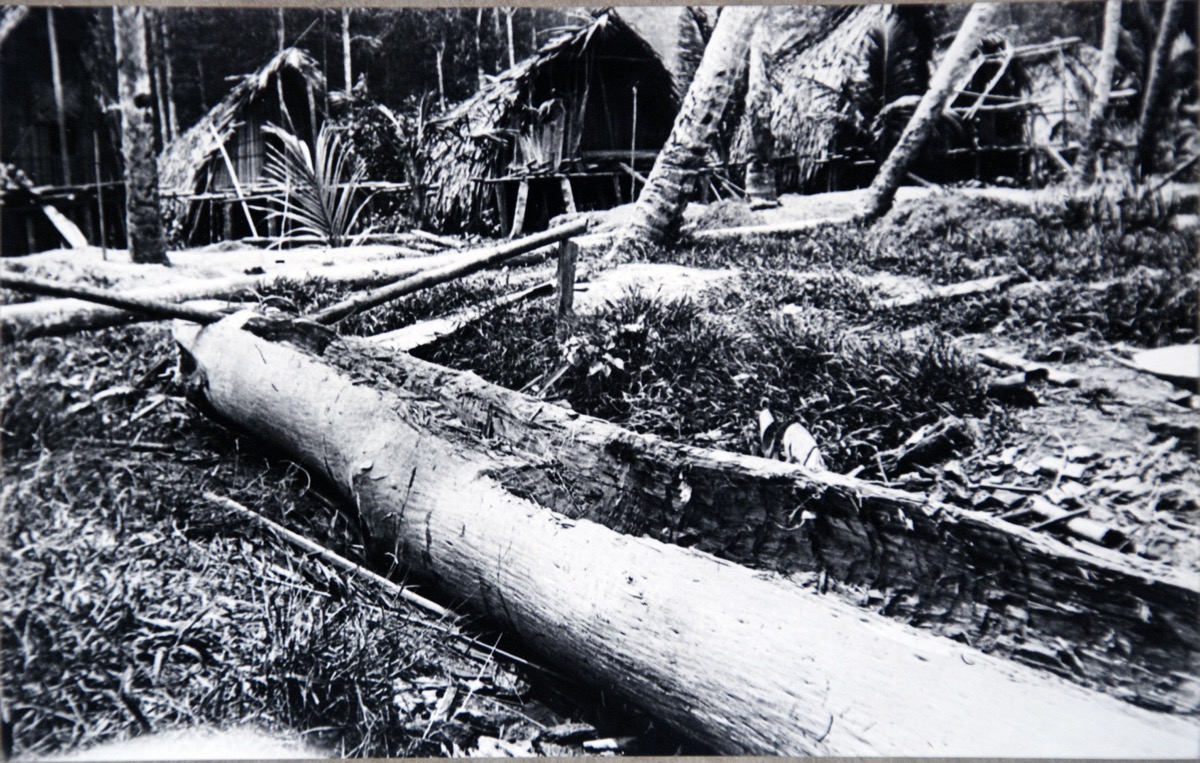
On Catalogue Card: “Canoes, Delta, Div. (photo)” [typed text]
“in process of manufacture” [manuscript in pencil]
Unfinished canoe on the riverbank with several houses resting on stilts behind it [Joshua Bell 9/6/2004].
Place
Oceania Melanesia; Papua New Guinea; Delta Division; Papuan Gulf; Purari Delta; Pai-i-ara Village [British New Guinea]
Cultural Affliation
Purari Delta
Named Person
Photographer
Haddon, Kathleen (later Rishbeth)
Collector / Expedition
Haddon, Alfred Cort and Haddon, Kathleen (later Rishbeth) [Expedition to New Guinea, 16 September - 20 November 1914]
Date
19 October 1914
Collection Name
Mounted Haddon CollectionKathleen Haddon Collection
Source
Rishbeth, Kathleen (nee Haddon)
Format
Print Black & White Mounted
Primary Documentation
Other Information
This is part of a series of photographs taken at Pai-i-ara that consists of the following photographs (duplicates are in brackets): P.9389.ACH1 [P.59663.ACH2]; P9390.ACH1 [P.59662.ACH2]; P.9399.ACH1 [P.59655.ACH2]; P.9400.ACH1 [P.5966.ACH2].
See Archive Box 178, Envelope WO6/1/13 (Interview with Mrs Rishbeth).
Pai-i-ara was a small coastal settlement occupied by the Kairu’u of the Purari Delta. Kathleen in her memoir remarks on page 81: "We visited a ravi and made some rubbings, and also watched the natives making a dug-out canoe. A great tree-trunk was drawn up on the bank and they were hollowing it out with iron axes – or ‘tommy-hawks.’"
Expedition: A.C. Haddon and his daughter, Kathleen Rishbeth arrived in the Papuan Gulf on October 7th, 1914. They spent two weeks in the Delta Division, the administrative division that covered the western side of the Papuan Gulf before leaving the region for Port Moresby. [JB 06/01/2004]
Related Archive: In Kathleen Haddon's unpublished manuscript 'An English Girl in New Guinea', 1914, pp.81 - 82 is the following extract for Monday 19 October:
“Next morning we again set off in the launch, and after about two and a half hours’ run we reached the village of Pai-i-ara, situated along the bank of one of the larger rivers. We visited a ravi and made some rubbings, and also watched the natives making a dug-out canoe. A great tree-trunk was drawn up on the bank and they were hollowing it out with iron axes - or “tommy-hawks” as they always call them. Formerly of course this was done with their stone adzes and must have been an extremely laborious task, for even now it takes a considerable time. When the trunk has been hollowed out sufficiently, they light fires within to harden the wood, and then the thing is complete. The ends of the canoes are usually left open or they may be plugged with mud to keep out the water; in some places the plug used is a small boy who is wedged into the bow of the canoe. We did not remain long at this village, but went on to another larger one, Kairu, about five miles away. " [JD 7/1/2015]
This catalogue record has been updated with the support of the Getty Grant Program One. [Mark Elliott 09/06/2004]
FM:144050
Images (Click to view full size):