IDNO
P.9398.ACH1
Description
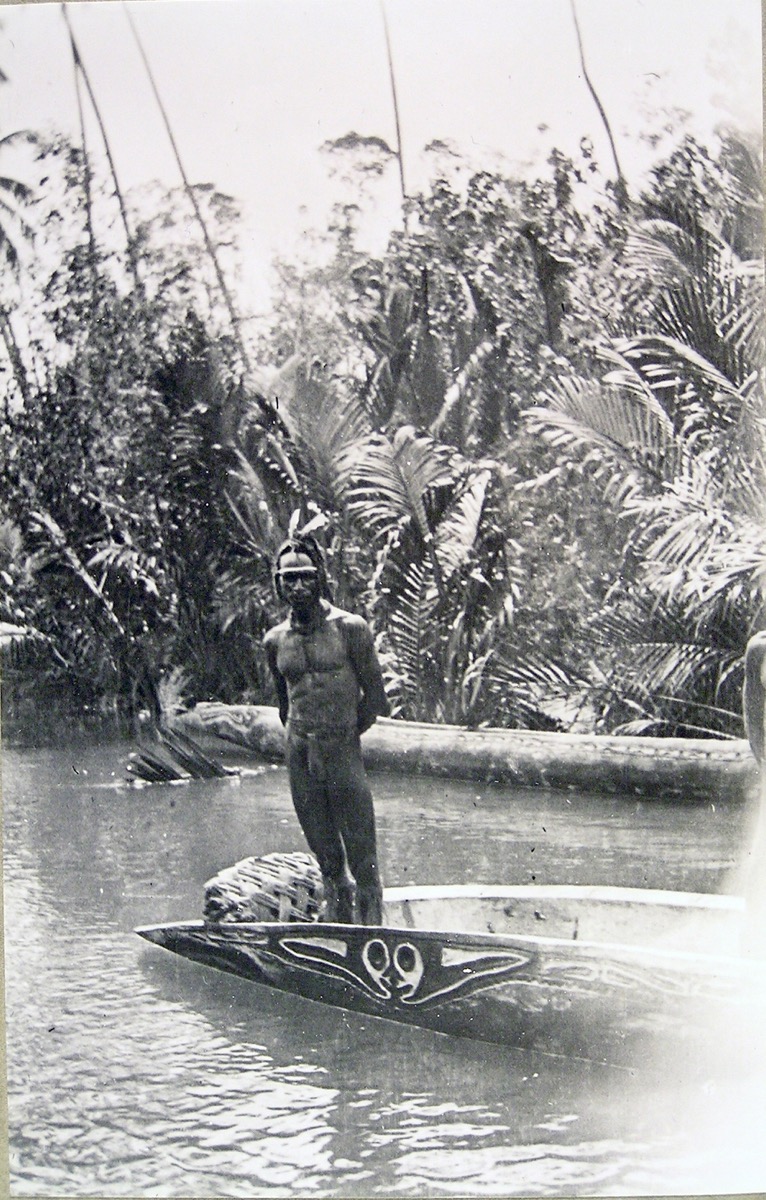
On Catalogue Card: “Canoe, Delta, Div. (photo)” [typed text]
“man standing with clay bulwark encased in palm leaf plaiting.” [manuscript in pencil]
A man wearing a shell headband and several feathers in his hair stands in the front of a canoe, which rests by the side of a river. The canoe’s front is blocked with a basket made of nipa palm leaves and mud. The canoe’s side is decorated with a painted carving of a stylised human face (known as imunu paku). Behind the man in the water rests another canoe. The bottom left hand corner of the photograph is over exposed [Joshua Bell 9/6/2004].
Place
Oceania Melanesia; Papua New Guinea; Delta Division; Papuan Gulf; Purari Delta [British New Guinea]
Cultural Affliation
Purari Delta
Named Person
Photographer
Haddon, Kathleen (later Rishbeth)
Collector / Expedition
Haddon, Alfred Cort and Haddon, Kathleen (later Rishbeth) [Expedition to New Guinea, 16 September - 20 November 1914]
Date
?17 or 25 October 1914
Collection Name
Mounted Haddon CollectionKathleen Haddon Collection
Source
Rishbeth, Kathleen (nee Haddon)
Format
Print Black & White Mounted
Primary Documentation
Other Information
See Archive Box 178, Envelope WO6/1/13 (Interview with Mrs Rishbeth).
Publication: This photograph appears as a plate facing page 216 in Rev. J.H. Holmes book In Primitive New Guinea (1924), with the following caption "A Typical Dug-Out and Native. Notice the shield in the bow to keep water out. It is a cushion of mud, covered with the plaited fronds of a palm, and forms a very effective protection in rough water." This print appears on page 113 of The Publisher’s Circular and Booksellers’ Record (1924) Feb. 9:112-113, in an anonymous review of Rev. J.H. Holmes (1924) In Primitive New Guinea. The image is captioned, "A typical dug-out and native" [JB 06/01/2004]
Expedition: A.C. Haddon and his daughter, Kathleen Rishbeth arrived in the Papuan Gulf on October 7th, 1914. They spent two weeks in the Delta Division, the administrative division that covered the western side of the Papuan Gulf before leaving the region for Port Moresby. [JB 06/01/2004]
Related Archive: In Kathleen Haddon's unpublished manuscript 'An English Girl in New Guinea', 1914, pp.74 - 75 for Friday 16th October, is the following extract:
“As we neared Urika we had to cross a large river, from which we looked straight out to sea. Large waves were breaking on the bar, but it was not too rough in the river and we were let off with only a little tossing. We followed a narrow creek running parallel to the sea and only about a quarter of a mile from it, but the vegetation was so dense that we could see nothing beyond the banks. Presently we reached a clearing and saw groves of coco-nuts and so knew that we had reached Urika, where Mr. and Mrs. Holmes of the London Missionary Society live."
The Haddon's used Urika as a base while visiting a number of other villages until the 25th October 1914. [JD 11/1/2015]
This catalogue record has been updated with the support of the Getty Grant Program One. [Mark Elliott 09/06/2004]
FM:144048
Images (Click to view full size):