IDNO
P.9394.ACH1
Description
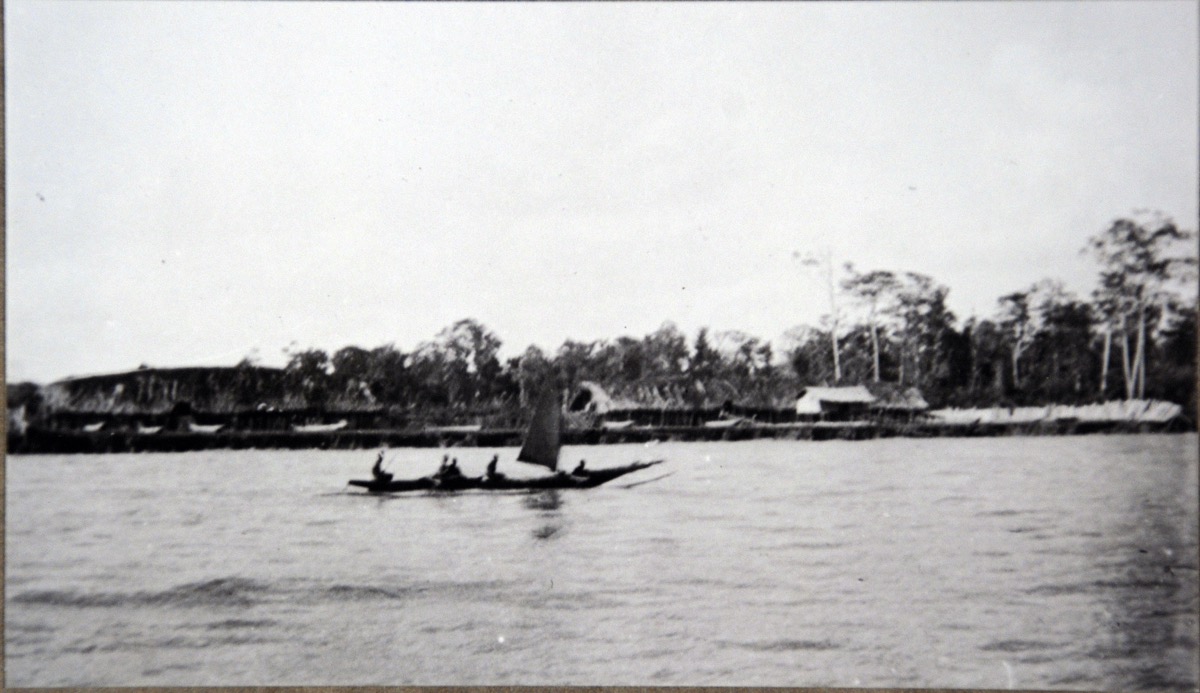
On Catalogue Card: Canoes, Delta, Div. (photo)
View of four people in a canoe with sail. Behind the canoe on a distant bank are two longhouses [dubu daima] and several other domestic dwellings [Joshua Bell 9/6/2004].
A canoe on the Bamu River, with probably the village of Wadodo on the river banks in the background. [JD 1/16/2015]
Place
Oceania Melanesia; Papua New Guinea; Western Province; Bamu River Estuary; Wadodo [British New Guinea; Western Division]
Cultural Affliation
Named Person
Photographer
Haddon, Kathleen (later Rishbeth)
Collector / Expedition
Haddon, Alfred Cort and Haddon, Kathleen (later Rishbeth) [Expedition to New Guinea, 16 September - 20 November 1914]
Date
4 October 1914
Collection Name
Mounted Haddon CollectionKathleen Haddon Collection
Source
Rishbeth, Kathleen (nee Haddon)
Format
Print Black & White Mounted
Primary Documentation
Other Information
Place: Judging by the longhouses on the bank, this photograph could be taken around Goaribari Island, or further west along the Bamu River and or near Kiwai Island. [JB 6/9/2004]
Place: The Place field was previously recorded as being “Oceania Melanesia; Papua New Guinea; Delta Division; Papuan Gulf; ?Goaribari Island ”, but placing it in the negative sequence for the film '13' shows that this photograph was probably taken in either the Bamu River or Fly River Delta. This print has subsequently been matched to the duplicate print, P.59728.ACH2, which is annotated as 'Wadodo'. This is accord with the film reference. The Place field has been pramended accordingly. [JD 10/23/2014, updated JD 16/1/2015]
Expedition: A.C. Haddon and his daughter, Kathleen Rishbeth arrived in the Papuan Gulf on October 7th, 1914. They spent two weeks in the Delta Division, the administrative division that covered the western side of the Papuan Gulf before leaving the region for Port Moresby. [JB 06/01/2004]
Related Archive: In Kathleen Haddon's unpublished manuscript 'An English Girl in New Guinea', 1914, pp.45 - 46 for Sunday 4th October is the following extract:
“The following day, Sunday, the river swarmed with canoes full of men and dogs going hunting or of women taking their sago away for trade purposes. Some of the men came alongside, and fine strong fellows they were, with their supple bodies and smooth skins. Several of them came aboard and watched us have breakfast, for it seems the custom for them to regard the boat as a kind of public hotel where all are welcome and tobacco may be had for the asking. This idea is encouraged as it is a splendid opportunity of getting acquainted with the natives, and a little trade tobacco goes a long way. The canoes were fine large ones with a single outrigger, and occasionally a kind of stage built up for the accommodation of the men, dogs, bundles of arrows, and the game they bring back. The arrows are of different kinds according to the sport to be indulged in: birds are shot with blunt-headed arrows so that they are knocked down without drawing blood, arrows for shooting fish are light with two or three sharp prongs, while pig-hunting is carried on with arrows having sharp bamboo blades that will pierce their tough hides. For fighting more subtle weapons are required, so the arrows are usually barbed to prevent their being pulled back easily, whilst reversed barbs are occasionally added, which prevent their being pushed out through the wound, and others again have loose heads that become detached and remain in the flesh. The men seem never to go far without their weapons, and it gives one a feeling of being face to face with the facts of life when every man carries with him his bow and arrows as a matter of course." [JD 1/16/2015]
This catalogue record has been updated with the support of the Getty Grant Program One. [Mark Elliott 09/06/2004]
FM:144044
Images (Click to view full size):