Accession No
2002.162 B.1-2
Description
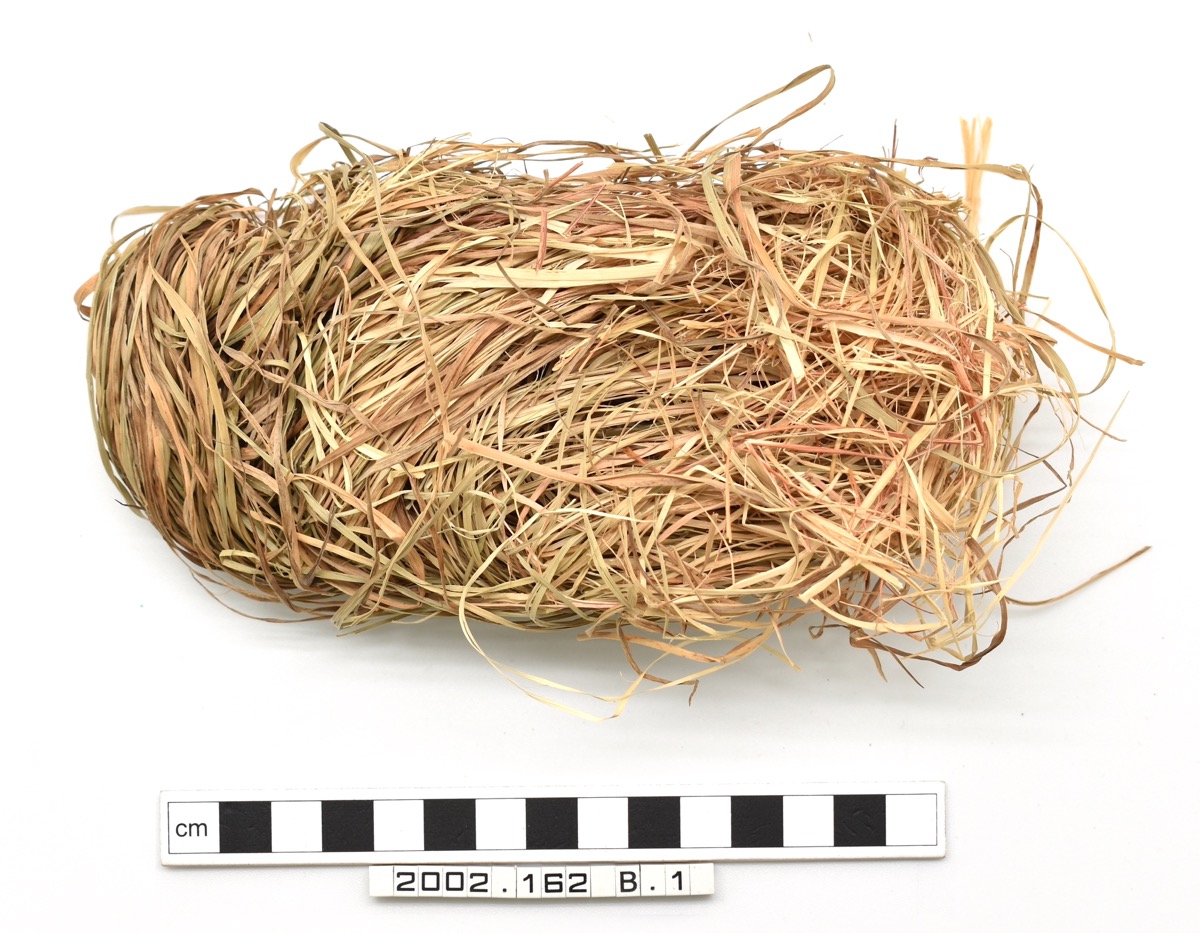
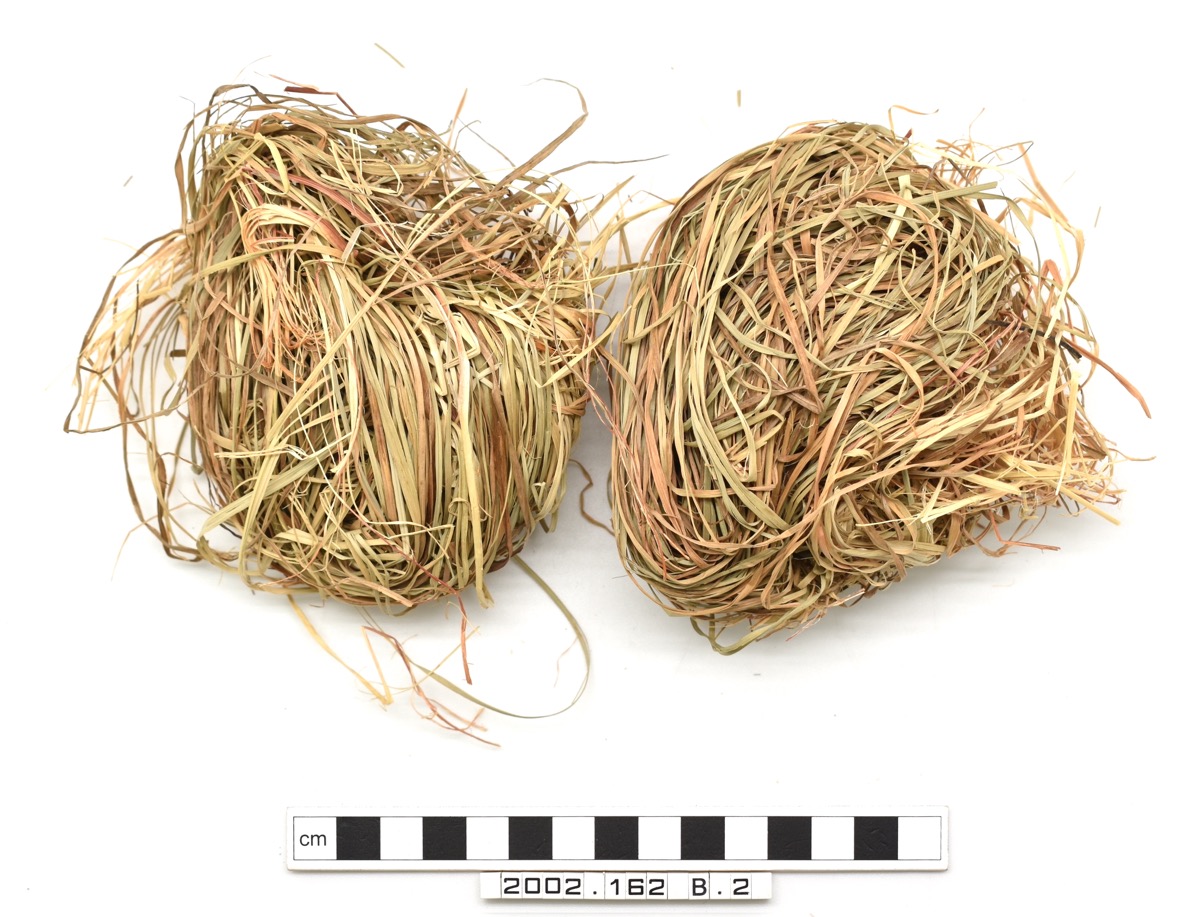
Two bundles of senna grass, used as shoe hay for a pair of children's winter boots (2002.162 A.1-2).
Place
Europe; Northern Europe; Fenno-Scandinavia; Sápmi; Norway; Finnmark; Karasjok
Period
early 21st century
Source
Webb, Sharon (Dr) [collector]
Department
Anth
Reference Numbers
2002.162 B.1-2
Cultural Affliation
North Sámi
Material
Plant; Grass
Local Term
seahkohat (Sámi); Skaller (Norwegian) direct translation = fur shoes
Measurements
100mm x 190mm
Events
Context (Field collection)
'The boots were collected by Sharon Webb during Ph.D. fieldwork. Interviews were made with the makers of the artefacts, these are lodged in the Museum's paper archive with tapes of the interviews and a copy of the report on the collecting project. The interviews consist of detailed conversations as to how the artefacts were made and what they mean to the Sámi today. All Sámi handicrafts are called duodji (this translates as 'anything a Sámi person makes with their hands').
These particular boots were made by Anna Berit Anti, a handicraft worker who makes artefacts for Sámi and tourists. These boots were made for sale to tourists and are of a very high quality. The woollen laces are a modern adaptation, in former times (and still today) shoes and boots were held onto the feet with shoe bands (see accession number 2002.167). The senna grass with which the boots are stuffed served as socks in former times (also for insulation), this is not often used today, although some people think it better than modern fabrics. Senna grass was collected in summer and beaten with a special tool to soften it before use. In this particular case, the grass has been used to help keep the shape of the boot. The boots were purchaced from Anna Berit Anti's tourist souvineer cabin near Stabusness, but were made in Karasok during the winter.' 11/12/2002 - S. Webb
Event Date 4/12/2002
Author: maa
Description (Physical description)
Description for 2002.162 A-B: 'Pair of winter boots. The main body of boots (including the sole) made from reindeer fur (gápmasiin). This is grey in colour, flecked with white hairs. The heel of the boots have a square of white reindeer fur sewn in for decoration. The toes curl upwards (this is so that loops to hold on skis can be attached). Designed to come some way up the ankle, the tops of the boots are decorated with woollen cloth; this decoration consists of yellow coloured triangles of wool cloth laid onto lightly larger triangles of very dark blue wool cloth laid onto a band of red wool cloth. There is a band of reindeer leather (sisti) sewn onto the decorated area, this is punched with holes so that laces can be drawn. The laces are made from red and yellow twisted and platted woollen cord. The ends of the laces are decorated with squares of red and yellow woollen cloth. The boots are stuffed with senna grass.'
Event Date 4/12/2002
Author: maa
Context (Display)
The boots (2002.162 A.1-2) are on display in 'Sápmi' (Case 70), Maudslay Hall, MAA, from 26/02/2010 onwards. The display was co-curated with staff from the Ajtee Museum in Jokkmokk.
Event Date 23/2/2010
Author: maa
Conservation (Freezing)
CON.2014.210 | Freezing
Event Date 4/6/2019
Author: Kirstie Williams
Description (Physical description)
Two bundles of senna grass, used as shoe hay for a pair of children's winter boots (2002.162 A.1-2).
Event Date 3/3/2023
Author: Lizzy Peneycad
FM:301184
Images (Click to view full size):