Accession No
1933.377 A.1-2
Description
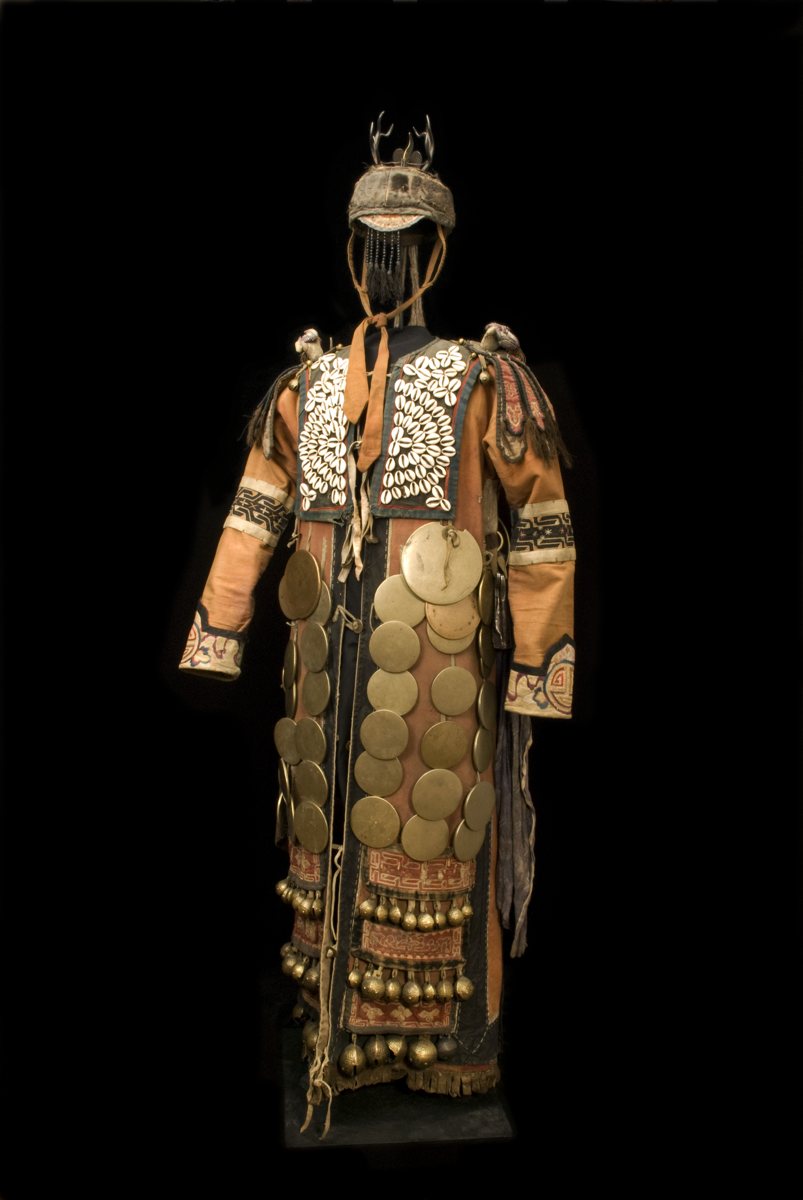
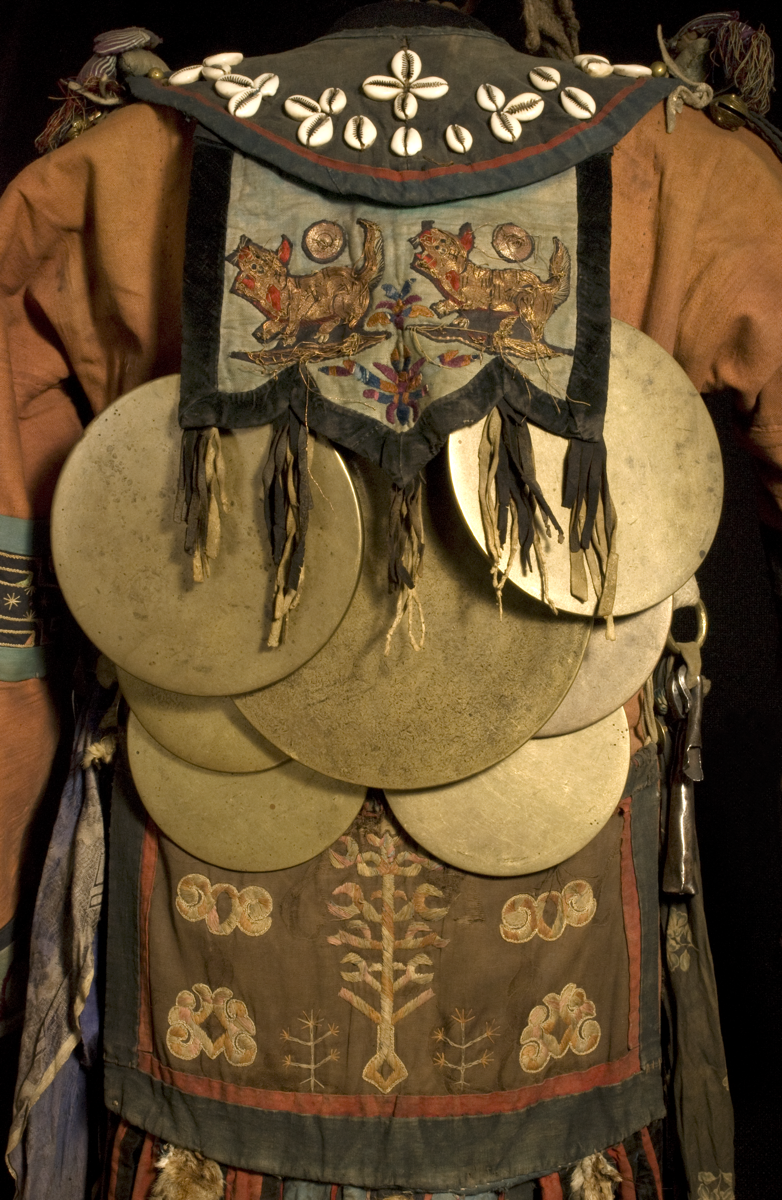
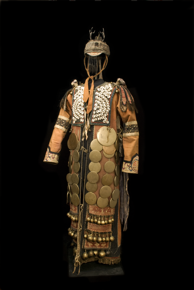
Samashi. Shaman's costume, comprising a heavy red cotton dress- or coat-like garment [.1], ornamented with embroidered cuffs and hide tassels as a trim. There are various sizes of brass mirrors hanging from the front and back of the garment, all with the smooth side facing out. The largest mirror, from the back of the coat, is now detached [.2]. There are also various sizes of brass spherical bells hanging in rows near the bottom on the garment front.
Place
Asia; East Asia; China; Inner Mongolia; Hulunbuir; Yimin River; x Xules
Period
20th century
Source
Lindgren, Ethel John (Dr) [collector]; Clarke, Louis Colville Gray [donor]
Department
Anth
Reference Numbers
1933.377 A.1-2
Cultural Affliation
Orochen; Oroqen [Tungus; Numinchen]
Material
Cloth; Textile; Cotton; Leather; Hide; Metal; Copper Alloy; Brass; Iron; Pigment
Local Term
Samashi [catalogue card]
Measurements
580mm x 1450mm
Events
Context (Display)
Old display label kept in the Shaman's headdress' box reads: 'Shaman's Dress which belonged to the elder daughter of the ex-chief of the Numinchen of the Chol and Imen region. 33.377, 379.'
Event Date
Author: rachel hand
Context (Related Documents)
The back of 1933.377 A-B is depicted on a drawing by Edith King (D.109911.LIN).
Event Date
Author: rachel hand
Context (Related Documents)
1933.377 B is depicted on a drawing by Edith King (D.78754.LIN).
Event Date
Author: rachel hand
Context (Other owners)
The unnamed shaman who wore this costume was the daughter of an Orochen Guzda (chief official). She was born around 1904 and died around 1929.
Event Date 1929
Author: Mark Elliott
Context (Field collection)
Catalogue card for 1933.377 A-B: 'The Shaman dress, head-dress and drum belonged to the elder daughter of the ex-chief of the Numinchen of the Chol and Imen region. She had died three years previous to the purchase, and there was no young aspirant to the Shaman's profession in the tribe at the time who would require them. The ex-chief refused to sell the Shaman outfit in August 1931, but agreed the following March.'
Event Date 3/1932
Author: rachel hand
Context (Field collection)
Purchased by Dr Ethel John Lindgren from a former Guzda (chief) and father of the female shaman who had worn it, in Anggo Xules, Yimin River, March 1932.
Event Date 3/1932
Author: Mark Elliott
Context (Production / use)
Catalogue card for 1933.377 A-B: 'Made by Numinchen of the Upper Imen River. (Brass mirrors bought from Chinese and iron objects no doubt made to order by Chinese smith). (...) The Shaman dress, hat and drum were stored on a covered platform 6 ft above the ground, concealed in the woods, when purchased.'
Event Date 1933
Author: rachel hand
Description (Physical description)
Catalogue card for 1933.377: 'Shaman's dress (A) and back piece (B)'.
Event Date 1933
Author: rachel hand
Description (Physical description)
Accession Register for 1933.377 A-B: 'A - Shaman's dress. B - Shaman's collar.'
Event Date 1933
Author: rachel hand
Context (Other owners)
'The costume had belonged to a Numinchen shamaness who died, probably of consumption, at the age of twenty-five, three years before it came into my possession. She was described as a tall Amazon who excelled in the manly arts of hunting and horsemanship, and conducted most of her father’s public and private business. He was formerly the Guzda (chief official) of his tribe, appointed by the Mongol Government in Hailar, but lost his office because of flagrant and extensive horse-stealing. He mourned his daughter bitterly and was loath to part with her shaman dress, which would have passed to a young, newly ‘called’ shaman if there had been one in the tribe. It was only on my second visit to the Numinchens of the Imin, in 1932, that I succeeded in obtaining it. Some months later all the Imin Numinchens, including the ex-Guzda, were reported to have been massacred by the Buriats of the Shinke River, in revenge for repeated thefts of horses.' (Lindgren 1935: 366)
Event Date 1935
Author: Mark Elliott
Context (Field collection)
'The costume… is a very complete example of this type of shaman dress. I acquired it from a group of Khingan Tungus living on the upper courses of the Cool and Imin rivers, near the watershed of the Great Khingan Range. Although they began appearing in this region at least forty years ago, they still call themselves Numinchen [numintʃɛn] after the Numin River, in the north, from which they came.’ (Lindgren 1935: 365-366)
Event Date 1935
Author: Mark Elliott
Context (References)
Published as Num. I in Lindgren, E.J. 1935. 'The Shaman Dress of the Dagurs, Solons and Numinchens in N. W. Manchuria'. Geografiska Annaler vol. 17, pp. 367-378. https://www.jstor.org/stable/519873
Event Date 1935
Author: Mark Elliott
Description (Physical description)
'Many parts of the Num. I costume are lined with flour bags, on one of which there is written some Russian letters, ‘flour’ and ‘Fire Brand’ in Chinese characters. These bags probably belonged to a Harbin firm, and in any case can scarcely antedate the building of the Chinese Eastern Railway (1900-1903).' (Lindgren 1935: 366).
Event Date 1935
Author: Mark Elliott
Context (Display)
Removed from display case 16, CUMAA anthropology galleries, 9 July 1986.
Event Date 9/7/1986
Author: rachel hand
Context (Display)
Displayed in the Maudslay Gallery in the Manchuria Case from 1990 to 2009. The display label noted "The costume and equipment of a female shaman".
Event Date 1990
Author: rachel hand
Description (Physical description)
A: shaman' s dress (known by Numinchen as samashi), decorated with metal discs.
B: collar piece.
Brass mirrors bought from Chinese and iron objects no doubt made to order by Chinese smith. The Shaman dress, headdress and drum belonged to the elder daughter of the ex-chief of the Numinchen of the Chol and Imin region. She had died three years previous to the purchase, and there was no young aspirant to the Shaman' s profession in the tribe at the time who would require them. The ex-chief refused to sell the Shaman outfit in August 1931, but agreed the following March. The Shaman dress, hat and drum were stored in a covered platform 6 ft above the ground, concealed in the woods, when purchased.
Event Date 24/5/1994
Author: rachel hand
Context (Amendments / updates)
The origin for this object was originally entered as "Upper Imin River; Barga; Manchuria; Mongolia; China; East Asia; Asia". This is not confirmed. According to the gallery display the costume is from Manchuria. Choi, Imin region and Imin River do not appear on any modern maps. The origin field has been changed to Manchuria until further research has been completed. (Jean Somerville 20/4/2006)
Event Date 20/4/2006
Author: rachel hand
Context (Display)
Exhibited: On display in the Andrews Gallery as part of the exhibition Assembling Bodies: Art Science & Imagination, from March 2008- November 2009
Event Date 3/3/2008
Author: Ayesha Fuentes
Context (Analysis)
'A shaman's costume from Inner Asia is one of a series of elements that allow a person's body to transform into a 'vessel' that received different spirits. Among the Imin Numinchen people of N.E. Manchuria, shamans were primarily concerned with healing, prediction and people's relations with their ancestors. The costume on display belonged to a young female shaman who died in the 1930s, aged 25.
'No two shaman's costumes are identical. The costume is assembled and added to as a shaman becomes more experienced, incorporating materials from different sources. The main part of the costume exhibited here was probably made by Dagur craftsmen, skilled at embroidery. The brass mirrors came from Chinese merchants, and the embroidered lions at the back were taken from her father's Manchu military dress (Lindgren 1935). The hat is decorated with iron antlers, which may refer to the reindeer that populate the nearby woodlands. These diverse features reflect some of the complex historical and political concerns of the people at the time. The costume also references genealogies by pointing to the different relationships fostered by the shaman to various ancestral spirits. The mirrors on this costume act in a double capacity: they protect the shaman by deflecting harm, while revealing what is normally invisible to the human eye. The number of mirrors on the costume indicates the shaman's powers and maps a geographical cosmos. By wearing the costume, the shaman is located in the centre of this cosmos. During performance, a shaman is possessed by one or more ancestral spirits, so that what is inside the mirror-costume is the spirits, rather than the shaman's body (Humphrey 2007) The costume points to the idea of the body as something open to forces which can control it, inhabit its form and shape its physical features.'
Anita Herle, Mark Elliott and Rebecca Empson. 2009. Assembling Bodies: Art, Science and Imagination. Cambridge: MAA, pp.20-21.
Event Date 22/3/2009
Author: Mark Elliott
Conservation (Remedial)
CON.2017.3874 | Remedial
Event Date 15/6/2017
Author: rachel hand
Exhibition (Li Ka Shing Gallery)
EXH.2018.5 | A Survival Story: Prehistoric Life at Star Carr
Event Date 20/6/2018
Author: rachel hand
Context (Display)
Survival Story: Prehistoric Life at Starr Carr, curated by Jody Joy, Li Ka Shing Gallery, MAA, 21/6/2018-16/3/2020.
Event Date 21/6/2018
Author: Mark Elliott
Context (Analysis)
Professor Songlin Meng and Mr Jinsong Bai (part of the Hulunbuir Delegation, Inner Mongolian visit to the museum, 28-29th January 2019), state: 'The costume is typical of an Oroqen Shaman but it is the first time PMA has seen one so exquisite.
Pm asked if the cowries were attached [to the backpiece or costume] when the costume was acquired? The cowries are traded from the East and are very rare and only possessed by the very wealthiest people. As a consequence of the Shaman performing a ritual, the weight of the costume c.20kg, they are often exhausted and collapse afterwards onto the floor.
This may have come from the hometown of Prof Meng, and could be related to his family as there are at least 7 generations of shaman’s in his family - possibly more.
Each shaman will make their own coat, but the coat referred to from the shaman’s father which was used to make the tails at the back seems reasonable. The back of the costume’s tails/cloth pendants are lined with patterned cloth which would have been traded from China. The Oroqen did not have the technology to weave and print their own textiles. The embroidery on the sleeves are typical of the Oroqen.
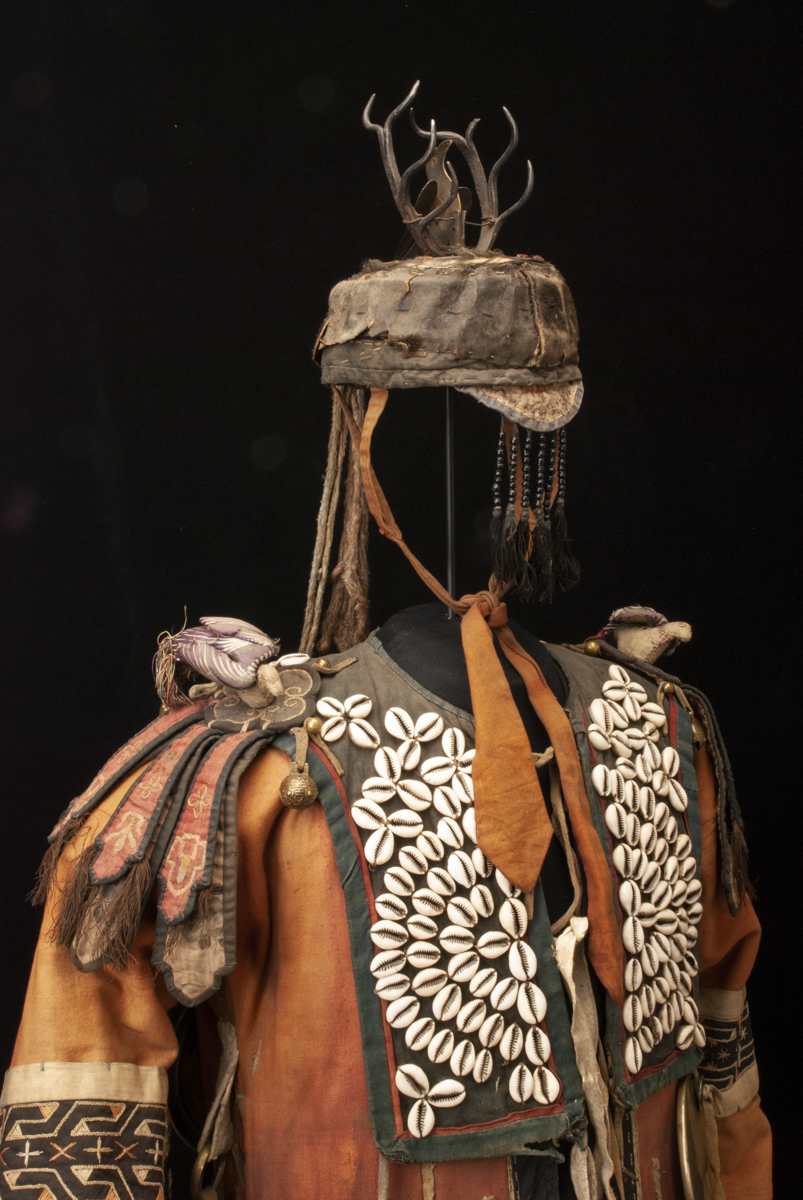
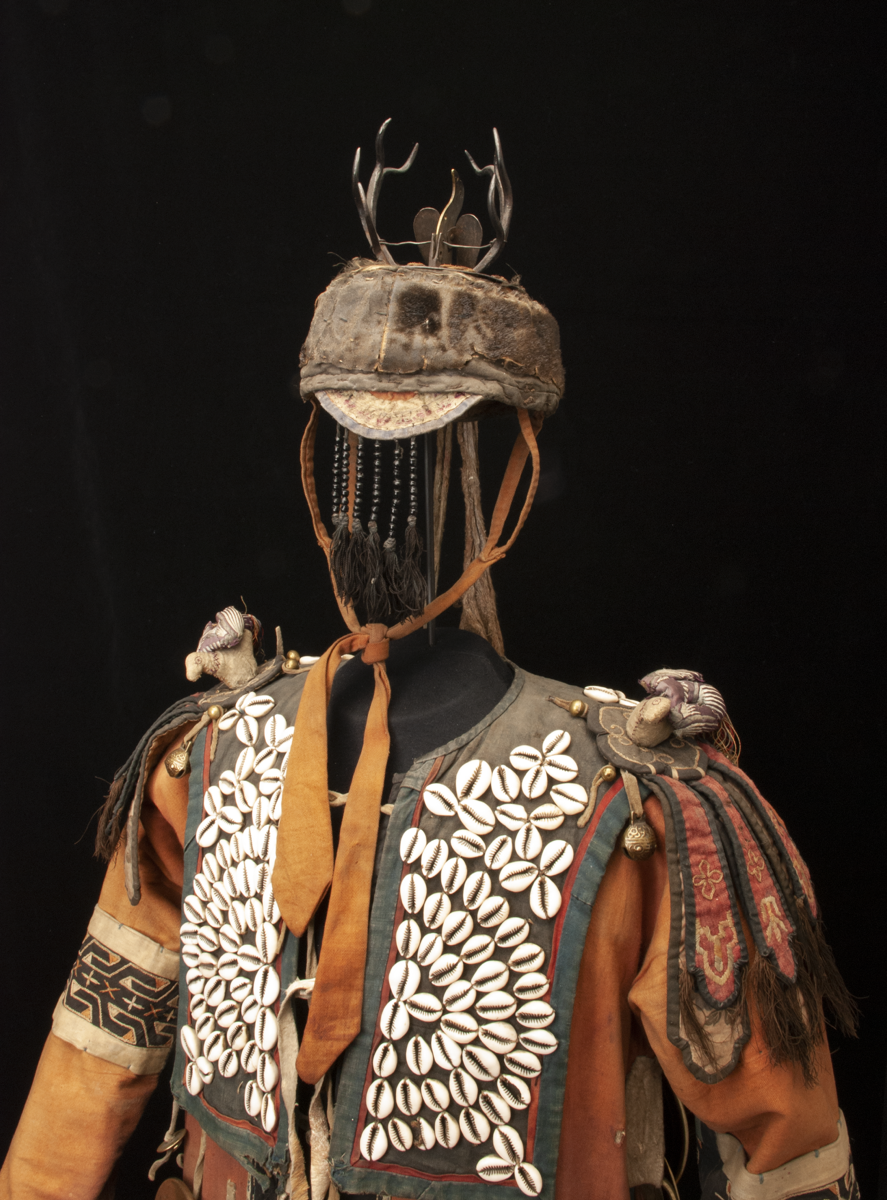
The number of antler points on the headdress is significant and indicates status. The highest number is seven, and this headdress has four points. The beads at the front are unusual as the shamans’ face should be hidden when in a trance. There are normally more and the whole face is covered, so some strands may be missing
There is an eagle figure on each shoulder [bright blue textile is visible under the wings- suggesting that the colour has faded significantly.] The headdress also has an eagle in the centre. Eagles are sacred to the Northern Tungus. They can fly everywhere and are very powerful birds. They can swoop on small animals and even children. This is why babies are tied into the cradles which are also tie to trees. This protects them from wolves and snakes too. [The rear of the coat has pendants of ferret fur, these are considered sacred animals and only shaman can touch them. If ordinary people do, they can fall sick.
[Sarah-Jane Harknett asked about the antlers and if symbolism related to their loss and regrowth can be attributed to the Shaman’s costume, as speculated by some]. Professor Meng replied that the antlers were used in hunting and worn for disguise, like the others in the exhibition. When a hunter wears a hat with the antlers, an outfit made of deer skin as camouflage and uses the wapiti caller, the deer only sees one of their own. Need to get within 50m of a deer to shoot it.
Two men may engage in a competition or bet with each other that one of them can sneak up on a sleeping deer and put a money coin on the sleeping deer and get away, while the other will suggest he can sneak up and remove the coin from the still sleeping deer. Oroqen people are very light footed almost as if they were flying through the forest’.
The large copper mirrors on the back are traded from China and there are many stories associated with mirrors. If China refuse to trade with the Oroqen, then there could be war according to Chinese histories. The Northerners would attack and take large laden wagons back home like Genghis Khan did! Mirrors reflect the evil spirits and ghosts, so that the shaman becomes aware of their presence and can then chase them away. They do not become visible per se but as the shaman has a supernatural mind and is clairvoyant and is assisted by the mirrors’ reflections.
Before the shaman starts a ritual, candles are lit and the rhythm of drums connects the shaman to the eternal sky- gods, and the shaman sends messages to them and hears their reply. The shaman then interprets the replies. During the ceremony the shaman is in a trance and unaware of the surroundings]. They can collapse into unconsciousness for 3-4 hours and wake up on their return to the human realm. The ceremony combined with the weight of the outfit is a significant undertaking and not easy, can get very physically intense and sweaty. Upon their recovery the shaman will know their next step or action, such as chase away spirits, heal the sick or predict the future.
But many people believe in the shaman as they are often right. Genghis Khan consulted shaman before embarking his activities so he would know who, when and where to attack. He never lost a war! There is a story that he once spent 3 days and nights on a mountain [without sleep or food or drink] with a shaman waiting for a prediction and then attacked the Middle East. Details are written in the Secret History of the Mongols.
Shamans believe that individual animals have sacred spirits and will embroider images of those animals that have special spiritual qualities that the Shaman may relate to. Each shaman will pick their own spirit guardian or animal e.g. bear, roe deer, even rabbit. Here the shaman has embroidered tigers, which used to be very common then- presumably when the costume was collected'.
Event Date 28/1/2019
Author: rachel hand
Context (Physical description)
B is a separate collar piece decorated with feline figures currently attached to the costume 1933.377 for display.
The item currently stored in (and noted incorrectly on the box list as B) is numbered only 1933.377 but was presumably attached to the costume when it was acquired. R. Hand 2015.9.21
Event Date 7/11/2019
Author: rachel hand
Context (Amendments / updates)
3D photography was undertaken by Prof. Sarah Kenderdine and Paul Bourke for the Experimental Museology at the Ecole Polytechnique Federale de Lausanne, as part of the Orochon loan to the City University of Hong Kong.
Event Date 1/4/2019
Author: rachel hand
Description (Physical description)
Shaman's heavy cotton coat decorated with large copper alloy metal discs, embroidered cuffs, and a bird on each shoulder. With three black fabric horizontal bands at base decorated with large brass bells. The discs are secured to the cotton coat with hide cords. The largest disc at the rear and the birds are detachable via hide loops and metal coin 'buttons'.
B. is a shoulder apron decorated with cowries and metal embroidered felines which is also detachable via hide loops and metal coin 'buttons'.
Two aprons are associated with coat.
Event Date 6/5/2021
Author: rachel hand
Context (References)
A detailed description and analysis of the shaman's costume and related items (1933.377-382) is offered in: E.J. Lindgren, 'The Shaman Dress of the Dagurs, Solons and Numinchens in N.W. Manchuria', Geografiska Annaler, 1935, Vol.17, Supplement: 'Hyllninngsskrift Tillagnad Sven Hedin' (1935), pp.365-378.
Event Date 19/1/2023
Author: Flo Sutton
Description (Physical description)
Samashi. Costume of a female shaman: a heavy cotton coat hung with large brass discs, with embroidered cuffs and a bird on each shoulder. There are three horizontal bands of black fabric at the base strung with spherical brass bells. The discs are secured to the cotton coat with hide cords. The largest disc at the rear and the birds are detachable via hide loops and coins serving as buttons.
Event Date 1/3/2023
Author: Flo Sutton
Description (Physical description)
Samashi. Shaman's costume, comprising a heavy red cotton dress- or coat-like garment [.1], ornamented with embroidered cuffs and hide tassles as a trim. There are various sizes of brass mirrors hanging from the front and back of the garment, all with the smooth side facing out. The largest mirror, from the back of the coat, is now detached [.2]. There are also various sizes of brass spherical bells hanging in rows near the bottom on the garment front.
Event Date 8/3/2023
Author: Flo Sutton
FM:291434
Images (Click to view full size):