Accession No
2017.59.1-2
Description
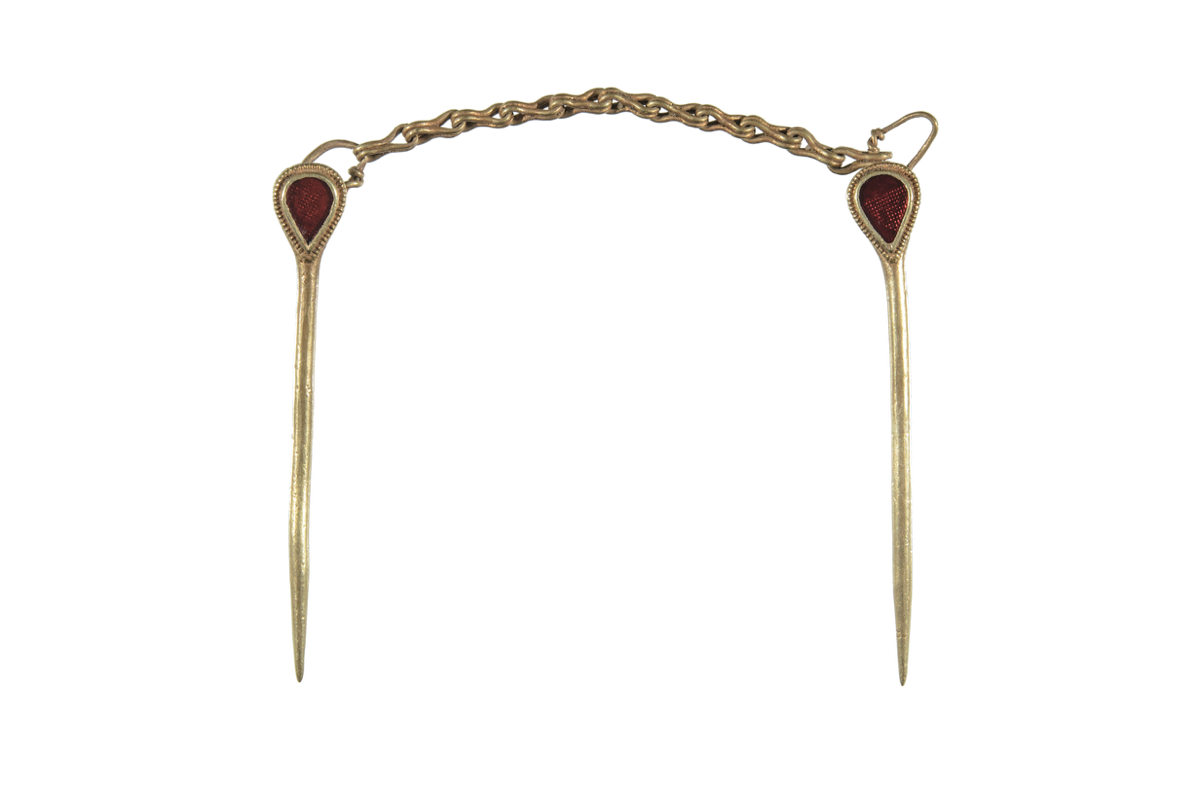
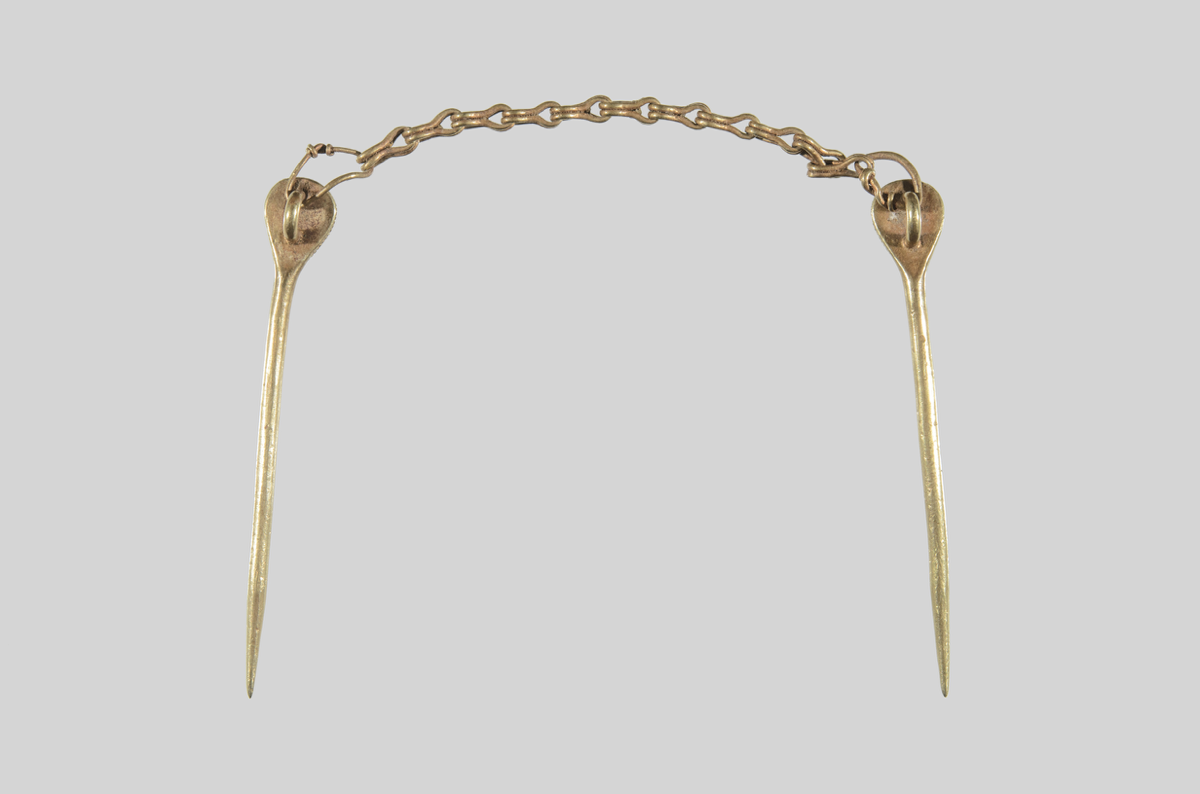
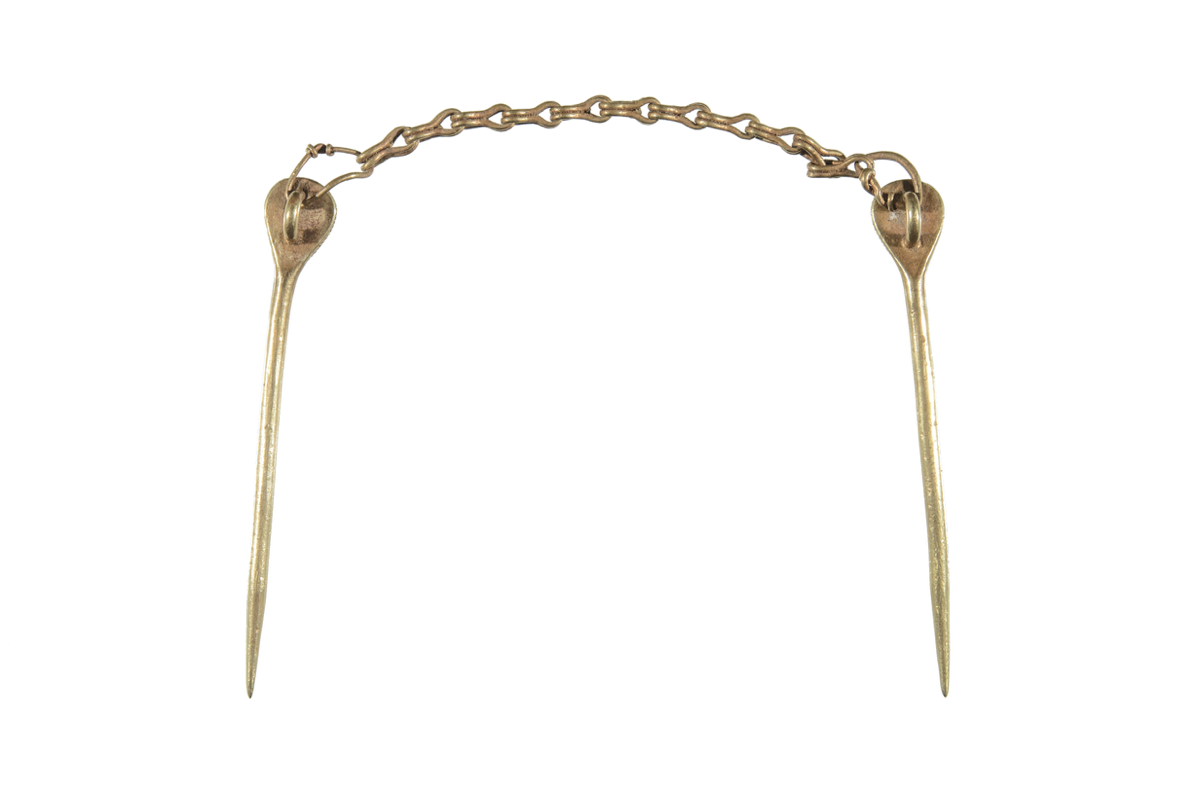
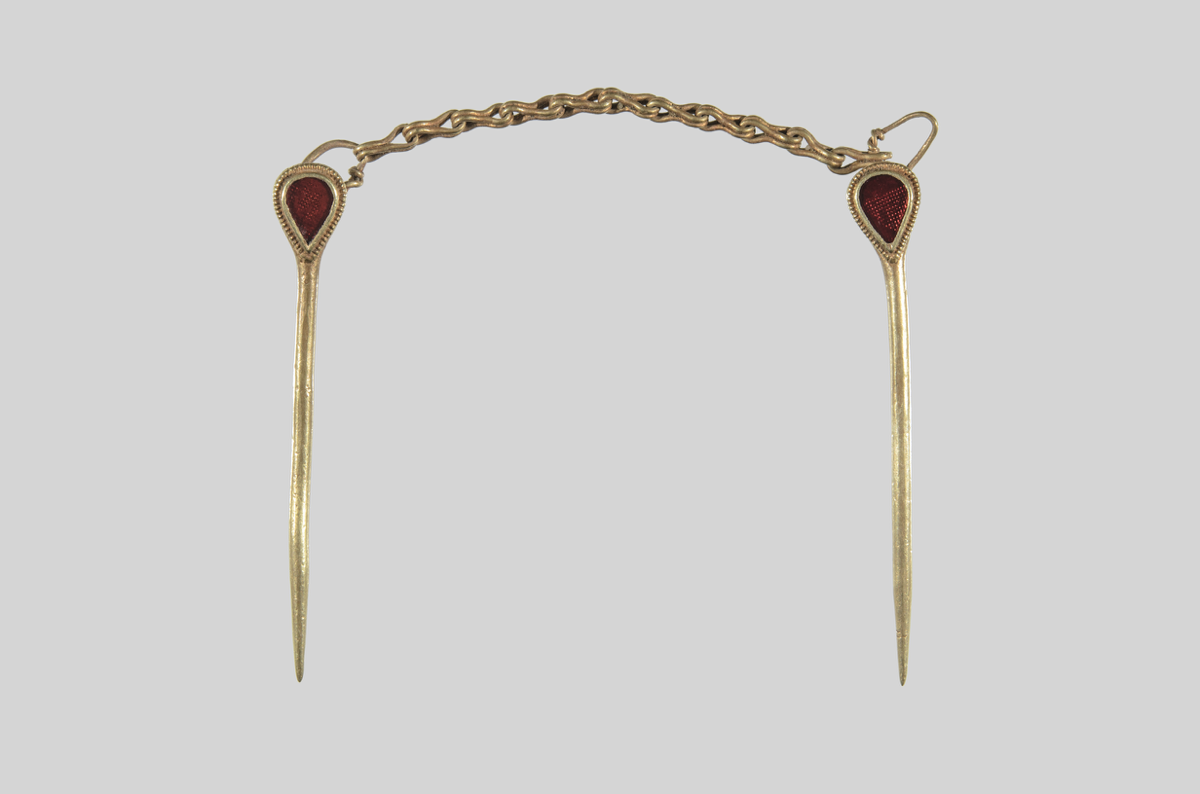
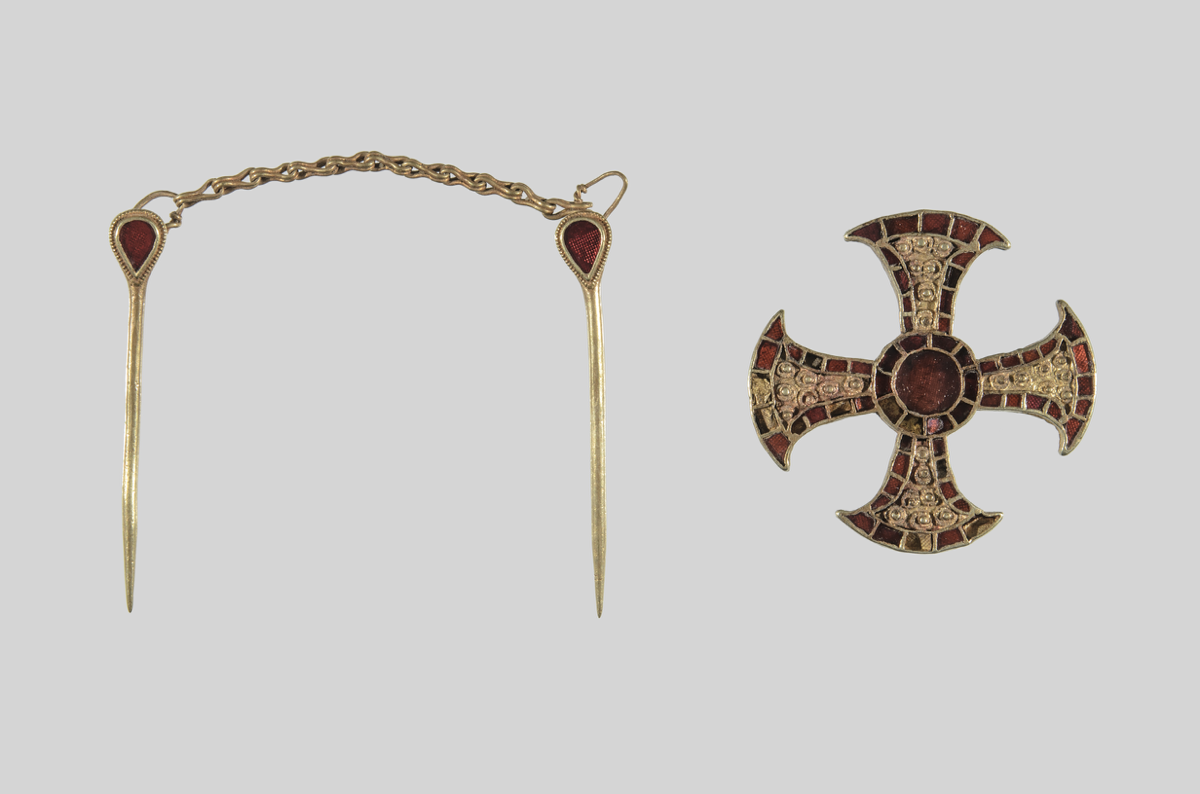
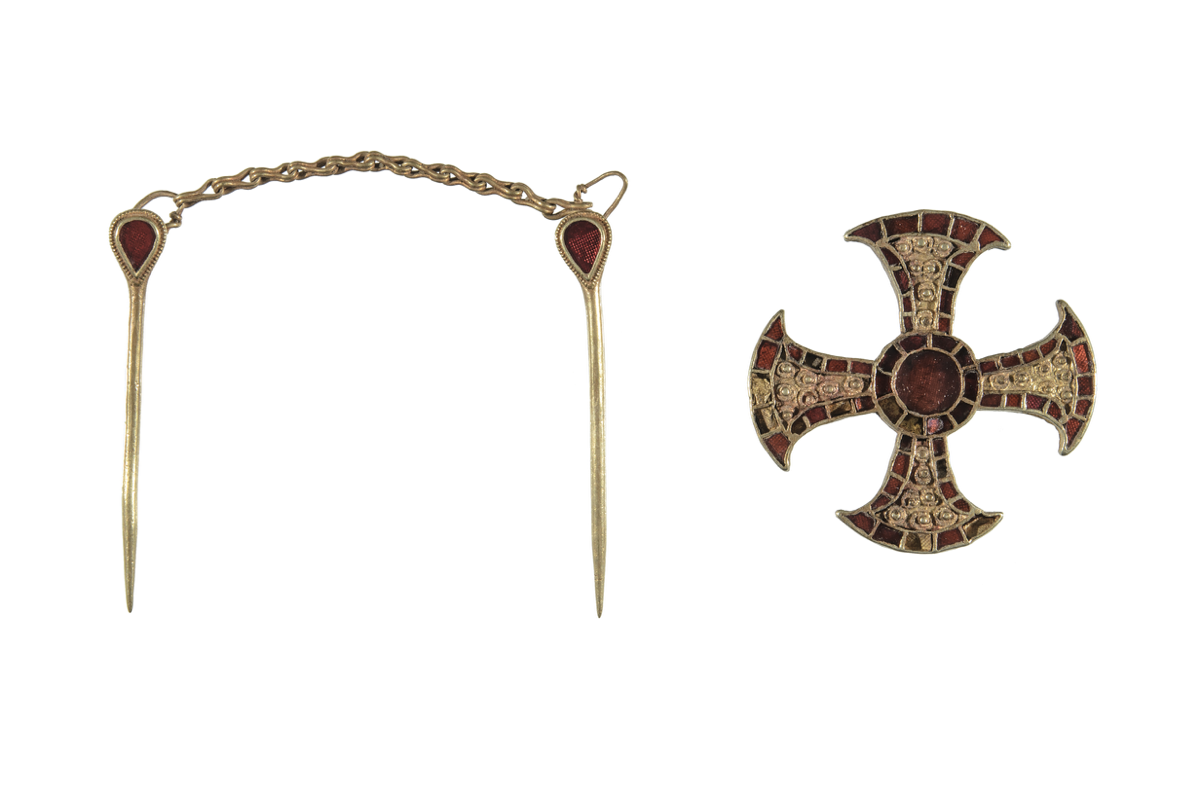
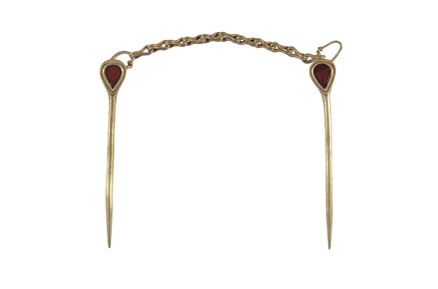
Gold and garnet linked pins. Identical gold pins, with plain tapering shafts and flattened heads. To each head has been applied a gold setting, surrounded with a beaded border, inset with a flat teardrop-shaped garnet backed with gold foil impressed with a waffle pattern. An attachment loop is soldered at the back of each pin's head. The gold chain, consisting of 11 double loops, is attached to the pins by two gold slip-knot rings.
Place
Europe; British Isles; England; Cambridgeshire; Cambridge; Trumpington; Trumpington Meadows
Period
Anglo Saxon 7th century
Source
Grosvenor Britain & Ireland [donor]; British Museum Treasure Trove; Cambridge Archaeological Unit [excavator]
Department
Arch
Reference Numbers
2017.59.1-2; MAA: MN0159; <8986> [CAU Catalogue no.]; 2012T52 [Treasure no.]; CAM-A04EF7 [PAS no.]
Cultural Affliation
Material
Metal; Gold; Stone; Garnet
Local Term
Measurements
40mm Weight 0.00161kg
Events
Context (Field collection)
Excavated from Context 3083.
Event Date 19/2/2011
Author: Imogen Gunn (admin)
Context (Field collection)
In 2010-2011, the Cambridge Archaeological Unit (CAU) undertook excavations along Trumpington's riverside in advance of the construction of the Trumpington Meadows housing development by Grosvenor Britain & Ireland. During the excavations an Early Anglo-Saxon settlement was found and, within the settlement, four burials. The burials were clustered together in a row, although radiocarbon dates indicate that they all may have been buried at different points in the seventh century. On Saturday, 19 February 2011 Grave 1 was excavated, which revealed a rare bed burial. It contained the remains of a girl, aged between 14 and 18 years, who was buried with a gold and garnet cross, linked gold and garnet pins, a chatelaine, a comb and a knife. She had been dressed in fine linen tabbies and a bead-edged shawl and was laid on a wood-framed bed, with a wool blanket covering a mattress. This grave is almost certainly the last burial of the four.
Event Date 19/2/2011
Author: Imogen Gunn (admin)
Context (Found together / assemblage)
The teenage girl had been buried with the pectoral cross and the pins at the upper chest; the chatelaine lay between the upper legs but would have been suspended from the waist; the iron knife lay under the elbow of the left arm, but may also have been suspended from the waist; and an antler comb were found at the right side of the waist. An ash box or casket with a decorative hasp may also have been buried with her, above the left shoulder.
Event Date 19/2/2011
Author: Imogen Gunn (admin)
Context (Auction / Sale)
The cross and pins, together with the associated burial, were declared Treasure under the terms of the Treasure Act 1996. In December 2017 the landowners, Grosvenor Britain & Ireland, waived their claim on the reward thereby donating the whole burial (2017.58-2017.74) to MAA.
Event Date 12/2017
Author: Imogen Gunn (admin)
Context (Production / use)
Evans et al. note that 'the fineness of this pin-set, together with its location at or near the neck, strongly supports the suggestion that they could have been used to secure a veil to an outer garment... or to fasten an inner chemise with vertical neck opening' (p 329)
Event Date 2018
Author: Imogen Gunn (admin)
Context (References)
Evans, C., Lucy, S. and Patten, R. (2018). 'Anglo-Saxon Burials and Settlement'. In Riversides: Neolithic Barrows, a Beaker Grave, Iron Age and Anglo-Saxon Burials and Settlement at Trumpington, Cambridge. Cambridge: McDonald Institute for Archaeological Research. pp. 307-396. Figs. 5.5, 5.5.2, 5.15.1-2
Event Date 2018
Author: Imogen Gunn (admin)
Context (Analysis)
Analysis of the girl's teeth suggest episodes of nutritional deficiency or childhood illness. In addition, lesions in the roofs of both eye sockets suggest that she suffered from iron deficiency, the result of a diet low in iron, parasitic infection, infectious disease or excessive blood loss (Evans, et al. p 311). Radiocarbon dating places this burial in the second half of the 7th century (666-710, 66.5% probability), and the last of the four burials found in the settlement. (Evans, et al. pp. 320-321).
Event Date 2018
Author: Imogen Gunn (admin)
Description (Physical description)
Gold and garnet linked pins. Identical gold pins, with plain tapering shafts and flattened heads. To each head has been applied a gold setting, surrounded with a beaded border, inset with a flat teardrop-shaped garnet backed with gold foil impressed with a waffle pattern. An attachment loop is soldered at the back of each pin's head. The gold chain, consisting of 11 double loops, is attached to the pins by two gold slip-knot rings.
Event Date 27/2/2018
Author: Imogen Gunn (admin)
Context (References)
Leggett, S., A. Rose, E. Praet, and P. Le Roux. (2021). ‘Multi-tissue and multi-isotope (d13C,d15N,d18O and87/86Sr) data for early medieval human and animal palaeoecology’. Ecology, 102(6).
Event Date 2021
Author: Imogen Gunn
Context (References)
Brownlee, Emma. (2022). 'Bed Burials in Early Medieval Europe'. Medieval Archaeology, 66(1). pp. 1-29
Event Date 2022
Author: Imogen Gunn
Conservation (Assessment Only)
CON.2022.5420 | Assessment Only
Event Date 9/8/2022
Author: Kirstie French
Loan (Exhibition)
Laing Art Gallery, 17/09/2022 to 04/12/2022, The Lindisfarne Gospels [TBC]
Event Date 17/9/2022
Author: Imogen Gunn (admin)
Exhibition (Li Ka Shing Gallery)
EXH.2023.12 | Beneath Our Feet: Archaeology of the Cambridge Region
Event Date 21/6/2023
Author: Imogen Gunn
FM:279484
Images (Click to view full size):