Accession No
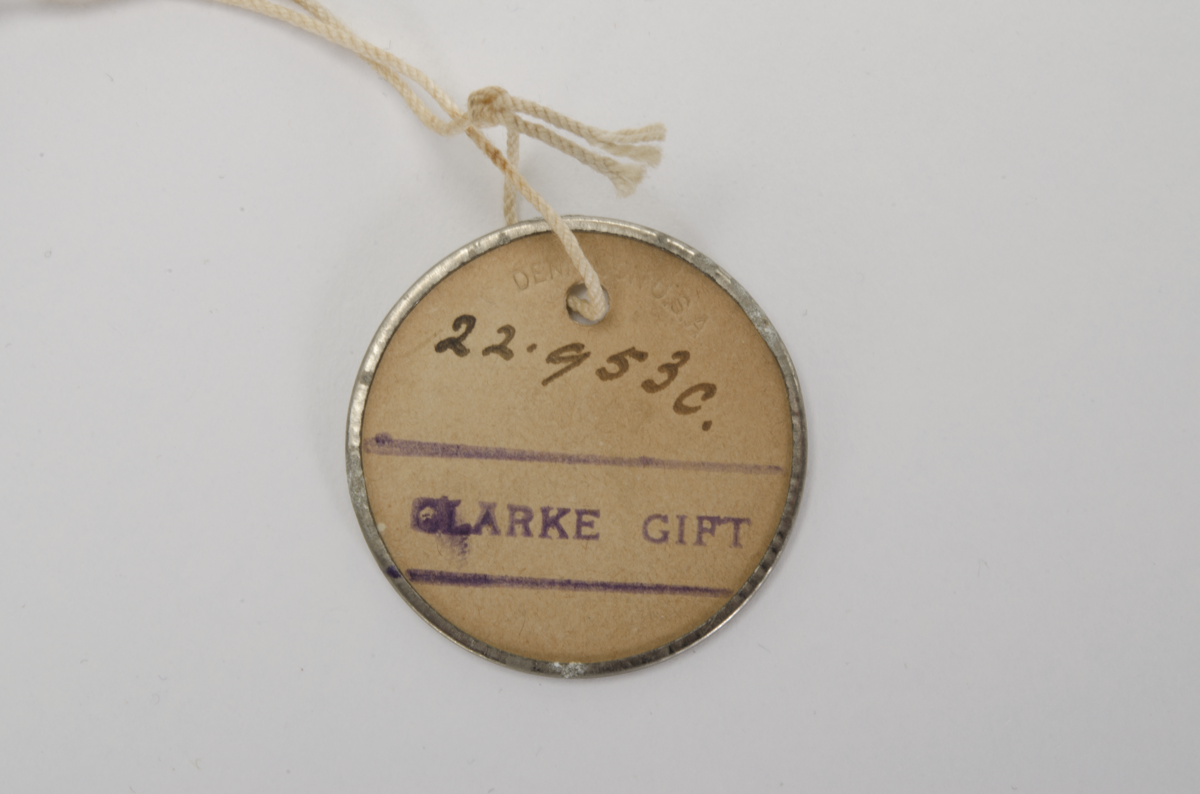
1922.953 C
Description
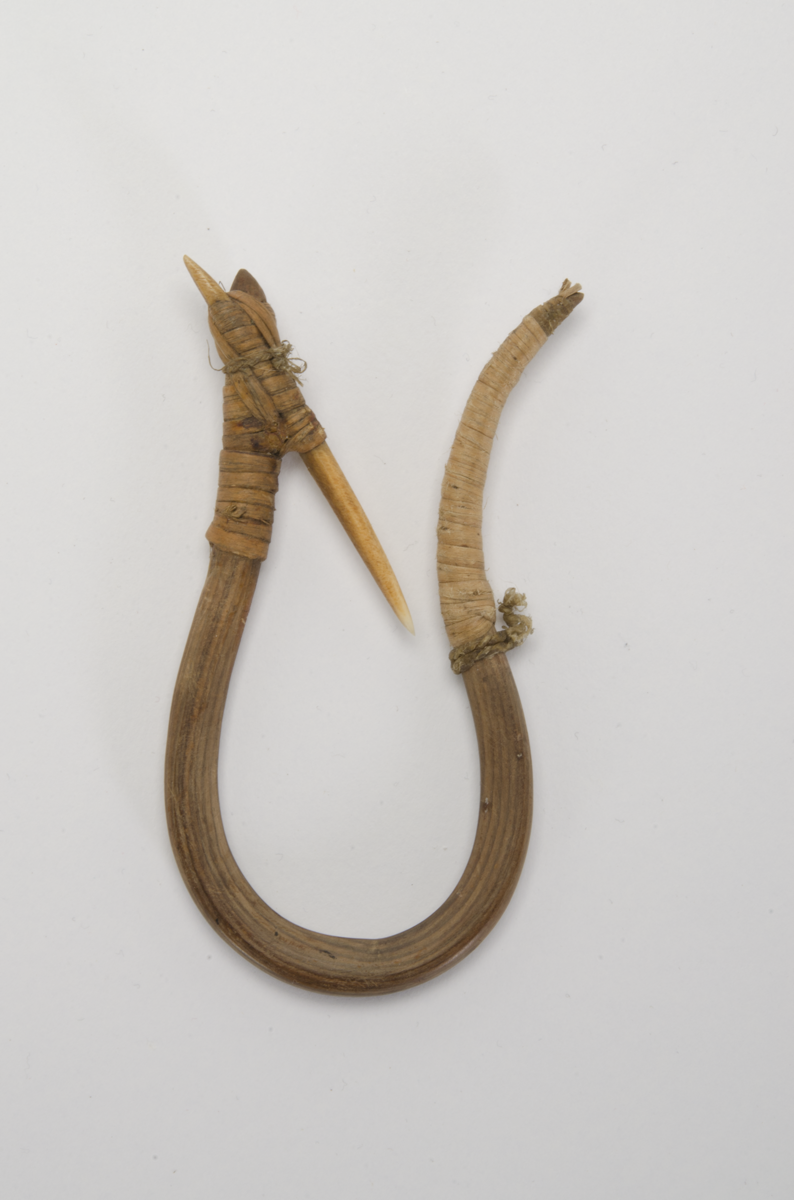
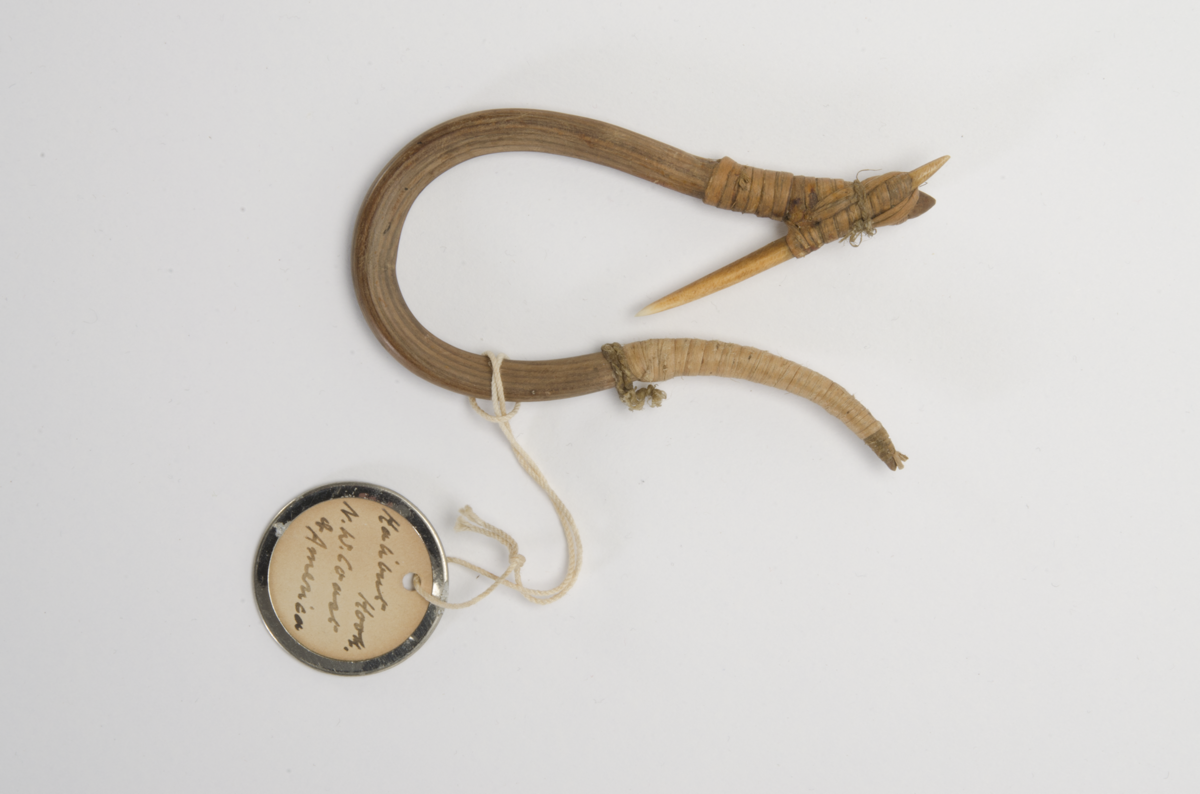
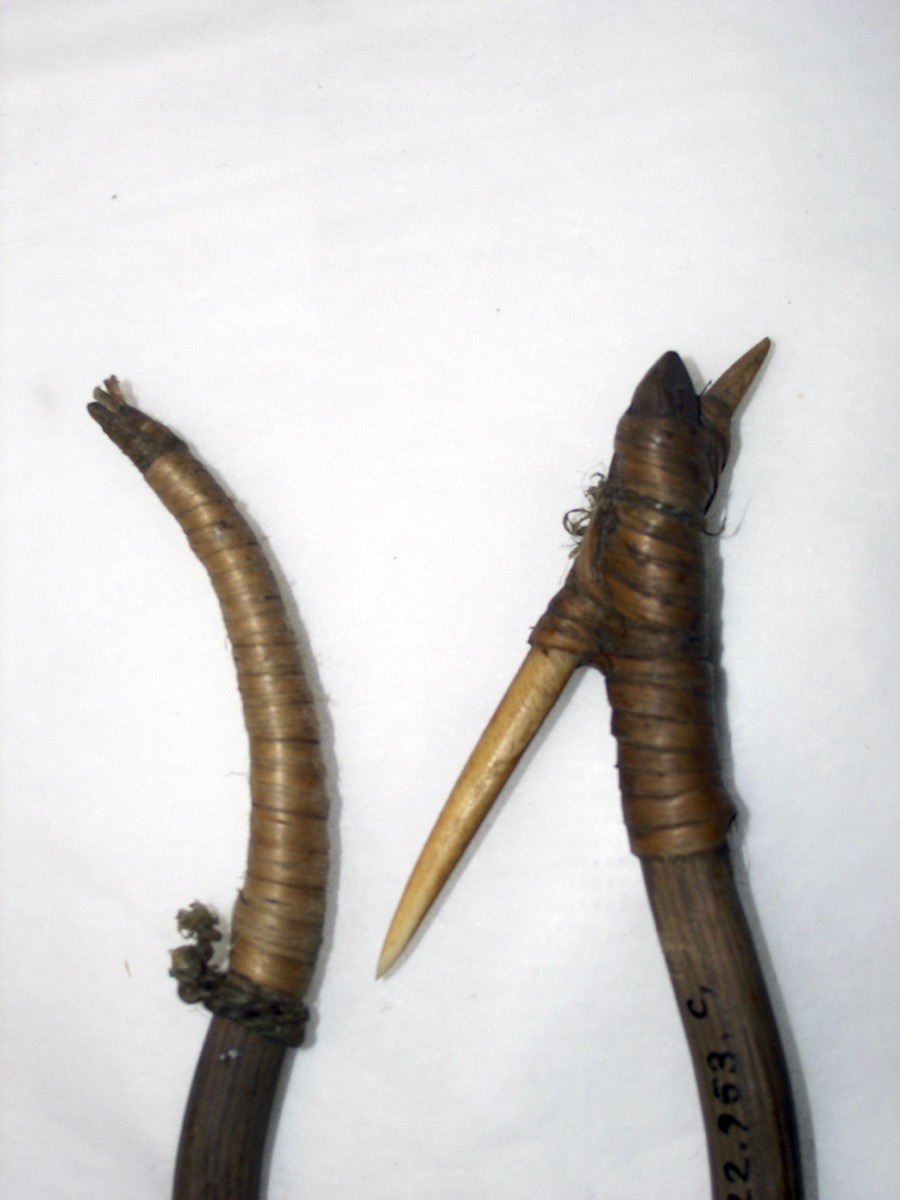
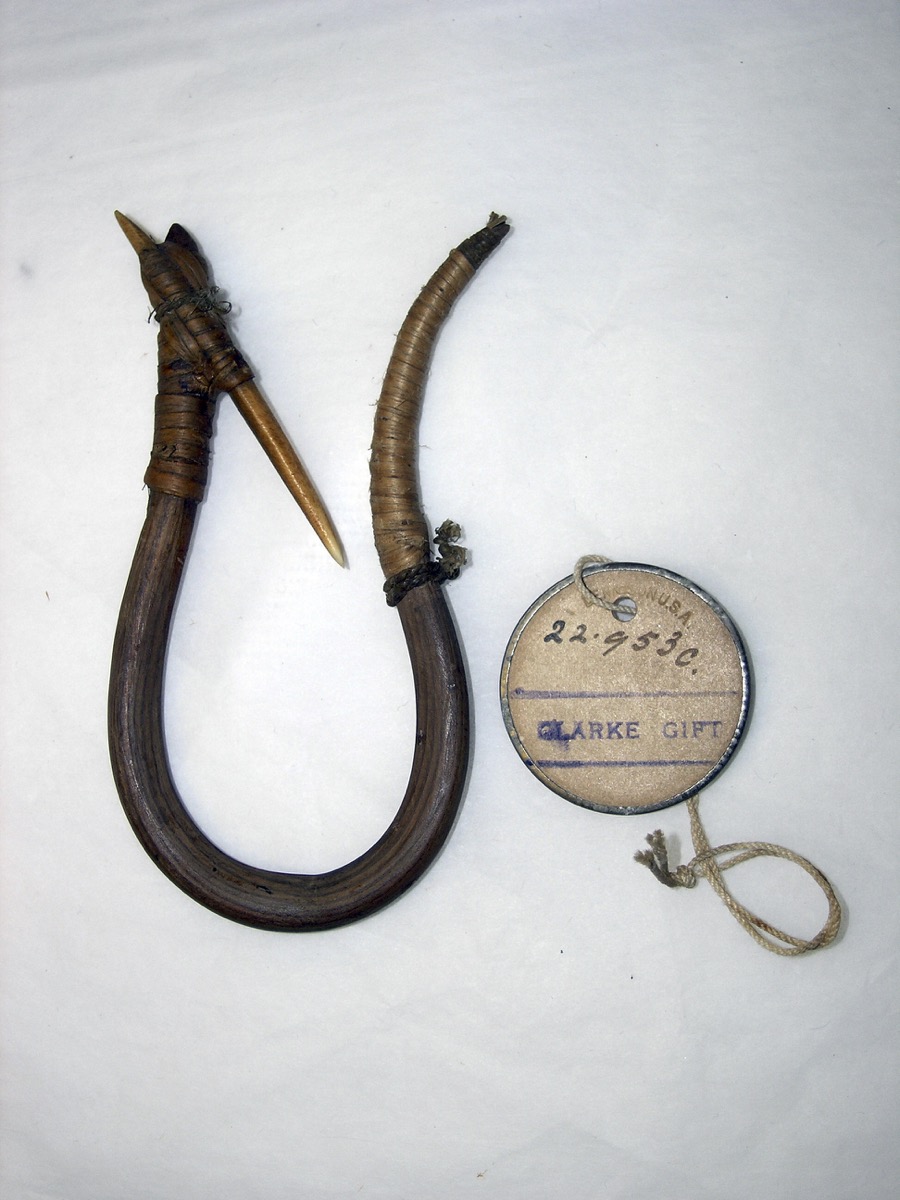
Bent wood cod hook with bone barb lashed on with bark.
Place
Americas; North America; Canada; British Columbia
Period
18th century
Source
Clarke, Louis Colville Gray (Dr)[donor]; Cook Collection; Leverian Museum; Widdicombe House
Department
Anth
Reference Numbers
1922.953 C; MAA: 1922.953 A-C
Cultural Affliation
Northwest Coast; Nuu-Chah-Nulth [Nootka]
Material
Wood; ?Hemlock; Bone; Bark
Local Term
Measurements
48mm x 96mm
Events
Context (Production / use)
Bent hooks were shaped by steaming, and amongst the Kwakiutl a mould was used to wrap the steamed wood around. The hook would be set with a piece of bait, possibly some octopus. The hook was then attached to a weighted line by a leader, often made from nettle fibre, the upper arm of the hook was that with the barb. The larger hooks were used for halibut fishing, and the smaller ones were secured in a series to a line for catching ling- cod, and sculpin.
Event Date
Author: Katrina Dring
Context (References)
Literature: See 'Artificial Curiosities' (1978), A. Kaeppler, p.276. Evidence: Leverian Museum. 3rd voyage.
Also see the 'Catalogue of the Northwest Coast Collection: Cambridge University Museum of Archaeology and Anthropology' (1996), Dr Gillian Crowther. (J.Tanner, May 1998).
cf. Fish hooks in "James Cook: Gifts and Treasures from the South Seas" (1998), edited by Brigitta Hauser-Schaublin and Gundolf Kruger, p. 340, fig. 318. (J. Tanner; February 1999).
See 'From Pacific Shores: Eighteenth-century Ethnographic Collections at Cambridge - The Voyages of Cook, Vancouver and the First Fleet' (J. Tanner, 1999:80).
See 'Artificial Curiosities from the Northwest Coast of America (J.C.H. King, 1981: cf. Monochrome Plate 80; 105-106).
Event Date
Author: Katrina Dring
Context (Amendments / updates)
Cook Collection: Captain James Cook undertook three world voyages around the globe from 1768 - 1779. The stated purpose of the first voyage (1768-1771) on the HMS Endeavour was to send a Royal Society team to observe the transit of the planet Venus from the vantage point of newly discovered Tahiti. However, the primary governmental motivation behind the first expedition was to establish the existence of ' Terra Australis Incognita' or the ' Great Southern Continent' , which was believed to exist in order to balance the great northern land mass. Cook set sail from Plymouth on Friday 26th August 1768 and headed to South America, round Cape Horn and westwards to carry out the experiment in Tahiti, and then went on to circumnavigate the globe in pursuit of the presumed continent.
The purpose of the second voyage (1772-1775) on the HMS Resolution and the HMS Adventure was to extend the search for the ' southern continent' . They sailed from Plymouth on 27 June 1772 and headed directly south past Cape Town and then set out on an eastward course of circumnavigation, crossing the Antarctic Circle several times en route in an effort to seek the imagined continent. The third voyage (1776-1780) on the HMS Resolution and the HMS Discovery, was concerned with the search for a Northwest Passage between the Atlantic and Pacific Oceans. They sailed from Plymouth on 13th July 1772, heading first for the Society Islands from whence they set course to search for the Northwest Passage. However, Cook was killed in Hawaii in 1779 and his command was taken up by Charles Clerke
More than 2000 extant pieces can be traced from Cook' s voyages (Kaeppler:1978), of which UCMAA has 215 identified objects. The majority of the material at UCMAA was collected from the Pacific, but also includes objects from the Pacific Northwest Coast of North America, the Northeast Coast of Asia and Tierra del Fuego in South America. Furthermore, all the three voyages are represented by objects in UCMAA' s collection. (J. Tanner, 1999).
Event Date
Author: Katrina Dring
Context (Field collection)
Collected by: ?Cook.Captain in 1778.
Event Date 1778
Author: Katrina Dring
Loan (Exhibition)
Royal Museums Greenwich
National Maritime Museum, Greenwich (11 July 2014– 4 Jan 2015); Folger Library, Washington, (19 March 2015 -23 August 2015); Mystic Seaport, Connecticut, USA (19 September 2015 – 28 March 2016); National Maritime, Museum, Australia, 5 May -30 October 2016)
, 11/7/2014 to 30/10/2016, Ships, Clocks & Stars: the Quest for Longitude at Sea
Event Date 11/7/2014
Author: rachel hand
Context (Display)
Exhibited: A-C were loaned to the Captain Cook Memorial Museum, Whitby in 'Smoking Coasts and Ice-bound Seas, Cook's Voyage to the Arctic' Feb- November 2008
Event Date 28/11/2016
Author: Rachel Hand
Context (Amendments / updates)
The original European tribal names and, where possible, current tribal names have both been given in separate GLT fields.
Event Date 28/11/2016
Author: Rachel Hand
Description (Physical description)
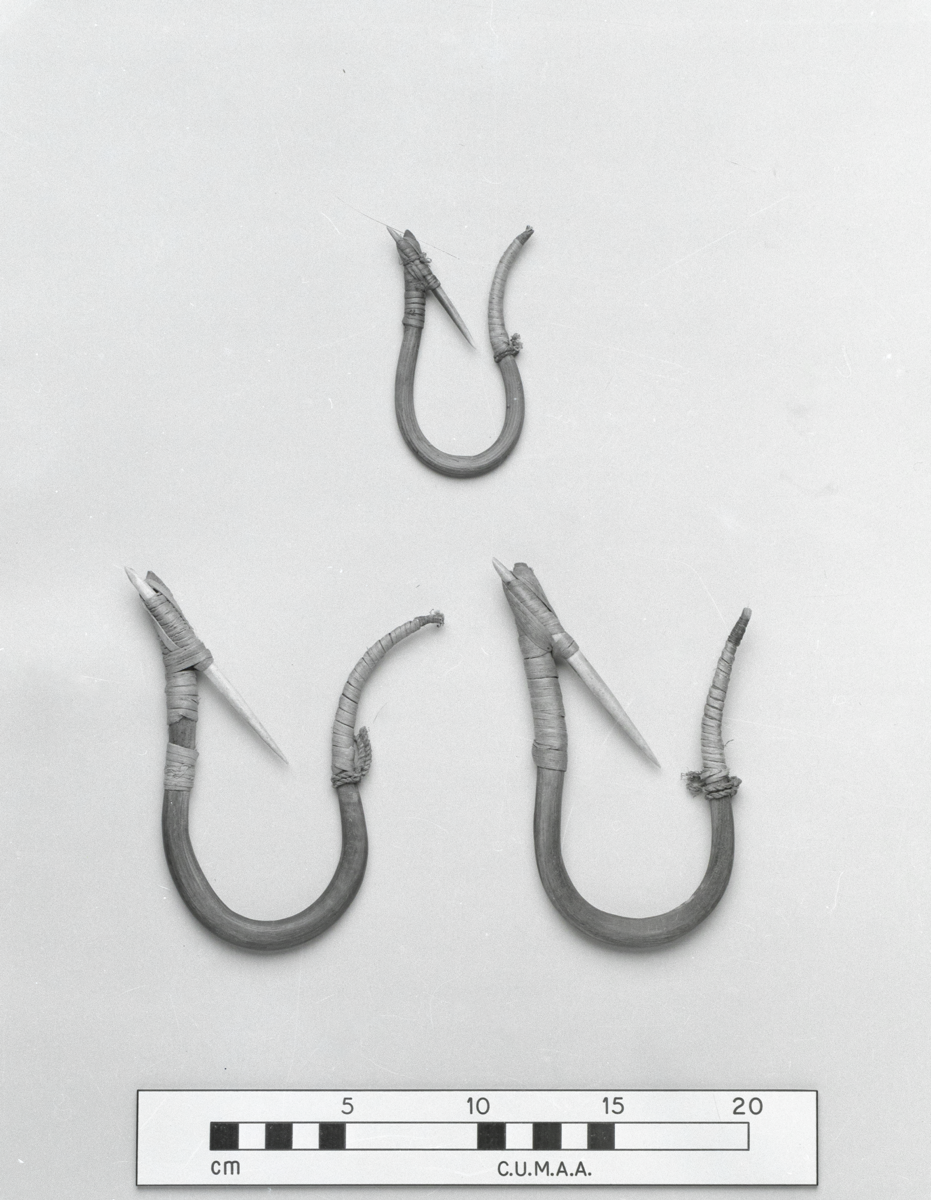
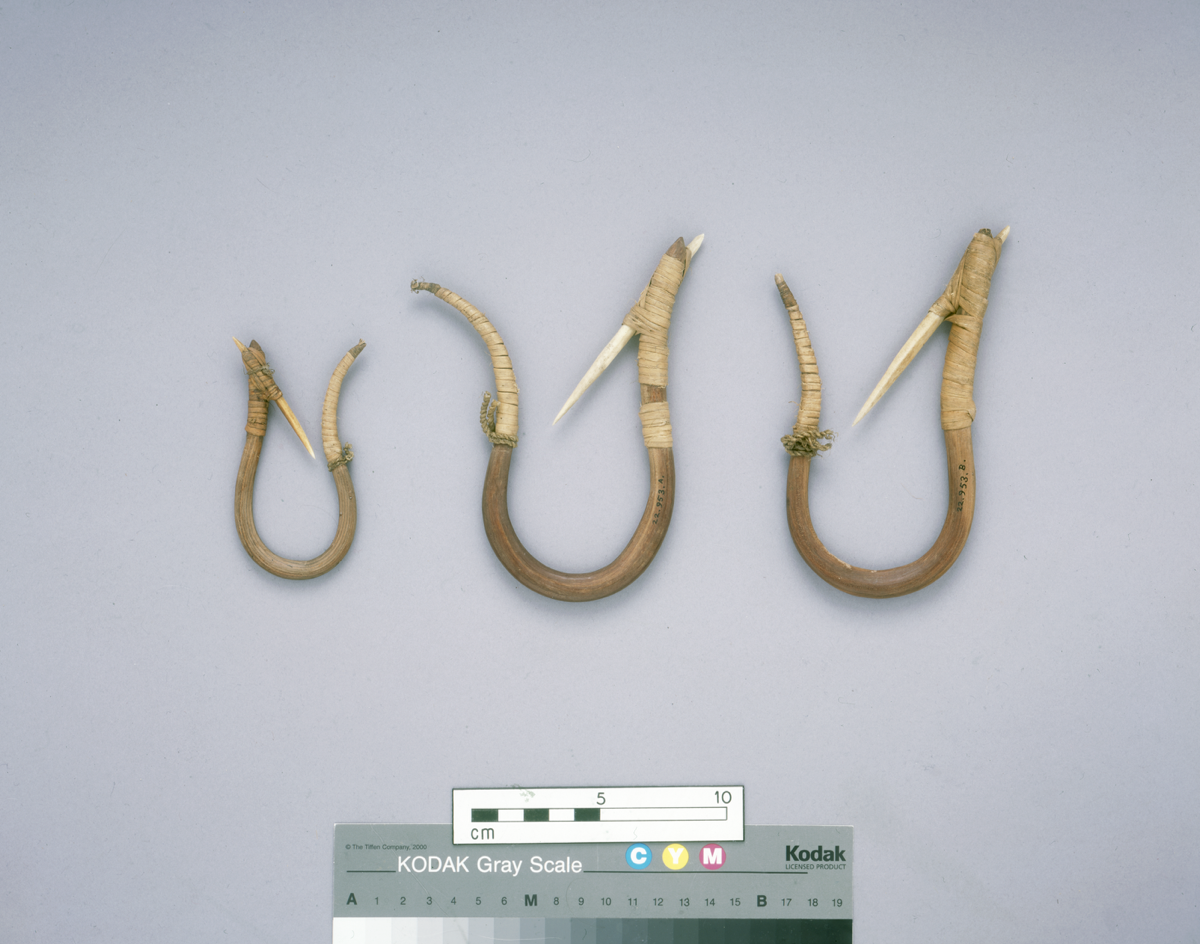
Card for 1922.953 A-C notes 'Three bent wood hooks with bone barbs lashed on with bark. The hooks have the remains of sinew leaders on the lower arm. A) & B) are halibut hooks, C) is a cod hook'.; Good.
Event Date 28/11/2016
Author: Rachel Hand
Context (Display)
Exhibited: On loan to 'Ships, Clocks & Stars: the Quest for Longitude at Sea', at the National Maritime Museum, Greenwich, 11 July 2014- 4 January 2015; Folger Shakespeare Library, Washington DC, 19 March- 23 August 2015
Mystic Seaport- the Museum of American and the Sea, 2019 September 2015 – March 2016
Australian National Maritime Museum, Sydney: 5 May 2016 – 30 October 2016. Returned to MAA 21 November 2016.
Event Date 28/11/2016
Author: Rachel Hand
Context (Amendments / updates)
The Holdsworths of Widdicombe House, Stokenham, Devon, were a wealthy merchant family. Collections from Widdicombe House were acquired by MAA between 1921 and 1922 probably at the instigation of curator Baron Anatole von Hügel, whose wife, Eliza, was related to the Holdsworth family through her mother.
Eliza donated several items to the museum in 1921 that she had probably purchased when parts of the estate were being sold off. The majority of the Widdicombe House material appears to have been purchased by von Hügel’s successor, Louis Colville Gray Clarke, and accessioned by the museum (along with a Baroness von Hügel acquisition) shortly after Clarke’s appointment in June 1922. A further item was accessioned in 1925, another six objects in 1927, 16 during the 1903s, with a final one in 2013. Scattered notes in accession registers, on catalogue cards and surviving labels record a first, second and third Widdicombe House Collection, deposited in 1922 by Baron von Hügel, which suggests that there may have been three separate groups of material that came to MAA, possibly deposited by von Hügel, but eventually paid for by Louis Clarke.
Research by Adrienne Kaeppler has revealed that the Holdsworth family acquired objects from the sale of the collections of the Holophusicon or Leverian Museum in 1806. The Leverian is known to have contained a large number of Cook voyage pieces, in particular third voyage pieces from the Pacific and Northwest Coast of America, as well as material from the First Fleet. Using a series of drawings commissioned by Lever from the artist Sarah Stone in the 1780s, Kaeppler was able to identify a number of artefacts and match them with items in the Leverian sale catalogue. Other Leverian Museum material was bought at J.C. Stevens Auction Rooms, (Stevens), in 1905 by von Hügel and later deposited/donated and may also be the source of other von Hügel pieces.
Kaeppler identified John Rowe, (a clergyman from Bristol), as the purchaser of 77 lots, made on behalf of his brother-in-law Richard Hall Clarke, of Bridwell House, Uffculme, Devon and Clarke’s son-in-law, Arthur Howe Holdsworth of Widdicombe House. According to Kaeppler, at least sixty artefacts in MAAs collections are most likely to be Cook voyage pieces and can reasonably be associated with Rowe’s purchases for Widdicombe House.
The MAA Widdicombe House collection encompasses 168 objects and includes items from North American Woodlands, Asia and Africa, that do not match any of the Leverian lots purchased by Rowe and which must have been acquired by the Holdsworths through other means.
For many years, the Holdsworth family were unaware of the Cook connection to their collections and believed them to have been acquired by a distant relative called ‘Admiral Gordon’. Consequently, MAA assigned Gordon as the collector for much of the Widdicombe House material and this is reflected in registers and catalogue cards. Despite extensive research, no Admiral
Gordon has ever been found and is now believed to have played no part in the history of these objects. For further information see: Adrienne Kaeppler, 2011. ‘Holophusicon: The Leverian Museum: An Eighteenth Century English Institution of Science, Curiosity and Art.’ Amiria J.M. Salmond, (publication pending). ‘Artefacts of Encounter: the Cook-Voyage Collections in Cambridge’ (Museum Ethnographers Group). Also see Bio entry for Widdicombe House.
(Rachel Hand, 12.01.2015)
Event Date 28/11/2016
Author: Rachel Hand
Context (Amendments / updates)
Catalogue card reads [handwritten in black ball point:] '22.953 A & B & C AMERICA. N.W. COAST. 3 halibut hooks. 2 large & 1 small. Clarke gift from Widdicombe House'. [Red circular sticker with cross in centre, top right of card.]
Probably part of donation listed in Annual Report for the year 1922, in Museum Annual Reports 1910-1981 (no page number), Appendix I, Donations: 'Clarke, Mr. L.C.G. 'weapons ornaments, etc, Tierra del Fuego, Cyrus, Egypt, Sandwich Islands, Tahiti, New Zealand and N.W. Coast of America (22.901-953B)'.
Accession register entry (Accessions 11 page 87) reads [handwritten in black ink:] '953 A B C[.] 2 Large halibut hooks & 1 small[.]' '[N.W. Coast of America]' [Louis CG Clarke.]" " [From Widdicombe House. Kingsbridge. S. Devon.]
Event Date 28/11/2016
Author: Rachel Hand
Context (References)
Kaeppler 'Holophusicon: The Leverian Museum' (2011:223) notes: 'A Nootka halibut hook was depicted by Stone, Sketchbook II: 42 upper left (Fig. 6.126 [Page 222]) but it has not been identified because of the similarity among artefacts of this type. It is similar to the hook in Vienna (103) and to hooks in Cambridge (22.953 A, B, C; Fig. 6.130 [Page 223].'
Reference compiled by Amiria Salmond during research for the ESRC funded project 'Artefacts of Encounters.
Sarah Stone's illustration (Sketchbook II:42), which could depict one of 1922.953 A-B (see Kaeppler (2011) above), also appears in Force & Force 'Art and Artefacts of the 18th Century: Objects in the Leverian Museum As Painted by Sarah Stone' (1968:161).
Event Date 28/11/2016
Author: Rachel Hand
FM:273799
Images (Click to view full size):