Accession No
1957.123 A
Description
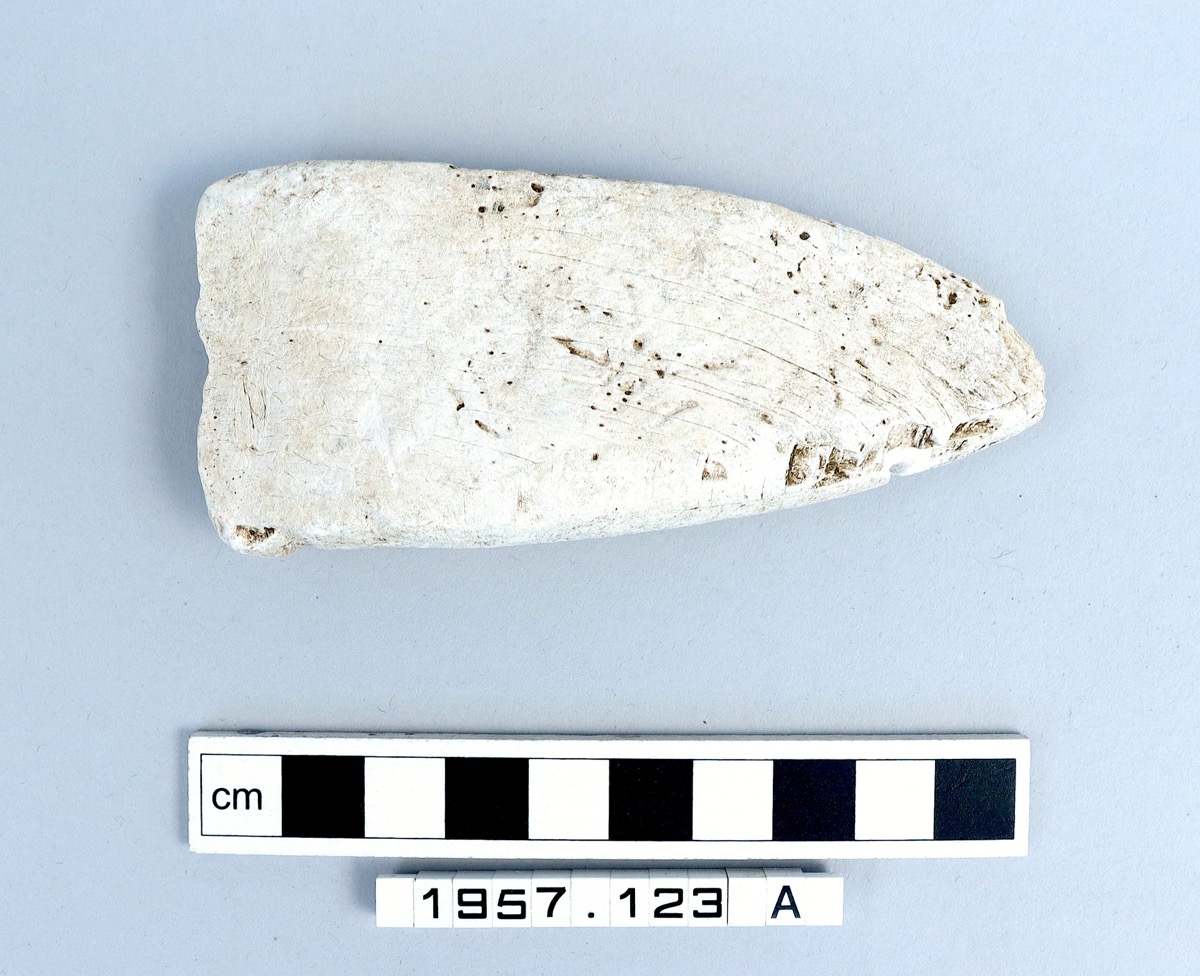
Shell adze, likely made from queen conch (Strombus gigas). The cutting edge is broken off and missing. The tool's form tapers and curves slightly along its length towards its narrow and damaged butt end. One face is flat; the other is curved. Both sides are flat. Pink-white in colour, with some brown accretions.
Place
Americas; Caribbean; Trinidad and Tobago; Tobago; Mount Irvine Coombe
Period
Pre-Columbian/Pre-Hispanic Saladoid
Source
Bushnell, Geoffrey Hext Sutherland [excavator and donor]
Department
Arch
Reference Numbers
1957.123 A
Cultural Affliation
Material
Shell; ?Strombus Gigas
Local Term
Measurements
102mm
Events
Context (Related Documents)
See archives relating to Bushnell's 1955 Tobago excavations (FR4/1/1 - FR4/1/7).
Event Date
Author: Josie Howl
Context (References)
Bushnell, G.H.S. (n.d.). Unpublished report on 1955 survey and excavations in Tobago. MAA Archive (FR4/1/4 text, FR4/1/2 plates).
Event Date
Author: Sophie Wardle
Context (Related Documents)
Cardboard box in which the object was stored reads: 'WEST INDIES - Tobago. MT. IRVINE COOMBE. 6 (ii) selected from superficial disturbed level'.
Event Date
Author: Josie Howl
Context (Field collection)
Mount Irvine Coombe, site 6. Excavated by Geoffrey Bushnell during his 1955 expedition to Tobago, funded by the Crowther-Beynon Fund and Louis C.G. Clarke.
Event Date 1955
Author: Josie Howl
Context (References)
Harris, M.H.G. (1988). ‘The Ceramics of Tobago and Barbados: A Report on Studies In Progress.’ In Saunders, N.J. and de Montmollin, O. (eds.), Recent Studies in Pre-Columbian Archaeology. BAR International Series 421. Oxford: British Archaeological Report. pp. 245-273.
Event Date 1988
Author: Sophie Wardle
Description (Physical description)
Shell adze.
Event Date 14/7/2016
Author: Josie Howl
Description (Physical description)
Shell adze, likely made from queen conch (Strombus gigas). The cutting edge is broken off and missing. The tool's form tapers and curves slightly along its length towards its narrow and damaged butt end. One face is flat; the other is curved. Both sides are flat. Pink-white in colour, with some brown accretions.
Event Date 20/5/2024
Author: Sophie Wardle
FM:271341
Images (Click to view full size):