Accession No
2015.1
Description
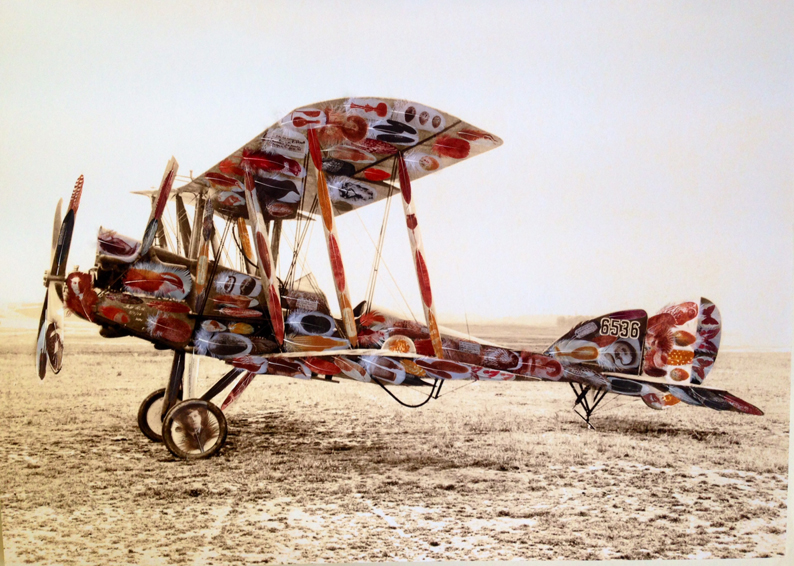
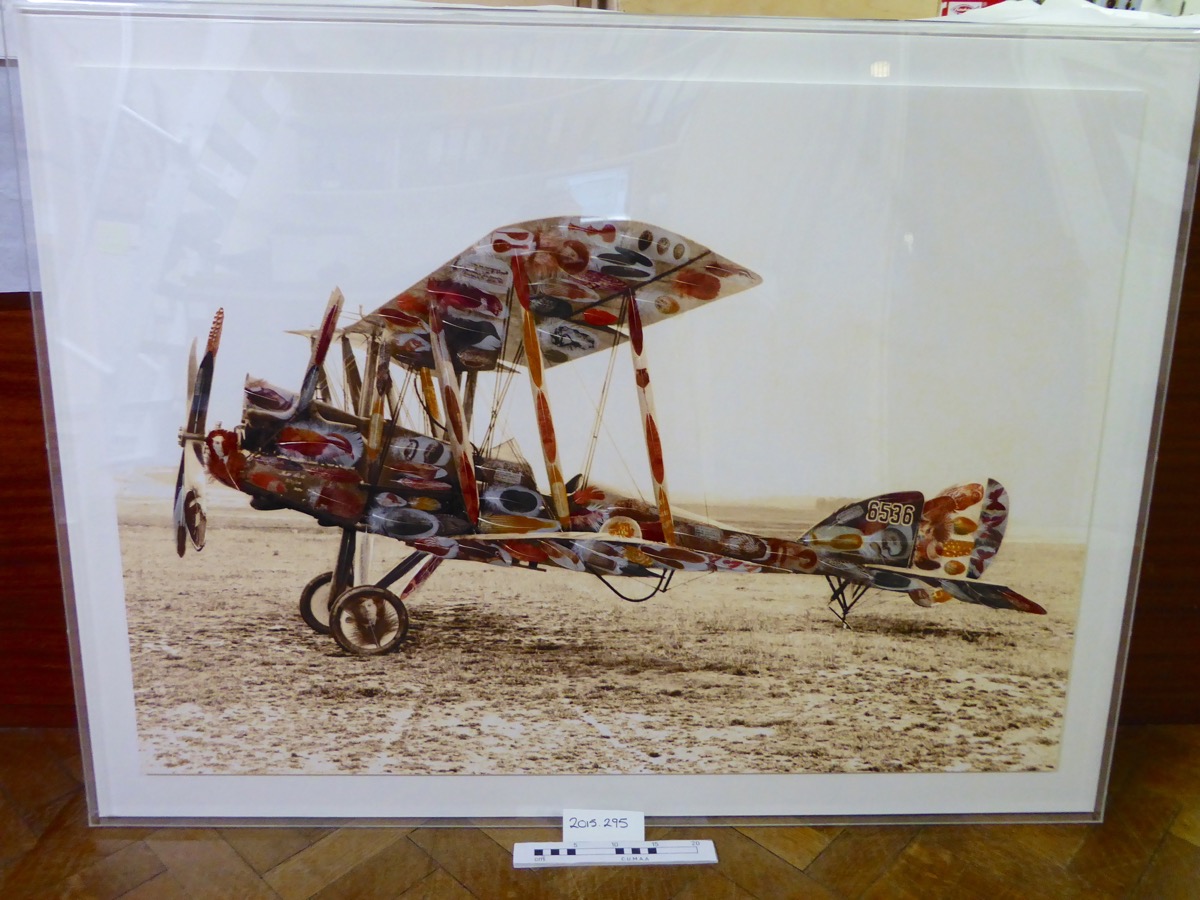
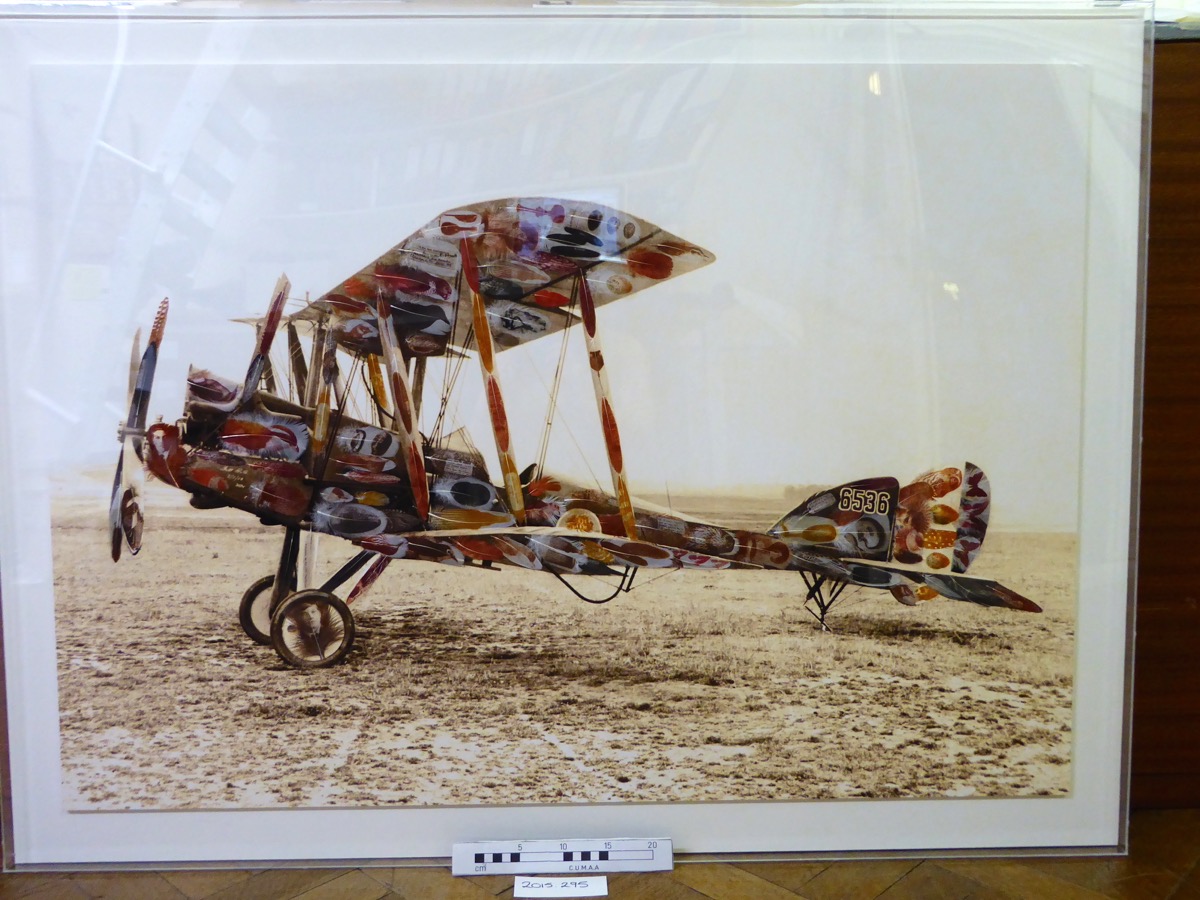
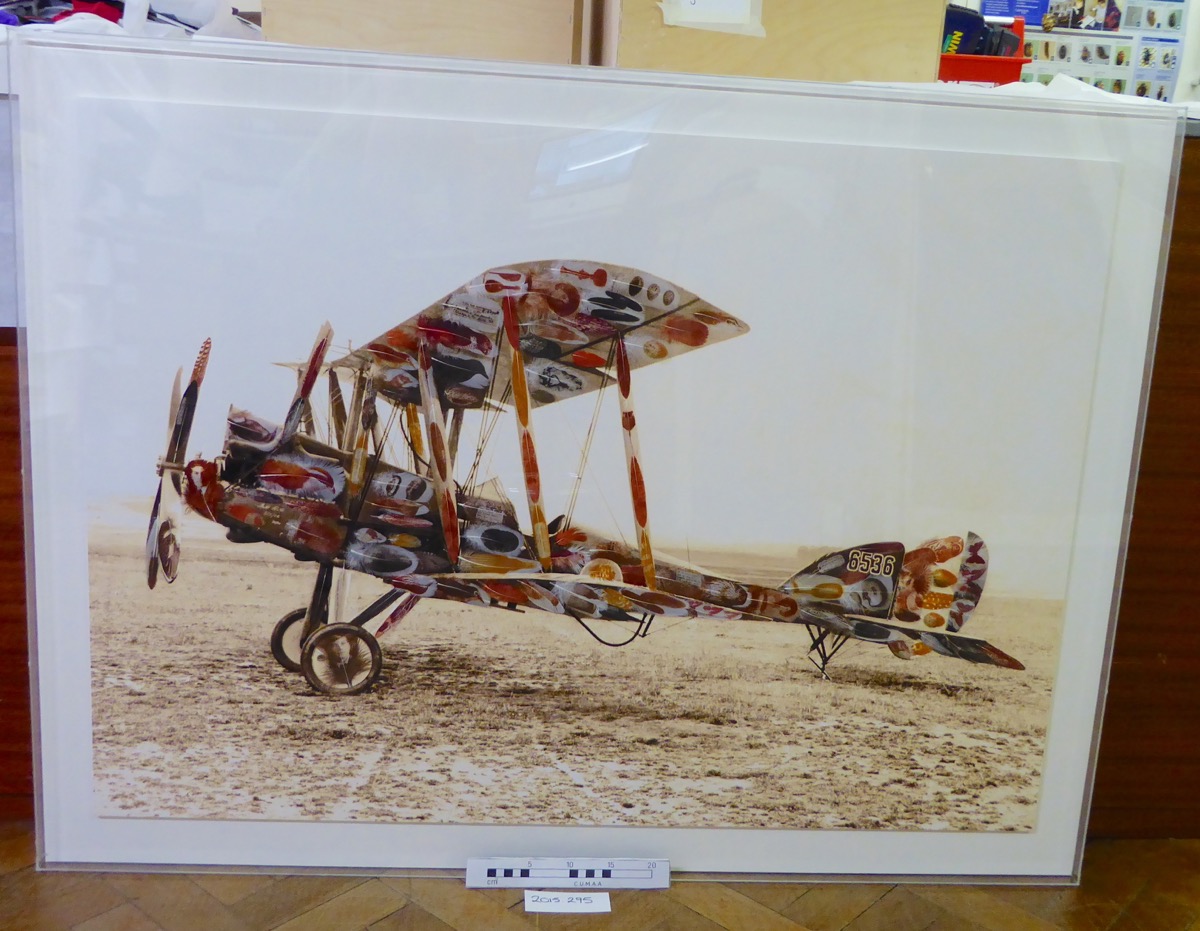
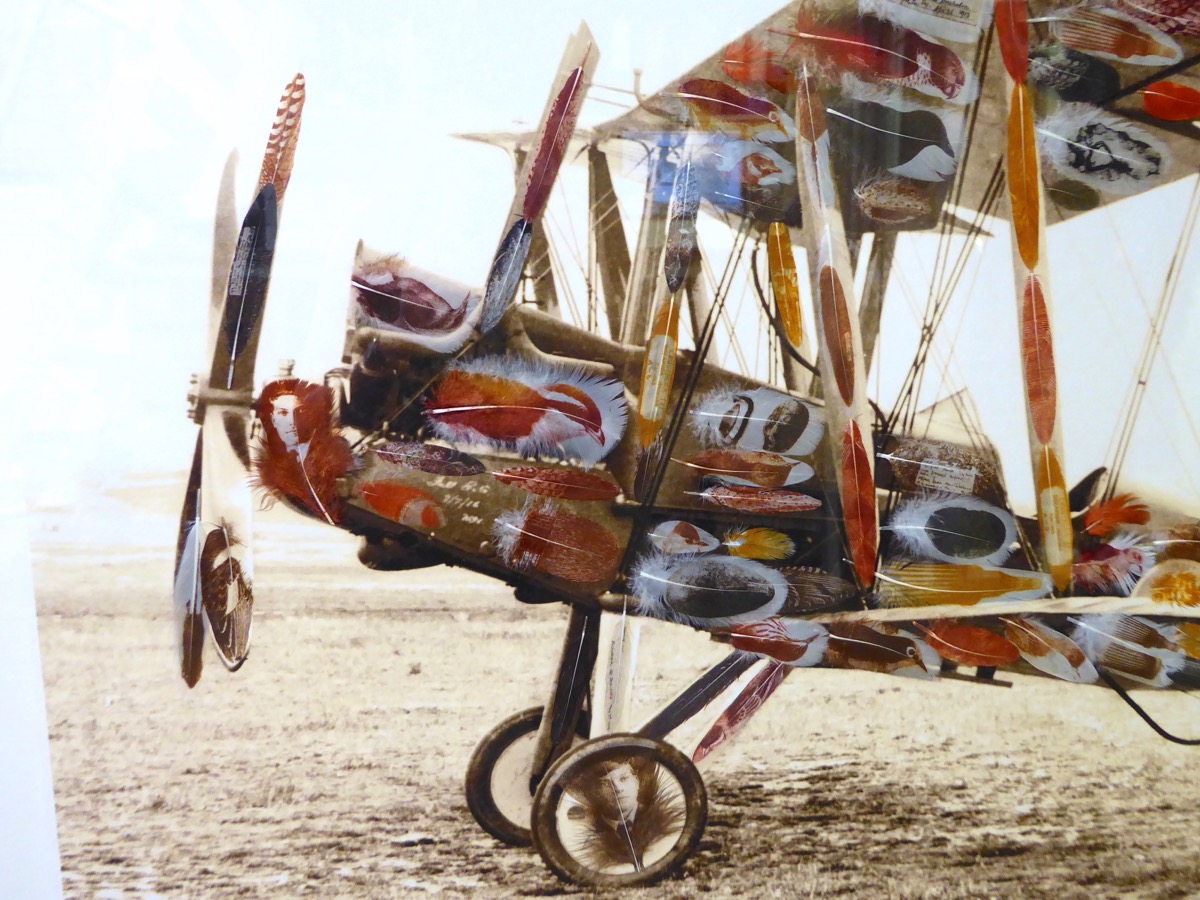
Archival giclee print by Rebecca Jewell, of a BE12 plane titled 'The Bird Man of Salonika'. The print has been collaged over with bird feathers, upon which are printed musical instruments, birds, birds' eggs, Kanak artefacts and images of Paul Denys Montague. He collected and/or made the objects represented on the feathers. The feathers are hand-printed using an etching press and oil-based inks.
Place
Europe; Northern Europe; British Isles; United Kingdom; Great Britain; England; London
Period
Source
Jewell, Rebecca [vendor]
Department
Anth
Reference Numbers
2015.1; MAA: 2015.295 [duplicate accession entry]
Cultural Affliation
Material
Feather; Paper; Pigment
Local Term
Measurements
Events
Context (CMS Context)
In the centenary year of the start of World War One, MAA invited artist Rebecca Jewell to create a piece of work inspired by Paul Montague’s life and collections. 'Birdman of Salonika' is the result of this commission. The art work was exhibited at MAA in 'Magic and Memory: Paul Montague in New Caledonia' in the Micro-gallery from 08/09/2014 - 23/02/2015.
Event Date 6/4/2016
Author: Remke Velden
Description (CMS Description)
Archival giclée print and collage by Rebecca Jewell titled: 'Bird Man of Salonika'. The artwork depicts a BE12 plane, similar to the one flown by Paul Montague in the WW1 Salonika campaign. The print is collaged with printed domestic goose, duck and turkey feathers. The images on the feathers include artefacts and natural history specimens collected by Montague, as well as photographs of him, museum labels, and the musical instruments he made. The feathers are hand-printed using an etching press and oil-based inks.
Event Date 6/4/2016
Author: Remke Velden
Context (CMS Context)
Information about the artist taken from her website rebeccajewell.com: 'Rebecca’s work is based on careful observational drawing as a way of seeing, recording, investigating and analyzing. During her time at the Royal College of Art she worked mainly in watercolour, drawing bird skins at the Natural History Museum and ethnographic artefacts made from feathers at the British Museum. Her interest in feather artefacts stems from a year spent living in the Highlands of Papua New Guinea (in 1982) and subsequently studying social anthropology at Cambridge University.
Rebecca is artist in residence at the British Museum, Department of Africa, Oceania and the Americas (AOA). From 2005-2010 she was part of of a research group at the British Museum working on the relatively little-known Melanesian collections. She is now working on an art project documenting the move of the AOA collections from storage in Shoreditch to a new premises at the British Museum North Entrance.
Rebecca’s work is about exploring the shared histories between the people that made these artefacts, the explorers, anthropologists and travelers that obtained them and the museum that now houses them. In storage the object is numbered, labeled, catalogued, photographed and measured; yet its aesthetic qualities can still be appreciated.
"There is a magic, routinely practiced by artists, that transforms the way we see our world. A shark floating in a tank of formaldehyde becomes a 'must see’ modern cultural totem worshipped by crowds that would in turn ignore objects belonging to a ‘primitive' religious past but retaining persistence in folk memory and superstition. It is therefore doubly ironic that Jewell’s art provides an access to this shared heritage by applying old fashioned technique to a contemporary art context and in doing so she produces beautiful, original work that shares with its subject matter an elusive and often unsettling undertow of meaning." Paul Bayley, Director, Florence Trust, 2009.
"Over the last five to ten years, Rebecca Jewell has produced increasingly exciting and beautiful work that represents a homage to Pacific works of art, to the beauty of the natural specimens sometimes collected along with them, and to the strangeness of their colonial and contemporary journeys." Nicholas Thomas, Director, Museum of Archaeology and Anthropology, Cambridge, 2011.'
Event Date 9/8/2016
Author: Flavia Cahn
Context (CMS Context)
Exhibited: 'Magic and Memory: Paul Montague in New Caledonia' at MAA 08/09/2014 - 08/03/2015.
Exhibition Text panel read: Paul Montague in New Caledonia
As europe prepared for war in the summer of 1914, Paul Montague, a young Cambridge-trained zoologist, was exploring the islands of New Caledonia in the South Pacific. Montague’s purpose was to collect wildlife specimens but he became fascinated with the Kanak people and their culture, in particular their use of ‘magic stones’ to manipulate the world around them.
Photograph of Paul Denys Montague courtesy of Jennifer estcourt
François Wadra from the Loyalty islands, New Caledonia, researching Montague’s collection in October 2013. Photograph by Mark Adams
Montague returned to Cambridge and began to catalogue his collection, but before his work was complete he volunteered to fight and became a pilot.Aware of the risks,he wrote to his sister: ‘Don’t tell my fond parents about the Flying Corps. One must do something nowadays’. On 29 October 1917, Montague was shot down in Salonika and killed.The site of his grave remains unknown.
For one hundred years, Montague’s collection has lain in the Museum’s stores. Now, as part of a project called Pacific Presences: Oceanic Art and European Museums, Kanak researchers are visiting Cambridge and reconnecting objects with Montague’s notes, drawings and photographs.Their work adds new layers of interpretation and raises questions about how individuals and communities deal with loss, memory and remembrance.
The centenary of the War’s declaration gives us an opportunity to consider how this world-changing conflict impacted upon the lives of those who fought and fell. Despite its overwhelming scale, the War and its ‘Lost Generation’ when remembered through individual human experience offers a compelling and intimate perspective; a perspective that resonates today.
Object label in the exhibition read: Bird Man of Salonika
by Rebecca Jewell, 2014
In the centenary year of the start of World War One, the Museum invited artist Rebecca Jewell to create a piece of work inspired by Paul Montague’s life and collections.
Bird Man of Salonika is composed of an archival giclée print of a BE12 plane, similar to the one flown by Montague in the Salonika campaign. The print is collaged with printed domestic goose, duck and turkey feathers. The images on the feathers include artefacts and natural history specimens collected by Montague, as well as photographs of him, museum labels, and the musical instruments he made. The feathers are hand-printed using an etching press and oil-based inks.
Event Date 9/8/2016
Author: Flavia Cahn
Context (CMS Context)
In 2014, the Pacific Presences project commissioned Rebecca Jewell to create a work of art inspired by the life of Paul Denys Montague. Montague's collection from New Caledonia had been held at MAA since his return from the field in 1914. After his death in World War One, the collection had remained largely unstudied until work began to investigate it in 2013. Rebecca worked with Julie Adams, Senior Research Fellow on the Pacific Presences project, to research the many aspects of Montague's life. He was trained as a zoologist and loved birds. He was a talented musician, who made his own musical instruments and regularly performed in concerts while he was student at Gonville and Caius College Cambridge from 1909-1911. Before carrying out fieldwork in New Caledonia, Montague undertook a zoological expedition to the Montebello Islands, off the coast of Western Australia. There he made a large collection which is now housed in the Natural History Museum, London and the Cambridge University Zoology Museum. He departed for New Caledonia in 1913 along with a botanist, R.H. Compton - a fellow Cambridge graduate. While in New Caledonia they collected animals, birds, plants and ethnographic items. Montague's handwritten journal (now in the collection at MAA) details their adventures. Rebecca's work is a visual representation of all aspects of Montague's life. Printing images of his musical instruments, birds he collected, his drawings of birds eggs, Kanak artefacts he collected in New Caledonia and also images of Montague himself upon feathers, Jewell then collaged them over an archival giclee print of a BE12 plane taken from the collections of the Imperial War Museum. This is the type of plane Montague was flying when he was shot down and killed In Salonika in October 1917. His colleagues in the Royal Flying Corps remembered that Montague was always searching for birds eggs and collecting specimens between flying raids. He became known as 'The Birdman of Salonika' and Jewell used this as the title for her work.
Event Date 9/8/2016
Author: Flavia Cahn
FM:269090
Images (Click to view full size):