Accession No
Z 32186
Description
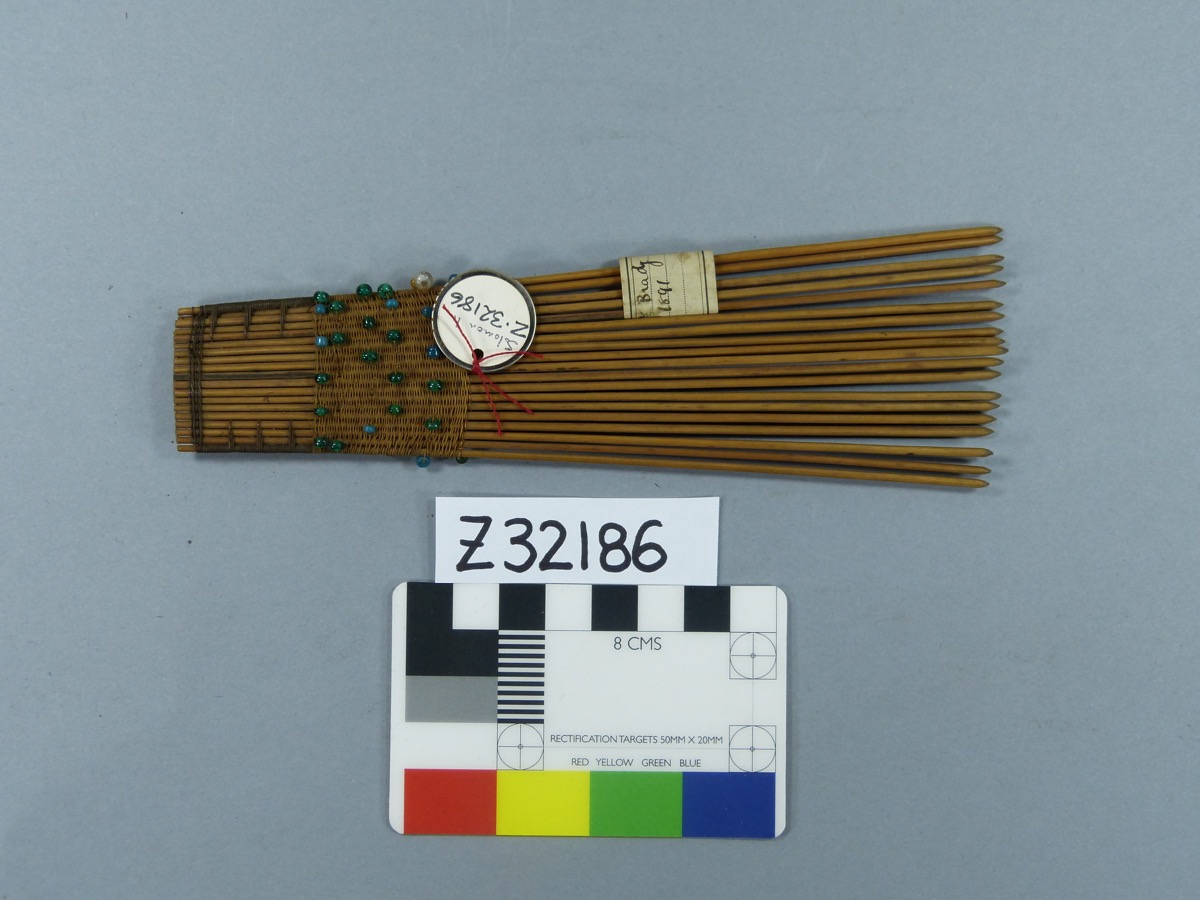
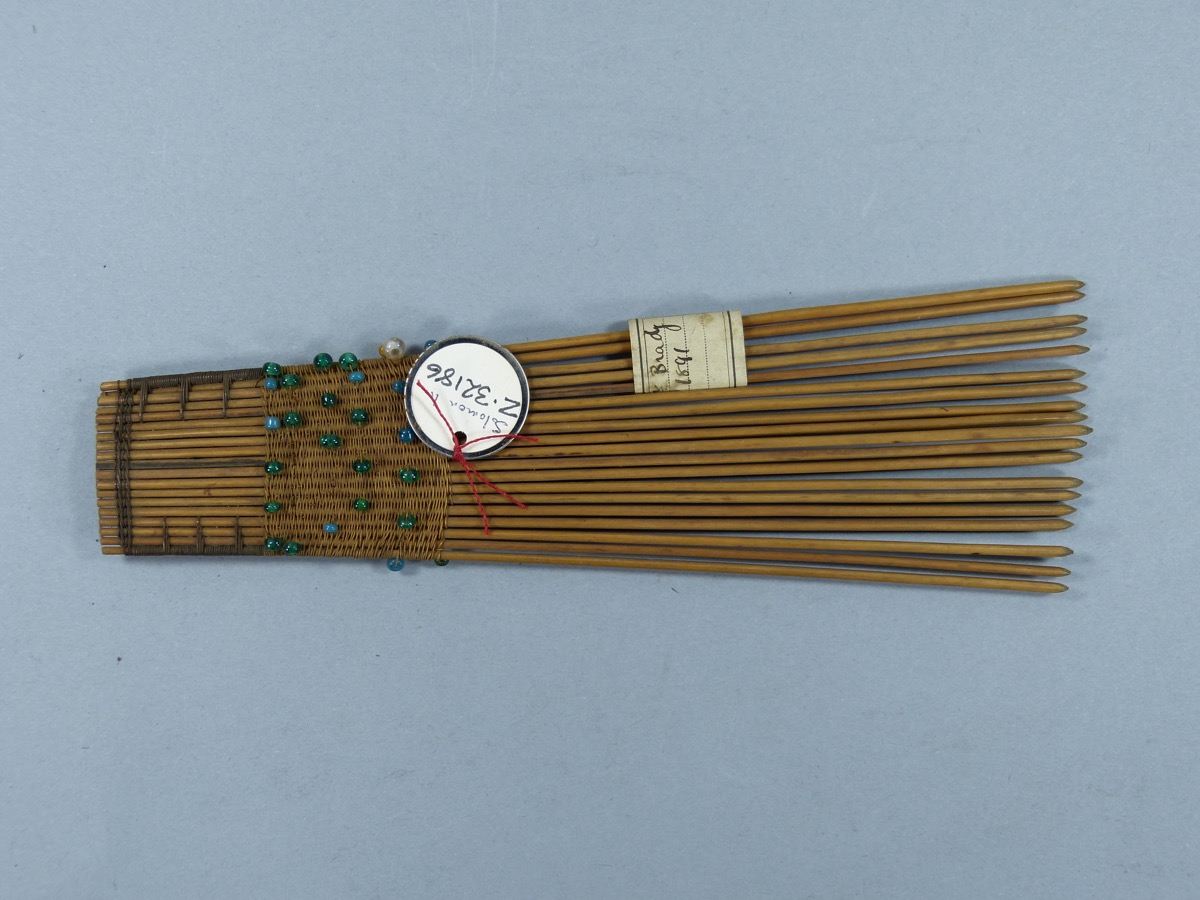
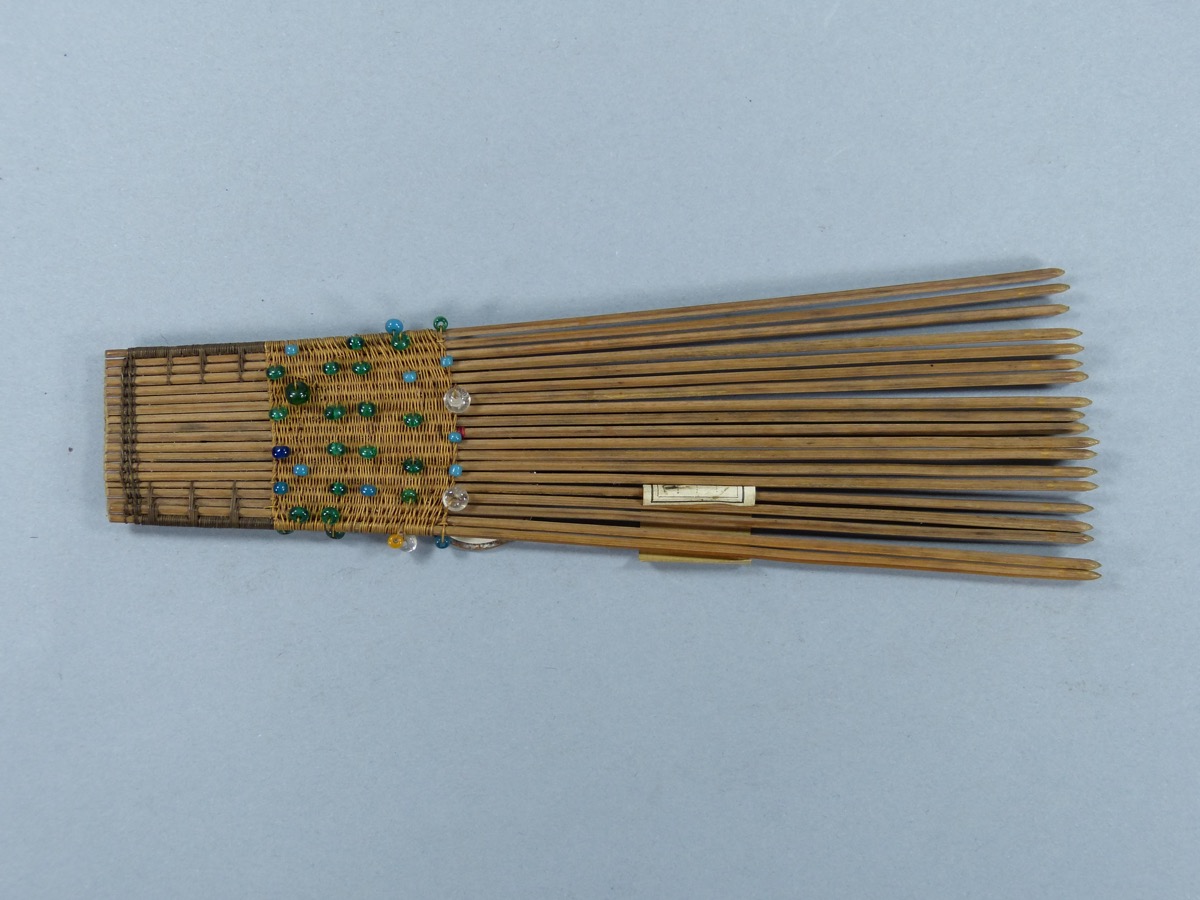
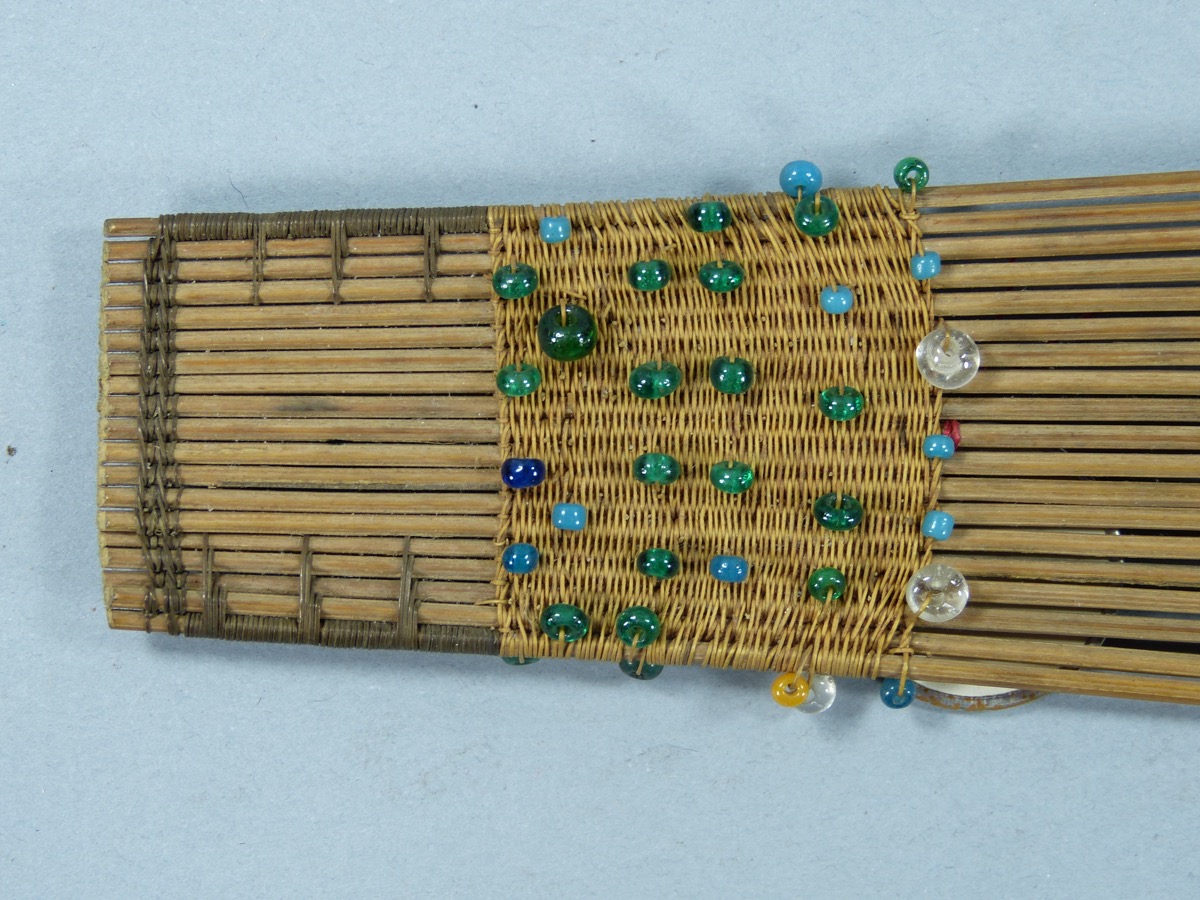
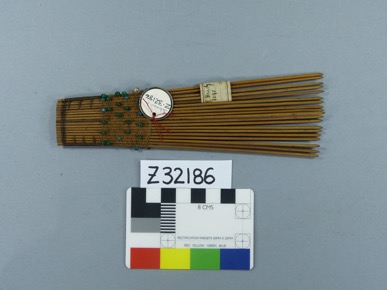
Comb. Made from ribs of coconut leaves. Decorated with tan fibre and a majority of green and blue beads'.
Place
Oceania; Polynesia; Tonga
Period
Source
Brady, George Stewardson (Professor) [donor]; ?Wheeler, Daniel (Reverend) [collector]
Department
Anth
Reference Numbers
Z 32186; MAA: AR 1892.82.1; one of 1891.95.2-4
Cultural Affliation
Material
Wood; Plant; Fibre; Glass; Bead
Local Term
Measurements
Events
Context (CMS Context)
The catalogue card for this object states that the Annual report no for this object is 1891.82 (1) - which is incorrect: it should be 1892.82.1.
Event Date 21/5/2015
Author: Lucie Carreau
Context (CMS Context)
Labels & inscriptions: A small rectangular label attached to the prongs of the comb reads: 'Dr Brady 1891'.
Event Date 21/5/2015
Author: maa
Description (CMS Description)
[From catalogue card:] 'Comb. Made from ribs of coconut leaves. Decorated with tan fibre and a majority of green and blue beads'.
Event Date 21/5/2015
Author: maa
Context (CMS Context)
Annual report entry for this object reads: '82. (1) A comb of palm wood decorated with coloured green plaiting' (1892:11). It states that the object comes from the Solomon Islands. If this object is indeed AR 1892.82.1, It is more likely that it originated from Tonga.
Event Date 21/5/2015
Author: Lucie Carreau
Description (CMS Description)
Comb formed of 19 prongs made from the midrib of coconut leaf. The upper part is bound with coir fibre dyed black and just below, with coir fibre in its natural colour. Blue, green, white and yellow glass beads are woven into the binding.
Event Date 21/5/2015
Author: maa
Context (Amendments / updates)
The 1892 Annual Report notes 'In 1891 the late Mr H. B. Brady, F.R.S., bequeathed to the Museum a most interesting collection of weapons, implements, and ornaments, from the South Sea Islands. Among these may be mentioned some specially fine stone-headed clubs and hafted stone implements from New Guinea. To his brother, Dr George Brady, F.R.S., the Museum is much indebted for a valuable collection of objects of native manufacture, including a number of specimens collected in the South Sea Islands during the years 1835—1837 by the Rev. Daniel Wheeler.'
Brady's scientific work was done at home and it is not clear how much he travelled abroad. He published on material bought back by his brother Henry Brady (1835-1891) and his donation may also have been collected by him or his great uncle, the Quaker missionary Daniel Wheeler (1771- 1840) who toured the Pacific 1834- 1837 on the Henry Freeling, purchased and provisioned by private members of the Society of Friends.
Event Date 23/10/2020
Author: rachel hand
Context (References)
Clunie provides a possible point of collection from Tongan material given by George Brady, whose letter in the MAA archives confirms that material was collected by his late great-uncle Daniel Wheeler during a religious mission to those islands, in 1835-6. (Brady MS. 1891: 15 February).
'The Henry Freeling visited Vava‘u, Lifuka and Nuku‘alofa between 18 August and 10 November 1836, during which time Wheeler befriended the Wesleyan missionaries and their patrons: Taufa‘ahau, Tu‘i Ha‘apai and Tu‘i Vava‘u, and Josiah Tupou, Tu‘i Kanokupolu. Despite those connections, however, insofar as Tongan “relics” are concerned his journal is disappointing, only referring to “trifling oddments of shells”, “a collection of war clubs and other implements of destruction, which we rejoiced to take out of their hands”, and, as already seen, a pair of pulekula pendants Taufa‘ahau gave him along with some spears, barkcloth and a mat. ... Wheeler provided free passage from Vava‘u to Lifuka to missionary families attending the annual Wesleyan meeting there, for this event culminated in a katoanga ‘festival’, during which Tongan converts presented offerings in kind to the Wesleyan God and His mission: "In October... [1836], a branch Missionary society was formed at Haabai. The list of subscriptions was very long. It contained 683 names, and in most cases a name stood for a family. Heathen gods, sacred clubs, whales’ teeth, formerly objects of worship, were among the things contributed. The amount realised by the articles sold at auction was £ 23 3s. 2d." (Farmer 1855: 61)'
Clunie, F. (2013). TAPUA: "POLISHED IVORY SHRINES" OF TONGAN GODS. The Journal of the Polynesian Society, Vol. 122, No. 2, JUNE 2013 Special Issue: TABUA AND TAPUA: WHALE TEETH IN FIJI AND TONGA, pp. 161-210, p. 193 https://www.jstor.org/stable/43285151 [Accessed 23/10/2020]
Event Date 23/10/2020
Author: rachel hand
FM:268264
Images (Click to view full size):